Rehabilitation Process Could Be Delayed by Up to 18 Months... Prolonged Battle Expected
Restructuring Led by Government and Creditors Possible... Meritz Faces Mounting Pressure
Scenario of Selling Prime Assets and Liquidating the Rest Also on the Table
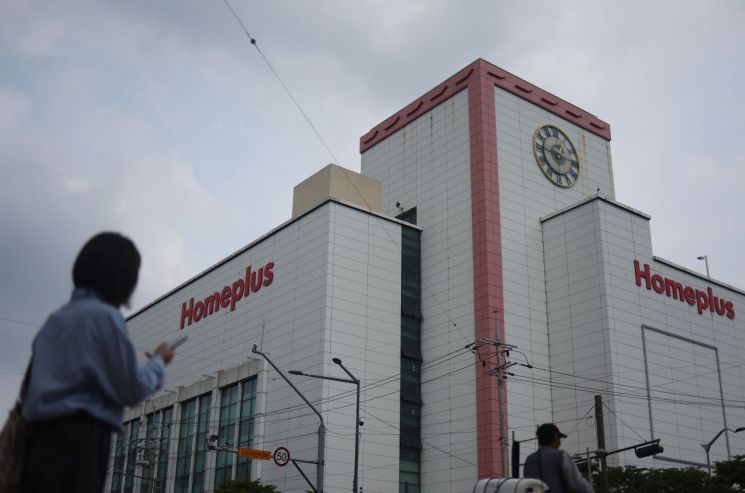
The main bid for the sale of Homeplus has failed as no one submitted a bid to acquire the company. This appears to be due to Homeplus's limited growth potential and the burden of excessive public scrutiny. As a result, the Homeplus rehabilitation process is expected to become a prolonged battle, likely extending into the middle of next year or beyond.
Rehabilitation Process Could Be Delayed by Up to 18 Months... Prolonged Battle Expected
According to the investment banking (IB) industry on November 27, no bid proposals were submitted for the main bid to acquire Homeplus, which closed at 3 p.m. the previous day. The sale manager, Samil PwC, and the sellers plan to resume the sale process in consultation with the Seoul Bankruptcy Court and the creditors' committee. It is reported that the next sale attempt will likely switch from an open bid to a closed bid process.
There are growing expectations that the sale will turn into a long-term battle. In a statement, Homeplus announced that the tentative deadline for the second sale attempt is set for December 29, the submission date for the rehabilitation plan. However, if no buyers emerge, Homeplus can request an extension of the rehabilitation process. Under current law, the rehabilitation process can last up to 18 months. Considering that Homeplus initiated its rehabilitation process on March 4 of this year, the sale could be delayed until as late as September next year.
Given Homeplus's current situation, the likelihood of a successful sale is considered extremely low. The company has already posted losses for four consecutive years through last year. In 2024 alone, its operating loss reached 314.1 billion won, with unpaid taxes amounting to about 90 billion won. Even if Homeplus is sold for more than the 2.6691 trillion won in rehabilitation claims, a significant amount of investment would be required to normalize the business.
An IB industry insider commented, "Since the court has acknowledged that the liquidation value exceeds the going concern value, it will be difficult for any conglomerate or financial holding company to take over, regardless of political pressure. For MBK Partners, it is highly likely they will prepare for a long-term process, waiting for public attention to subside while proceeding with restructuring at Homeplus."
Restructuring Led by Government and Creditors VS Partial Sale
 Byungjoo Kim, Chairman of MBK Partners, is responding to a lawmaker's question during the National Assembly's Political Affairs Committee audit of the Fair Trade Commission and the Personal Information Protection Commission held on the 14th of last month. On the left is Kwangil Kim, CEO of Homeplus. 2025.10.14 Photo by Hyunmin Kim
Two main scenarios are being discussed for the future. The first is restructuring led by the government and creditors. This would involve canceling MBK's existing shares, partially writing off financial debt, and converting the remaining debt into equity. In this scenario, the creditors and a new strategic investor (SI) or a policy finance institution such as Korea Development Bank would become the largest shareholders. This approach is similar to the restructuring that took place at Neiman Marcus, a U.S. luxury department store chain that went bankrupt during the COVID-19 pandemic.
In this case, the government and creditors would shoulder the burden of restructuring, allowing MBK to step out of the public spotlight. Since the government would be involved, gradual restructuring is more likely than outright closure or mass layoffs. For Homeplus employees, having the government as the negotiating counterpart could increase their bargaining power.
However, the creditors-especially Meritz Financial Group-may face significant dilemmas. Meritz Financial (including its securities, insurance, and capital subsidiaries) lent about 1.2166 trillion won to Homeplus in May 2024 and had recovered 256.1 billion won, including principal and interest, by May 2025. With about 1 trillion won still outstanding, becoming a shareholder would mean bearing both potential investment losses and the risk of having funds tied up for an extended period.
Another option being considered is a partial sale, where only valuable assets are sold off instead of saving the entire company. This scenario would involve selling off prime real estate, profitable stores, or the online business, while closing or converting less profitable stores to commercial properties and liquidating the remaining business units or legal entities-a "gradual dismantling" approach. MBK Partners had already attempted to sell Homeplus Express, the company's supermarket division, last year.
While this method makes it easier to attract buyers or investors compared to an outright sale, it could be the most painful option for Homeplus employees, as it could result in store closures and mass layoffs. In addition, the message that the second-largest hypermarket chain in Korea is being dismantled could become a political burden for both the central and local governments, as well as labor unions.
A restructuring specialist accountant explained, "The key will be how quickly the creditors, government, and employees can find common ground. With local elections scheduled for June next year, political calculations will also play a significant role, making a prolonged process inevitable."
© The Asia Business Daily(www.asiae.co.kr). All rights reserved.
![Clutching a Stolen Dior Bag, Saying "I Hate Being Poor but Real"... The Grotesque Con of a "Human Knockoff" [Slate]](https://cwcontent.asiae.co.kr/asiaresize/183/2026021902243444107_1771435474.jpg)

















