Three Leading Korean Hydrogen Companies Join Forces for New Power Supply Technology
Distributed Power Solutions to Meet Rising Data Center Demand
Potential to Contribute to Carbon Reduction in Power Generation Sector Highlighted
HD Hydrogen, a specialized subsidiary of HD Hyundai focusing on fuel cells and water electrolysis, is partnering with HD Hyundai Infracore and Doosan Fuel Cell to develop eco-friendly hybrid power supply technology based on domestic technology.
On the 27th, HD Hydrogen announced that the three companies had signed a memorandum of understanding (MOU) on "Response to the New Power Supply Market Based on Domestic Eco-Friendly Hybrid Energy System and Technical Cooperation." The signing ceremony was attended by Oh Seunghwan, Executive Director of HD Hydrogen, Jeon Sungho, Executive Director of HD Hyundai Infracore, and Lee Seungjun, Head of Doosan Fuel Cell Division, who shared the necessity of technical cooperation and discussed future directions. This collaboration aims to establish a next-generation power supply system that ensures both stability and environmental friendliness by combining fuel cells and hydrogen engines.
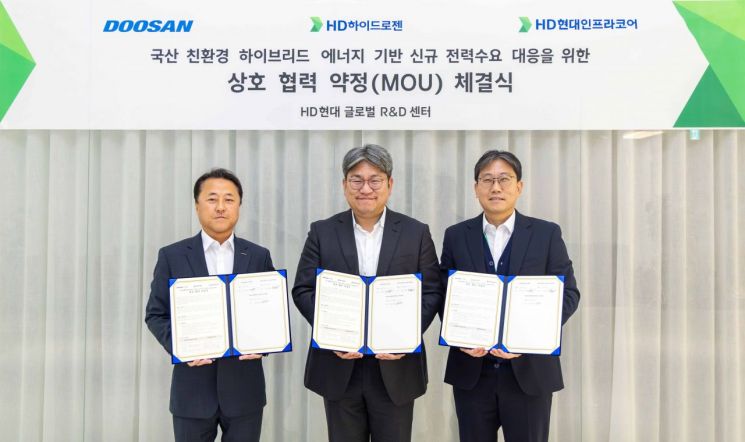 Lee Seungjun, Head of Doosan Fuel Cell Division (from left), Oh Seunghwan, Executive Director of HD Hydrogen, and Jeon Sungho, Executive Director of HD Hyundai Infracore, are taking a commemorative photo after signing the agreement on "Response to the New Power Supply Market Based on Domestic Eco-Friendly Hybrid Energy System and Technical Cooperation" on the 27th. HD Hydrogen
In this system, fuel cells will serve as the primary power source for high-load demand sites such as data centers, while hydrogen engines will support peak load demands. The three companies plan to divide roles, with HD Hydrogen and Doosan Fuel Cell providing fuel cell-based technology, and HD Hyundai Infracore contributing hydrogen engine technology, to jointly develop system integration technology. Their goal is to implement a hybrid structure that can efficiently manage fluctuations between base and peak power demands.
As domestic data center power demand is expected to reach approximately 19.4 TWh by 2030, various distributed power generation methods are being discussed in the industry to ensure power supply stability. In particular, the combination of fuel cells and hydrogen engines offers the advantage of compensating for the variability of renewable energy while minimizing carbon emissions.
A representative from HD Hydrogen stated, "It is significant that companies with domestic technology are working together to develop next-generation energy production technology," adding, "We believe this will contribute to achieving the challenging carbon reduction targets in the power generation sector under the 2035 Nationally Determined Contribution (NDC)."
HD Hydrogen began its growth in 2018 with the development of a solid oxide fuel cell (SOFC) system at HD Hyundai's fuel cell research institute, and was newly launched as a specialized fuel cell subsidiary in 2024. With the completion of the Pyeongtaek SOFC plant in 2025, the company is expanding its product lineup and accelerating its entry into both domestic and international markets.
© The Asia Business Daily(www.asiae.co.kr). All rights reserved.

















