Large-Scale Cancellation Unavoidable if Commercial Act Is Amended
IMM Faces Greater Exit Pressure Amid Poor Performance
Attention on Whether This Will Mark a Turning Point for Corporate Value
As the third amendment to the Commercial Act approaches passage, attention is focused on Hanssem's next moves. If the bill, which requires companies to cancel treasury shares within one year of acquisition, becomes reality, Hanssem will be required to dispose of nearly 30% of its total outstanding shares held as treasury stock. With a large-scale cancellation inevitable, debates are expected to follow regarding shareholder returns and potential changes in corporate governance.
According to the Financial Supervisory Service's electronic disclosure system on November 27, Hanssem holds treasury shares amounting to 29.46% of its total shares, one of the highest levels among all listed companies. As the ruling party recently announced plans to enact the third amendment to the Commercial Act-centered on mandatory cancellation of treasury shares within one year-by the end of the year, treasury shares have emerged as a key variable in Hanssem's management strategy.
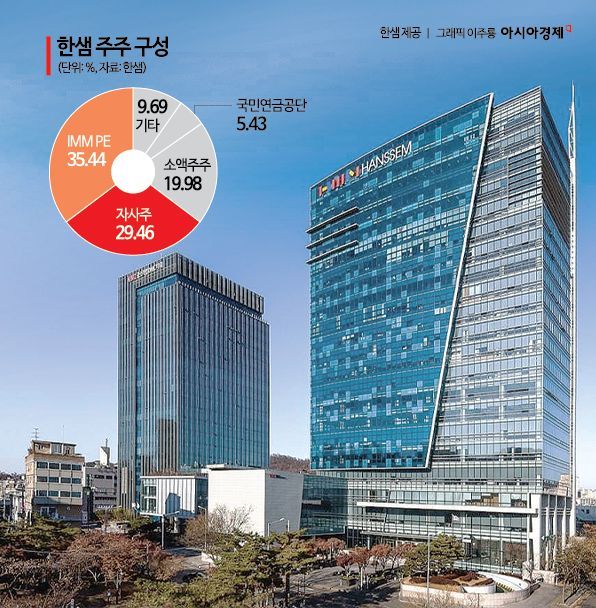
Hanssem has stated that no specific plans have been made yet, but considering the intent of the bill, some level of cancellation appears unavoidable. Since share cancellation reduces the number of outstanding shares, thereby improving earnings per share (EPS) and potentially boosting the stock price, some analysts consider this virtually the only remaining shareholder return option for Hanssem, whose dividend capacity has diminished due to recent poor performance.
When IMM Private Equity (PE) acquired Hanssem in 2022, the share price was around 96,000 won, but it has since halved to the 45,000 won range. Amid the downturn in the furniture and interior market, both sales and profitability have declined. Given that an exit (investment recovery) is virtually impossible at the current share price, IMM PE, which needs to enhance the company's value, is seen as naturally inclined to support treasury share cancellation.
If treasury shares are canceled, the ownership percentage of existing shareholders will automatically increase. IMM's stake, currently in the 30% range, would also rise, opening the possibility of securing a majority stake depending on the scale of the cancellation. Since a majority stake is a key factor in securing a management premium during a future sale, large-scale cancellation is not necessarily a disadvantageous choice from IMM's perspective.
However, it remains uncertain whether treasury share cancellation will lead to a genuine improvement in corporate value beyond a short-term boost in the stock price. Hanssem succeeded in turning a profit in the third quarter of this year through cost efficiency measures such as improving sales channel commission rates, but this is considered more of a short-term adjustment than a structural improvement. For a full-fledged recovery in performance, macroeconomic improvements such as revitalization of home sales and increased demand for remodeling must come first.
Nevertheless, the market consensus is that the cancellation of treasury shares will be the most immediate inflection point for the stock price. Lee Sangheon, an analyst at iM Securities, stated, "If the bill passes, some level of cancellation will be unavoidable, whether mandatory or voluntary," adding, "In terms of expanding shareholder returns, this could serve as a momentum for a rise in the stock price."
Jang Moonjun, an analyst at KB Securities, also commented, "Given the extremely challenging market environment, it does not seem easy to find stock price momentum from the core business in the short term," adding, "Whether or not treasury shares are canceled could create the first inflection point for the stock price."
© The Asia Business Daily(www.asiae.co.kr). All rights reserved.
![Clutching a Stolen Dior Bag, Saying "I Hate Being Poor but Real"... The Grotesque Con of a "Human Knockoff" [Slate]](https://cwcontent.asiae.co.kr/asiaresize/183/2026021902243444107_1771435474.jpg)











