Ministry of Education: 58.4% of Students "Satisfied with Elective Subjects Offered at School"
Satisfaction with "Support for Ensuring Minimum Achievement Standards" Reaches 70%
Teachers' Associations: "Results Differ from Actual Experience, Hard to Accept"
This year marks the first implementation of the high school credit system for first-year high school students. On November 26, the Ministry of Education announced survey results showing that more than half of students and teachers are "satisfied with the high school credit system." However, teachers' associations criticized the findings, calling them "difficult to accept" and "disconnected from the reality on the ground."
On this day, the Ministry of Education stated that a recent satisfaction survey conducted by the Korea Institute for Curriculum and Evaluation, as part of its "High School Credit System Performance Analysis Study," found that both teachers and students reported relatively high levels of satisfaction with the system. The survey, conducted from August 19 to 29, targeted 160 general high schools nationwide and covered topics such as school curricula, subject selection guidance, and support for ensuring minimum achievement standards. A total of 11,513 respondents participated, including 6,885 first-year high school students and 4,628 teachers.
According to the survey, 58.3% of students responded that "our school offers a sufficient selection of elective subjects that I want."
In particular, 74.4% of students responded positively to the statement, "I am free to choose the subjects I wish to take at my school."
The percentage of students who agreed that "the elective subjects offered at our school help me plan my academic path and career" was also relatively high at 63.7%.
However, only 58.4% of students said they were satisfied with the variety of elective subjects offered at their school. The Korea Institute for Curriculum and Evaluation explained that while not all desired subjects are available, students are relatively satisfied with their ability to choose among the options provided.
Satisfaction levels were also high regarding the "support for ensuring minimum achievement standards," which has been a central issue in debates over whether to abolish the high school credit system.
Among teachers, 70% responded that "my plan and implementation for supporting students in achieving minimum standards were helpful to participating students," and 79% said, "Through this system, students ultimately reached the minimum achievement standards."
Among students, 67.9% said, "My teacher's preventive or supplementary guidance helps me complete my subjects," and 69.3% responded, "My teacher checks my learning level and helps me address my weaknesses."
Kim Chunghong, Director of Educational Policy at the Ministry of Education, stated, "This satisfaction survey is significant in that it is the first official survey conducted by a public research institute since the full implementation of the high school credit system," adding, "We will closely examine and improve areas where satisfaction is relatively low."
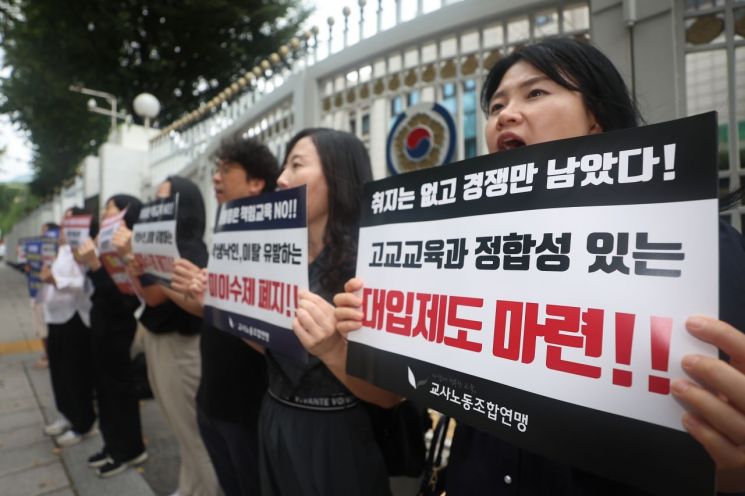
However, three major teachers' organizations (the Korean Federation of Teachers' Associations, the Teachers' Labor Union Federation, and the Korean Teachers and Education Workers Union) immediately pushed back, saying, "There is a significant gap between the survey results and the actual perceptions in schools."
Previously, these three organizations conducted their own survey of 4,060 teachers from November 4 to 14, finding that 9 out of 10 teachers said "worries over subject selection have increased learning anxiety and career-related stress." Regarding the impact of the high school credit system on students, only 17.4% responded that "students chose subjects that matched their career paths and aptitudes," and just 6.7% said "the system had a positive effect on student growth and development."
Additionally, 55.2% of respondents said the current credit completion criteria-"at least 40% academic achievement rate and at least two-thirds subject attendance rate"-should be abolished. Meanwhile, 31.7% supported applying only the "two-thirds subject attendance rate," 4.5% supported considering only the "40% academic achievement rate," and 8.7% preferred to "maintain the current criteria."
The three teachers' organizations argued, "There is a clear gap between the Ministry of Education's survey sampling method and the actual experiences in schools," pointing out, "Although the Ministry stated that the survey was conducted in 160 schools, about 10% of general high schools nationwide, it is difficult to find teachers in the field who have participated in or are aware of the specific survey process." They explained that the survey lacks representativeness of the field.
They also criticized the survey questions, saying they focused on evaluating the "effort levels" of individuals and schools rather than the system itself, making it difficult to regard the survey as an assessment of the system.
They stated, "Rather than asking about the structural validity of the system or the appropriateness of the policy, the questions mainly assessed the sense of responsibility and diligence of individual teachers and school members. Teachers are doing their utmost to ensure students are not disadvantaged, regardless of any problems with the system, and under such circumstances, it is not easy for them to respond negatively about their own or their school's efforts."
They continued, "We strongly urge the Ministry of Education to conduct a comprehensive review so that students' right to learn and teachers' right to teach are genuinely protected, including abolishing the non-completion system and support for minimum achievement standards, and switching the evaluation method of certain subjects such as career and integrated electives to absolute grading." They emphasized, "The three teachers' organizations demand a full reconsideration of the high school credit system."
© The Asia Business Daily(www.asiae.co.kr). All rights reserved.

















