Base Rate Held at 2.50%: Fourth Consecutive Freeze After July, August, and October
Growth Outlook Raised Amid Real Estate and Exchange Rate Uncertainty, Easing Economic Concerns
Outlook for Next Rate Cut Divided... "Unlikely Even in January Next
On November 27, the Monetary Policy Committee of the Bank of Korea decided to keep the base interest rate unchanged at 2.50% per annum. This decision was influenced by the continued surge of the won-dollar exchange rate, which is threatening the 1,500-won mark, as well as the ongoing rise in housing prices in major areas of Seoul even after the October 15 real estate measures, both of which have underscored the need for financial stability. Additionally, the Bank of Korea raised its economic growth forecasts for this year and next to 1.0% and 1.8%, respectively, in its revised economic outlook, which analysts say has eased the pressure to lower rates in response to downward economic risks.
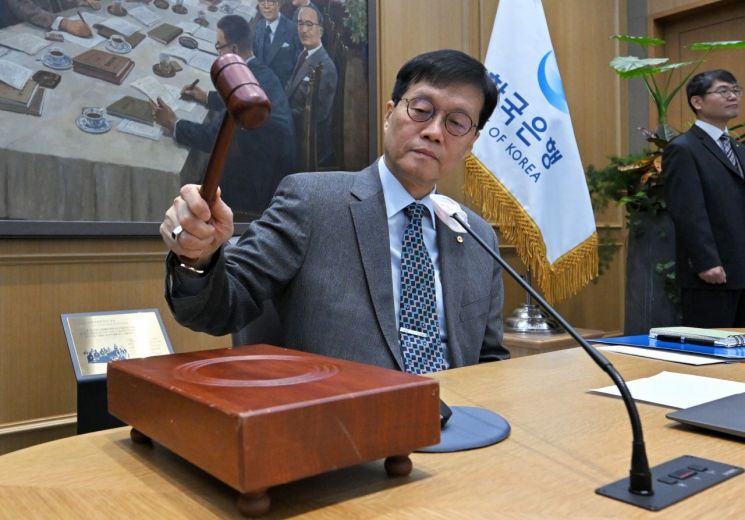 Lee Chang-yong, Governor of the Bank of Korea, is striking the gavel at the Monetary Policy Committee plenary meeting held at the Bank of Korea headquarters in Jung-gu, Seoul on the 27th. Photo by Yonhap News
The Monetary Policy Committee announced at its policy meeting held at the Bank of Korea headquarters in Jung-gu, Seoul, that it would maintain the base rate at 2.50% per annum. This marks the fourth consecutive freeze following decisions in July, August, and October, aligning with market expectations. In a recent survey conducted by The Asia Business Daily, all 13 experts polled predicted a rate freeze for this month.
The main reason for this month's freeze is currency instability. On November 24, the weekly closing price of the won-dollar exchange rate in the Seoul foreign exchange market was 1,477.1 won, the highest in about seven and a half months since April 9 (1,484.1 won), when fears of a U.S. tariff war were at their peak. Despite repeated assurances from foreign exchange authorities about their commitment to stabilizing the exchange rate, the rate has continued to hover around 1,470 won. The real effective exchange rate, which reflects the actual purchasing power of the won, is also at its lowest level since the global financial crisis. According to the Bank of Korea's Economic Statistics System (ECOS), South Korea's real effective exchange rate index stood at 89.09 at the end of October this year (2020=100), the lowest since August 2009 (88.88), during the global financial crisis, marking a 16-year and two-month low. Although the United States has recently begun lowering its policy rates, the Korea-U.S. interest rate differential remains high at about 1.5 percentage points at the upper bound.
Ongoing concerns about the real estate market have also supported the decision to freeze rates. After the October 15 measures, the pace of housing price increases in Seoul had slowed but has recently begun to accelerate again, influencing the decision to maintain rates. According to the Korea Real Estate Board, in the third week of November (as of November 17), the average sales price of apartments in Seoul rose by 0.20% compared to the previous week. Immediately after the October 15 measures, the average sales price of apartments in Seoul jumped by 0.50% in the third week of October, then slowed to 0.23% in the fourth week of October, 0.19% in the first week of November, and 0.17% in the second week, before expanding again after four weeks. While the number of listings has decreased and transactions have slowed, leading to a wait-and-see attitude, demand for "smart single-unit" properties in preferred areas remains strong.
Expert opinions are sharply divided on the timing of the next rate cut, but most agree that it is unlikely before January next year. Even those forecasting a cut in the first quarter of next year note that, despite signs of improvement in the domestic economy, the recovery in domestic demand remains sluggish, indicating a continued need for further rate cuts. However, they also believe the timing will depend on confirming the level of financial stability. Kang Minjoo, Senior Economist at ING Bank, stated, "A rate cut will be implemented after confirming improvements in global financial market sentiment due to the U.S. Federal Reserve's rate cuts, reduced exchange rate volatility, stabilization of the domestic economy, and the gradual stabilization of the real estate market following the October 15 measures."
On the other hand, a significant number of experts believe that the rate-cutting cycle is effectively over. Kim Sungsoo, a researcher at Hanwha Investment & Securities, commented, "Cash investments in the United States and Korea-U.S. exchange rate negotiations have generally limited the authorities' ability to stabilize the foreign exchange market," adding, "Once the gap between gross domestic product (GDP) and potential growth rate is closed, the need for monetary policy responses to growth will be greatly reduced."
© The Asia Business Daily(www.asiae.co.kr). All rights reserved.
![Clutching a Stolen Dior Bag, Saying "I Hate Being Poor but Real"... The Grotesque Con of a "Human Knockoff" [Slate]](https://cwcontent.asiae.co.kr/asiaresize/183/2026021902243444107_1771435474.jpg)
















