Deputy Prime Minister's Briefing with Economic Reporters
Koo Yoonchul, Deputy Prime Minister for Economy and Minister of Economy and Finance, stated on the 26th regarding the launch of a four-party consultative body for foreign exchange market stabilization involving the National Pension Service, "There will never be a case where the National Pension Service is mobilized as a temporary measure to address the rise in exchange rates." He also said, "We will consider all possible policy options" to stabilize the exchange rate.
On the morning of the same day at the Government Complex Sejong, Deputy Prime Minister Koo held a briefing with reporters on recent economic developments, including the foreign exchange market. He said, "Within the scope of maximizing returns, the National Pension Service also believes that stabilizing the foreign exchange market helps increase its profitability," emphasizing, "Contrary to media reports, the National Pension Service is not being mobilized for exchange rate stabilization."
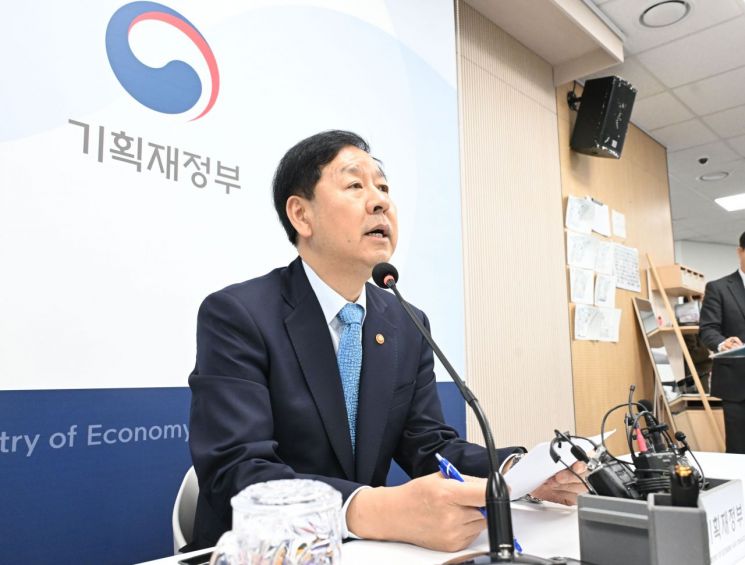 Koo Yoonchul, Deputy Prime Minister for Economy and Minister of Economy and Finance, is answering reporters' questions at a briefing on the foreign exchange market held at the Ministry of Economy and Finance press room in the Central Building of the Government Complex Sejong on the afternoon of the 26th. (Source: Ministry of Economy and Finance)
Regarding the role of the recently established four-party consultative body, Deputy Prime Minister Koo explained, "Its purpose is to devise fundamental alternatives that will allow for the stable payment of pensions over the long term without undermining fund profitability, and it is part of discussions on a 'new framework' to prepare short-, mid-, and long-term institutional improvements."
He added, "The National Pension Service, the third largest pension fund in the world, now has a fund size exceeding 50% of Korea's gross domestic product (GDP), and its overseas assets are greater than the country's foreign exchange reserves. As the fund is expected to surge to over 3,600 trillion won in the future, there are growing concerns about whether our economic and financial markets can absorb the expanding scale of the pension fund."
On the 24th, the foreign exchange authorities launched a four-party consultative body for foreign exchange market stabilization with the National Pension Service, the Ministry of Health and Welfare, and the Bank of Korea. The main purpose is to discuss exchange rate stabilization measures involving the National Pension Service. At the closed-door meeting, topics such as increasing the foreign exchange hedge ratio within the scope that does not harm the fund's investment returns were discussed. Some have raised concerns that mobilizing the National Pension Service, which manages the public's retirement funds, for exchange rate stabilization could negatively impact the fund's profitability.
Deputy Prime Minister Koo said, "Currently, as the National Pension Service focuses on overseas investments to maximize returns, demand for the dollar is increasing. However, at some point, when it becomes necessary to sell overseas assets to pay out pensions, the exchange rate will appreciate. For the government, discussing a new framework at this time is meaningful for the stability of the foreign exchange market."
Regarding the request for strategic foreign exchange hedging by the National Pension Service, he said, "Considering the professionalism and independence of fund management, this is a matter to be decided by the Fund Management Committee chaired by the Minister of Health and Welfare." He added, "However, as a member of the Fund Management Committee, the highest decision-making body of the National Pension Service, I will participate in discussions to ensure that stability, liquidity, profitability, and public interest are balanced."
When asked whether the government is considering short-term incentives for major suppliers such as large corporations to convert dollars, he replied, "Short-term incentives are not under consideration at this time," but added, "If necessary, we are open to reviewing them at any time."
On whether the current exchange rate reflects economic fundamentals, he said, "The exchange rate is determined by the market," adding, "The government will do its best to maintain stability in the exchange rate market," without making further specific comments.
Regarding the United States' position on discussions between the National Pension Service and the government about exchange rate stabilization, he said, "The U.S. Treasury also wants stability in the foreign exchange market. From that perspective, they have not expressed any particular opinions."
The authorities have recently issued a series of statements aimed at stabilizing the foreign exchange market. On the 14th, Deputy Prime Minister Koo made an oral intervention, saying, "We are preparing measures to stabilize the exchange rate." On the 19th, he also held a press briefing, stating, "We are working with major foreign exchange supply and demand entities to ensure that excessive uncertainty or instability does not occur in the exchange rate."
Although the authorities have repeatedly expressed their commitment to exchange rate stabilization, they do not have concrete defense measures in place, so the upward trend in the exchange rate continues. As of the previous day's weekly closing, the won-dollar exchange rate had risen to 1,472.4 won. The exchange rate has continued to climb in recent months, reaching its highest level in seven months.
© The Asia Business Daily(www.asiae.co.kr). All rights reserved.
![Clutching a Stolen Dior Bag, Saying "I Hate Being Poor but Real"... The Grotesque Con of a "Human Knockoff" [Slate]](https://cwcontent.asiae.co.kr/asiaresize/183/2026021902243444107_1771435474.jpg)
















