Government Announces Measures to Enhance Competitiveness of Autonomous Vehicle Industry
"Full Commercialization of Autonomous Vehicles Targeted for 2027"
Just as Tesla conducts autonomous driving research using data collected from vehicles it has sold, measures will be put in place to allow South Korean manufacturers to utilize data from their own vehicles as well. There are also plans to designate entire cities as autonomous driving demonstration zones to facilitate data collection. These initiatives are aimed at gathering vast amounts of data for autonomous driving, similar to efforts in the United States and China, and are expected to serve as an opportunity to elevate the technological capabilities of South Korea. <See page 16 of The Asia Business Daily, November 20 edition>
On November 26, the Ministry of Land, Infrastructure and Transport and other relevant ministries held a joint meeting of economic ministers and the Growth Strategy Task Force (TF) to discuss measures to enhance the competitiveness of the autonomous vehicle industry. The goal is to lower regulatory barriers in order to secure large volumes of high-quality data. Currently, companies collecting and utilizing video data for research and development (R&D) purposes must use pre-designated vehicles and process the data to be pseudonymized.
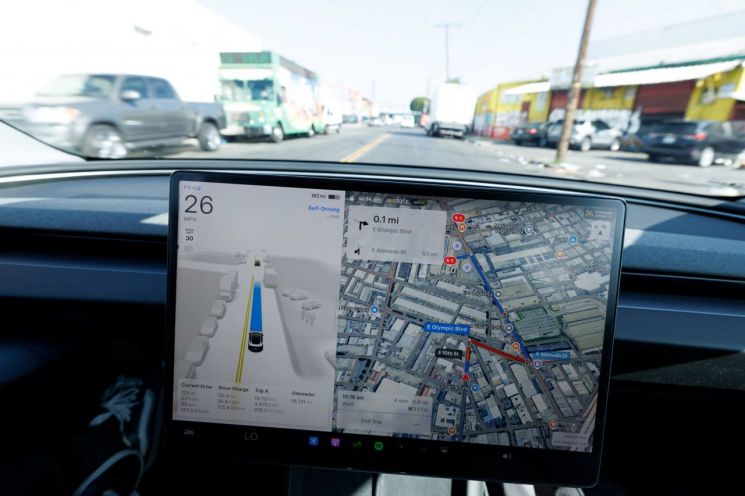
Going forward, amendments to the Personal Information Protection Act and the Autonomous Vehicles Act will allow the use of original, non-pseudonymized video footage. Using original footage can improve recognition accuracy by up to 25%. At a regulatory rationalization meeting held in September this year, President Lee Jaemyung proposed this measure.
Data collection, which was previously limited to demonstration and R&D autonomous vehicles, will be expanded to include privately owned vehicles with the owner's consent. Currently, there are only about 132 autonomous vehicles in South Korea available for demonstration and R&D, resulting in limited data collection. In contrast, Tesla collects data from vehicles whose owners have given consent. Tesla has sold approximately 1.8 million vehicles worldwide, and the amount of data accumulated in real time is known to be enormous.
Starting next year, an entire city will be designated as a demonstration city where test autonomous vehicles can operate. In Phoenix, the main testbed for Waymo in the United States, autonomous vehicles operate within an 815 km² area, which is larger than Seoul. Wuhan, a leading autonomous driving city in China, covers as much as 3,000 km². The South Korean government plans to establish its own unique model by collaborating with both large corporations and software startups, initially targeting more than 100 vehicles. In addition, the operation of autonomous buses will be expanded in rural and fishing villages and other areas with limited public transportation. This dual strategy aims to both accumulate data and enhance services in transportation-vulnerable regions.
Transportation service providers will also be allowed to obtain temporary operation permits for autonomous vehicles. If bus drivers receive relevant training, they will be able to operate these vehicles directly without the need for development company staff. Previously, only autonomous vehicle development companies could obtain such permits. The fast-track process, which was previously limited to vehicles with steering wheels and pedals, will be expanded to cover all types of vehicles.
In protection zones for vulnerable road users, companies will be allowed to operate vehicles temporarily if they establish their own safety plans. Currently, even temporarily permitted autonomous vehicles must switch to manual operation within these zones. Safety plans could include measures such as operating at speeds below 30 km/h or avoiding operation during commuting and school hours. The authority to designate pilot operation zones will also be extended from the Minister of Land, Infrastructure and Transport to provincial governors and mayors. By the first half of next year, there are also plans to establish special regulations for remote control. While remote control is currently only allowed for parking, it may be needed in emergencies such as accidents.
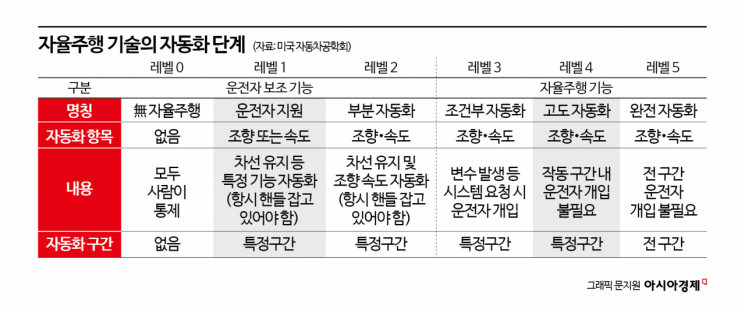
The concept of a legally responsible entity will be introduced to manage the operation of autonomous vehicles. This addresses concerns that there is currently no clear subject of sanctions for Level 4 or higher autonomous vehicles, which operate without drivers. To discuss how to allocate liability for damages in the event of an accident, the Ministry of Land, Infrastructure and Transport, the Korea Transportation Safety Authority, the insurance industry, and other relevant organizations will launch an accident liability task force starting next year. In consideration of growing opposition from the taxi industry due to the commercialization of autonomous vehicles, a social consultative body comprising the government and various stakeholders will begin operations as early as next month. The Product Liability Act will also be amended to ease the requirements for presuming vehicle defects, while also introducing measures to protect manufacturers' trade secrets.
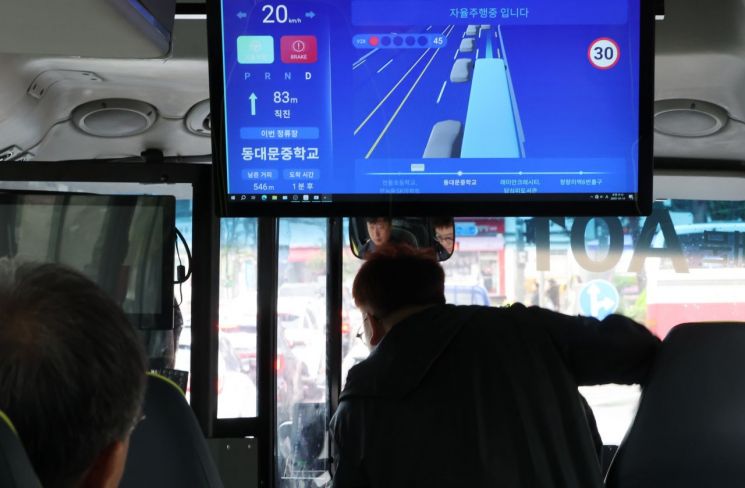 On the 14th of last month, a self-driving bus was operating on the road near Dongdaemun Middle School in Dongdaemun-gu, Seoul. The Dongdaemun self-driving bus "Dongdaemun A01," which began operation that day, runs a round-trip route of 15 km between Janghanpyeong Station and Kyung Hee University Medical Center, serving a total of 23 stops. Photo by Yonhap News Agency
In addition, starting next year, dedicated graphics processing units (GPUs) for autonomous vehicles will be supported, and an artificial intelligence (AI) training center will be established by 2029 to assist companies' R&D activities. Support will be provided for the development of end-to-end (E2E) technology, which enables vehicles to make judgments and control themselves based on AI-trained data. There are also plans to establish specialized platforms and semiconductor production networks for autonomous vehicles. Universities seeking to nurture talent in advanced fields such as autonomous driving will be allocated increased enrollment quotas.
© The Asia Business Daily(www.asiae.co.kr). All rights reserved.
![Clutching a Stolen Dior Bag, Saying "I Hate Being Poor but Real"... The Grotesque Con of a "Human Knockoff" [Slate]](https://cwcontent.asiae.co.kr/asiaresize/183/2026021902243444107_1771435474.jpg)


















