Proposal for Establishing a Global Education Cluster
The Industry-Academic Cooperation Foundation of Sangmyung University announced on November 26 that it presented a plan for establishing a global education cluster in Songdo International City at the final report meeting for the strategic research project commissioned by the Yeonsu-gu Council in Incheon.
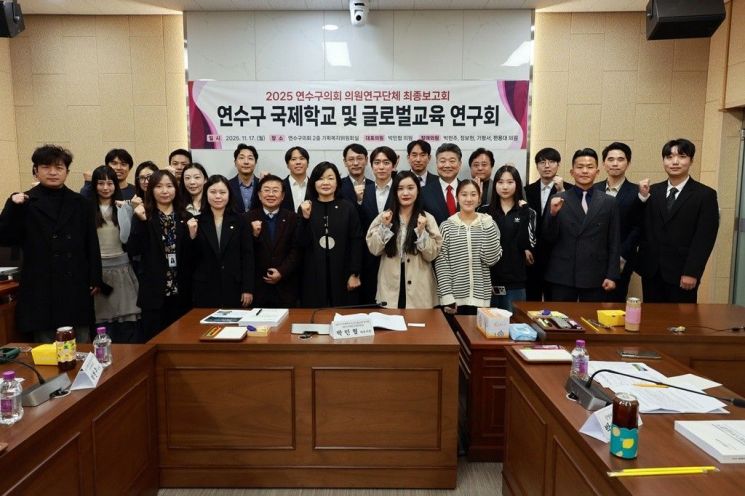 Officials attending the final report meeting on the "Yeonsu-gu Global Education Cluster Establishment and Songdo International School Attraction Strategy Study" are taking a group commemorative photo. Sangmyung University
This research was initiated by a research group of Yeonsu-gu Council members, with Professor Park Jaekeun from the Department of Dance Arts at Sangmyung University serving as the principal investigator and presenting the findings.
Professor Park emphasized that the international schools, foreign universities, arts institutions, MICE, and tourism resources in Songdo could be integrated into a single ecosystem and developed into an "edu-tourism" (education + tourism) model.
He also analyzed that regional characteristics, such as the historicity of the old downtown and the coexistence of Russian and Central Asian cultures in Hambak Village, Yeonsu-dong, could be leveraged as global cultural infrastructure.
The research covered a wide range of areas, including strategies for attracting international schools, the second phase of attracting overseas universities to the Incheon Global Campus (IGC), the possibility of establishing a branch of the Bolshoi Ballet Academy, the development of stay-type content combining performing arts, MICE, and tourism, and strategies to revitalize the cultural economy linked to the old downtown.
In particular, Professor Park specifically proposed a strategy for attracting a branch of the Moscow State Academy of Choreography (Bolshoi Ballet Academy), the world’s leading dance education institution, to Songdo.
He highlighted that the IGC College of Arts building was originally designed with the establishment of a branch campus in mind and has remained vacant for over 10 years, making it immediately available for use.
He further stated, "Cultural and artistic exchanges can serve as a cornerstone for restoring Korea-Russia relations, and international cooperation led by local governments is emerging as a new diplomatic channel."
According to the research findings, attracting a Bolshoi branch could bring up to 150,000 visitors annually and generate an economic impact of approximately 100 billion won per year. The combination of education, arts, and MICE is expected to yield an economic multiplier effect about 1.5 times greater than that of general tourism.
When including indirect effects such as enhanced brand value, increased real estate value, and a rise in the foreign resident population, the overall impact is projected to be even greater.
Based on over 20 years of both official and unofficial exchanges with the Bolshoi Academy, Professor Park introduced examples of agreement negotiations and program cooperation.
He also mentioned discussions on the Arctic shipping route in Pohang City, highlighting that the importance of cultural diplomacy and international cooperation led by local governments is increasing.
Park Minhyeop, Chair of the Operations Committee of the Yeonsu-gu Council, assessed that "this research has provided a practical foundation for Yeonsu-gu’s global education city strategy." The results will be shared with Incheon City and related organizations to be used as reference material for policy review.
Meanwhile, it has been reported that Professor Park, who is participating as the artistic director of the World Ballet Grand Prix (WBGP), is pursuing plans to hold next year’s competition at the Bolshoi Academy in Russia.
© The Asia Business Daily(www.asiae.co.kr). All rights reserved.

















