Relocated from Hwawon to Habin-myeon Two Years Ago
A 3,000-Seat Performance Hall to Be Built
On November 25, Dalseong County in Daegu announced that the former site of Daegu Prison, which had hindered regional development since 1971 and spans 104,613 square meters, will be transformed into a nationwide, large-scale cultural complex. This comes 13 years after the decision to relocate the prison was finalized in February 2012 and two years after the facility was moved from Hwawon-eup to Habin-myeon in November 2023.
Since its opening in 1971, Daegu Prison had been located in the heart of Hwawon for over 50 years. While it served as a state facility for maintaining law and order, it also brought about significant negative effects, including underdevelopment of the surrounding area, building height restrictions, and a decline in residential value.
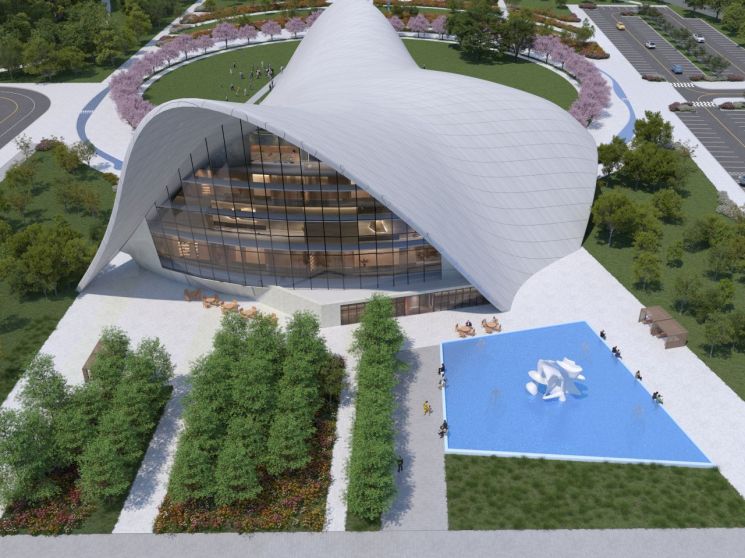 Perspective rendering of the cultural facility to be built on the site of Daegu Prison in Hwawon, Daegu
The relocation of the prison seemed to finally offer a solution to these long-standing issues. However, the remnants of the prison remained. As urban blight in the surrounding area accelerated and even the parking lot was closed, expectations for redeveloping the site grew even higher.
In July 2025, the redevelopment plan for the former Daegu Prison site was finally confirmed. The site will be transformed into the nation’s largest cultural complex, featuring large-scale performance venues, exhibition halls, and a major premium park. This marks the beginning of the “Dalseong Arena,” which will usher in a new century for the region.
Negotiations for the redevelopment were challenging from the outset. After the prison relocation was confirmed in 2012, Dalseong County continuously called for the entire site to be developed as public facilities. Although the site was included in a pilot project for state-owned land development in 2019, the relevant ministries maintained that developing the entire site for public use was difficult due to the direction and feasibility of the national project. These differences in opinion persisted, causing the redevelopment to stagnate for many years.
In January 2025, Dalseong County proposed a new plan to directly purchase and develop part of the site. The aim was to both expedite the project and address the long-standing needs of residents.
From February 2025, a dedicated task force composed of the Ministry of Economy and Finance, Daegu City, Dalseong County, and Korea Land and Housing Corporation (LH) began in-depth discussions. After four rounds of intensive negotiations, a final agreement on the direction of the redevelopment was reached in July of this year. This concluded 13 years of lengthy discussions since 2012.
The main development plans include a cultural facility (developed by Dalseong County, 51,258 square meters), apartment housing (developed by LH, 500 units, 20,556 square meters), urban support facilities (developed by Daegu City, for youth and entrepreneurship support, 16,033 square meters), and neighborhood living facilities (developed by LH, 3,110 square meters). The site will be created as a comprehensive cultural complex integrating cultural, residential, and support facilities.
This agreement is noteworthy as it demonstrates the pivotal role of local government in addressing central government tasks and establishes a foundation for rapid development by ensuring project feasibility. It sets a new standard for utilizing idle state-owned land and serves as the first cooperative development model and exemplary case between central and local governments.
In 2023, Dalseong County was selected as Daegu’s first legally designated cultural city. Based on its unique history and cultural assets, it has hosted original outdoor cultural events such as the “100 Pianos Festival” and the “Daegu Contemporary Art Festival,” which have become nationally recognized festivals representing Dalseong.
However, the lack of high-quality indoor performance venues and exhibition halls has led to ongoing calls for the creation of a cultural hub to expand residents’ opportunities to enjoy sophisticated cultural experiences.
The “Dalseong Arena,” scheduled for completion in 2033, is a large-scale development project with an investment of approximately 350 billion won. It will feature a main performance hall seating 2,000 to 3,000 people, exhibition halls, a spacious lawn, and a premium park. It is set to become the region’s leading cultural platform and landmark, offering art and relaxation in everyday life.
The detailed development plan will be finalized after approval in March 2026, with basic planning and feasibility studies incorporating input from relevant agencies and local residents. There are also efforts to reinterpret parts of the former prison facilities, transforming spaces of isolation and oppression into new cultural assets. The plan is to give new cultural significance to the traces of the prison, developing the site into a heritage landmark that attracts visitors from across the nation, not just Daegu.
The site’s locational advantages are also noteworthy. It is just a three-minute walk from Hwawon Station on Subway Line 1, providing excellent public transportation access. It is also adjacent to National Route 5 and Hwawon-Okpo Interchange, making it easily accessible from distant areas. The extension of Subway Line 1 and the opening of the Daegu Industrial Line will directly connect the industrial complex and the site, creating synergy as a core support area for the second national industrial complex to be established in 2030.
On October 31, Dalseong County took the initiative to open the prison’s outer area to the public. Utilizing 11,270 square meters of green space, it created walking trails, a lawn plaza, and a nightscape-themed street. The previously closed parking lot was also renovated and reopened to residents free of charge, with 204 spaces. This preemptive action meaningfully utilized the idle site before the main project, returning it to residents who had endured inconvenience for many years.
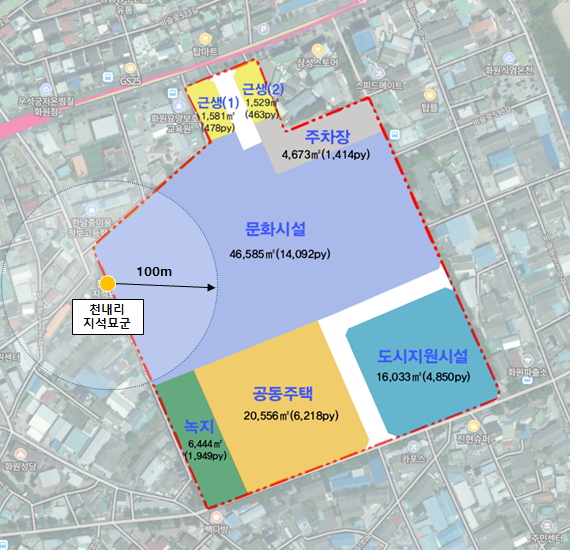
The revitalization of Hwawon is just beginning. The Hwawon Community Center, scheduled for completion in 2027, along with the Hwawon Waterfront, Family Theme Park, and Historical and Cultural Experience Center in the Samunjin area, all signal transformative changes for the Hwawon region.
The redevelopment of the former Daegu Prison site will serve as a key driver not only for Hwawon’s progress but also for the revitalization of Dalseong, further enhancing the quality of life for its residents.
© The Asia Business Daily(www.asiae.co.kr). All rights reserved.


















