President Lee holds press conference aboard Air Force One on the 24th
Asked about considering reduction of South Korea-U.S. joint exercises
"Soon, it's hard to say, but in the long run, there may be no need"
On possibility of dialogue with
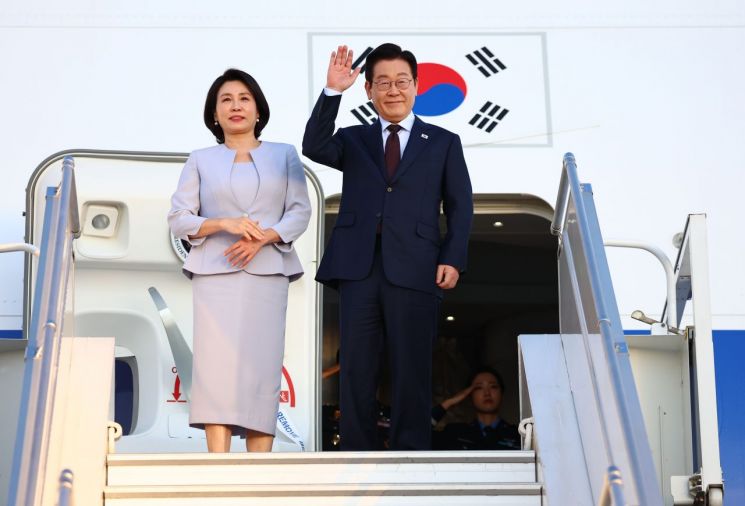 President Lee Jae-myung and First Lady Kim Hye-kyung, having concluded the schedule of the Group of Twenty (G20) summit, are boarding Air Force One at OR Tambo International Airport in Johannesburg, South Africa, on the 23rd (local time) to depart for their next state visit to Turkey. Photo by Yonhap News Agency
President Lee Jaemyung, who is on a tour of four countries in the Middle East and Africa, stated on the 24th (local time) that “If a solid peace regime is established between North and South Korea, it would be preferable not to conduct the South Korea-U.S. joint military exercises.”
"In the long run, there may be no need for South Korea-U.S. joint exercises"
President Lee made these remarks during a press conference aboard the presidential Air Force One en route to Turkey, when asked whether he was considering reducing the scale of the South Korea-U.S. joint military exercises to improve relations with North Korea. He said, “The issue that North Korea is most sensitive about is the South Korea-U.S. joint military exercises,” adding, “There are some who argue that we should proactively consider reducing or postponing the scale of the exercises.”
President Lee continued, “It is difficult to comment on whether to reduce the exercises right now,” but explained, “However, in the long term, if South Korea takes full responsibility for its own defense and a solid peace regime is established, there may be no need to conduct joint military exercises that President Trump did not favor.”
He also reiterated his willingness to engage in dialogue with North Korea. President Lee criticized, “Unfortunately, inter-Korean relations have turned extremely hostile and confrontational,” and added, “During the Yoon Sukyeol administration, all railways leading to North Korea were destroyed. We are now in a situation where accidental clashes could occur at any time.”
President Lee questioned, “Is this truly in the national interest of South Korea?” and asserted, “At times like this, we must be even more patient, secure strong deterrence, and then, on that basis, communicate, engage in dialogue, persuade, and open a path.” He further emphasized, “We are always open to dialogue. Why is it that we interact and communicate with every other country, but not with North Korea?”
In particular, President Lee pointedly asked, “Why are we broadcasting to North Korea? What benefit does it bring us?” Regarding the issue of unconverted long-term prisoners in South Korea, he remarked, “Why are we stopping those over 90 years old who want to return to North Korea? What good does it do to detain them?”
"Economic cooperation with China and developing the U.S. alliance are not mutually exclusive"
When asked about his approach to diplomatic relations with China and Japan, President Lee stated that his fundamental principle is “pragmatic diplomacy centered on national interest.” He said, “Economic cooperation with China and the development of the South Korea-U.S. alliance are by no means mutually exclusive,” and added, “If we skillfully leverage both sides based on our national interest, our diplomatic horizon could actually expand significantly.”
President Lee also said, “If we approach inter-state relations in a black-and-white, all-or-nothing manner, there is nothing to be gained,” and explained, “During the summits with China and Japan, I thoroughly explained South Korea’s basic positions and ensured that there was no misunderstanding through careful consultation.”
He also shared details of his conversation with Japanese Prime Minister Sanae Takaichi at the Group of Twenty (G20) summit held in Johannesburg, South Africa. President Lee said, “I told Prime Minister Takaichi that relations between countries are no different from those between people,” and added, “Ultimately, it is important to try to see the positive aspects, and if there are difficult or uncomfortable issues, it is best to manage them well.”
President Lee confessed that the consecutive state visits made him realize the need to improve South Korea’s foreign policy. He said, “I told the Minister of Foreign Affairs and the Director of National Security that we must systematically reorganize and invest more in the field of diplomacy,” and pointed out, “I feel that South Korea’s management of external relations is extremely fragmented.” President Lee believes that the nation’s diplomacy, which is currently carried out separately by each ministry, sector, and industry, should be managed in a more detailed and integrated manner.
"Major achievements in the UAE... Turkey is highly interested in defense"
President Lee cited the United Arab Emirates (UAE) as the country where the most significant achievements were made during the tour. He said, “Chief of Staff Kang Hoonshik visited as a special envoy in advance and identified many areas for cooperation,” and evaluated, “Since we discovered concrete projects, we were able to achieve substantial results.” The two countries agreed to cooperate in fields such as artificial intelligence (AI), defense, nuclear power, and energy, including the UAE’s “Stargate Project” worth 20 billion dollars (about 30 trillion won).
Regarding Egypt, one of the countries visited, President Lee said, “President Abdel Fattah el-Sisi of Egypt plans to expand Cairo Airport, and he mentioned that it would cost 3 to 4 trillion won, and expressed his hope that Korean companies would take charge of the expansion and operation.” He added, “If we had made efforts and prepared thoroughly in advance, and accumulated exchanges and cooperation over a long period, we could have achieved even more in-depth cooperation, which I regret.”
As for Turkey, the last country visited on this trip, President Lee cited “defense” as the expected area of achievement. He analyzed, “Turkey is highly interested in defense and national security, and South Korea’s strength also lies in the defense sector.” He also explained that there is potential for cooperation in culture, tourism, and nuclear power.
© The Asia Business Daily(www.asiae.co.kr). All rights reserved.

















