Gyeongsangnam-do Province has emphasized the need for real estate policies tailored to local realities and has announced measures to revitalize the regional housing market.
On the 24th, the provincial government held a briefing at the press center in the provincial office and announced its "Measures to Revitalize the Housing Market."
The province assessed the current housing market by stating, "While the government's real estate policies have focused on stabilizing housing prices in the Seoul metropolitan area, local regions are facing a crisis of decline."
According to Gyeongsangnam-do, over the past three years, the housing price index in the province has dropped by 4.6 percentage points, yet the price gap between the Seoul metropolitan area and Gyeongsangnam-do continues to widen.
Since December 2022, the price gap has increased from 34.3 percentage points to 58.5 percentage points by August 2025.
The volume of housing permits, which is an indicator of housing supply for the next two to three years, also sharply declined to 52.2% of last year's level as of September this year.
The number of registered housing construction companies in the province decreased from 485 in December 2020 to 273 as of October this year.
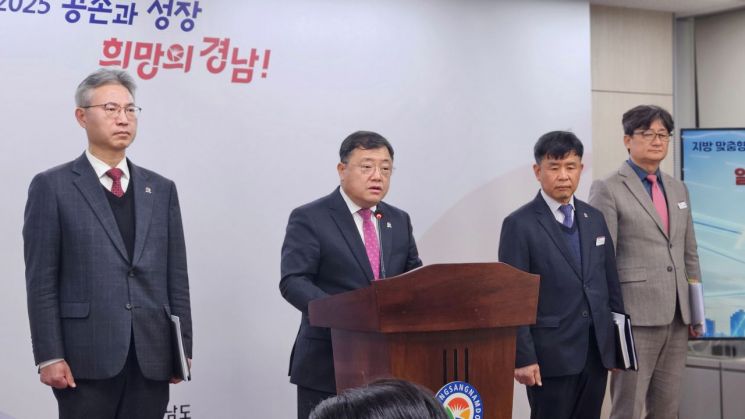 Park Myungkyun, Deputy Governor of Gyeongnam Province, is announcing measures to revitalize the housing market. Photo by Lee Seryung
Gyeongsangnam-do believes that the current local housing market is facing a triple crisis: the widening price gap with the metropolitan area, the collapse of the housing supply, and the breakdown of the housing construction industry base. The province is urging the differentiated application of regulations that reflect local realities, instead of imposing uniform regulations as in the metropolitan area.
First, the province is proposing the abolition of the heavy acquisition tax on owners of multiple homes, but only in non-metropolitan, non-regulated areas.
They determined that the heavy acquisition tax on owners of multiple homes, which is applied nationwide regardless of region, has become an obstacle to housing transactions in non-metropolitan areas, contrary to its original purpose of curbing speculative demand. They expect that abolishing this tax will revitalize transactions and have a positive effect on tax revenue.
Additionally, the province is requesting that the "stress total debt service ratio (DSR) system," which lowers the borrowing capacity for home purchases by reducing loan limits, should not be applied to non-metropolitan areas where housing prices are falling.
To restore the local construction industry ecosystem, the province is also asking the government to: ▲ significantly expand the allocation of Korea Land and Housing Corporation (LH) purchase rental housing projects and improve conditions for local construction companies to participate, such as revising purchase price calculation methods; ▲ ease the equity ratio requirement for project financing (PF) loans for housing construction projects in non-metropolitan areas to about 10%; ▲ and allow private developers to supply public land developed by LH.
The province plans to officially submit these measures to the Ministry of Land, Infrastructure and Transport and LH within this year, and to propose them as agenda items at the council of city and provincial governors, working together with other non-metropolitan regional governments to persuade the central government.
Alongside these proposals to the central government, the province will also pursue its own measures to revitalize the housing market.
The province will establish guidelines for designating public-supported private rental housing promotion districts and plans to expand the supply of both public and private rental housing.
It also plans to increase the supply of customized housing equipped with facilities linked to job creation or safe retirement, tailored to the needs of target groups such as young people, newlyweds, and retirees.
Hamyang County and Hapcheon County will participate in the Ministry of Land, Infrastructure and Transport's specialized rental housing project led by local governments, and plan to launch new public rental housing projects starting next year.
The province will also simplify procedures for promoting housing construction and reconstruction projects.
Furthermore, from the permitting and project bidding stages, the province will encourage local small and medium-sized construction companies to be given priority in subcontracting public and private housing construction projects, so that these projects can become a source of business for local firms.
Deputy Governor Park Myungkyun said, "These measures are not just for our region, but I am confident that they will help ease the concentration in the metropolitan area and have a positive impact on the real estate market there as well."
© The Asia Business Daily(www.asiae.co.kr). All rights reserved.
!["The Woman Who Threw Herself into the Water Clutching a Stolen Dior Bag"...A Grotesque Success Story That Shakes the Korean Psyche [Slate]](https://cwcontent.asiae.co.kr/asiaresize/183/2026021902243444107_1771435474.jpg)
















