Private Taxi Drivers Attach Protest Stickers
"Staria available for 150,000 won."
On the afternoon of the 25th, in the hotel district of Myeongdong, Jung-gu, Seoul, which is frequented by many foreign tourists, it was common to see vans with rental car license plates such as "Ha," "Heo," or "Ho" loading the luggage of foreign tourists at hotel entrances. In order to legally transport passengers or luggage for a fee, vehicles are required to have official yellow license plates, such as those issued to taxis or authorized call vans. However, these vehicles were using white license plates.
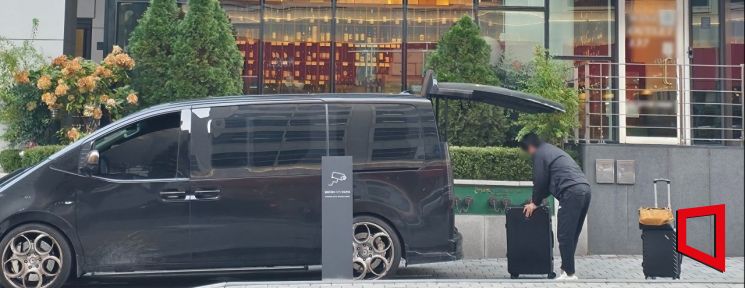 A van with a "Heo" license plate is carrying luggage of foreign tourists in front of a hotel in Myeongdong, Jung-gu, Seoul. Photo by Choi Youngchan
As these illegal paid transportation services, such as one-time airport pickup, become more prevalent, dissatisfaction among taxi drivers and other transportation industry workers is growing.
When contacting a company offering a "rental car with driver" service, they responded that a trip from Myeongdong in Seoul to Incheon Airport would cost 150,000 won. Under current law, a "rental car with driver" can only transport passengers for a fee if it meets the following criteria: it must be for foreign tourists, use a vehicle with 11 to 15 seats, and be rented for at least six hours. However, there was no separate verification as to whether these conditions were met, and a reservation could be made immediately.
Illegal paid transportation, which was previously conducted covertly near airports targeting foreign tourists, now appears to be spreading into urban areas such as Seoul. On November 3, the Incheon Metropolitan Police Agency apprehended a total of 466 individuals on suspicion of violating the Passenger Transport Service Act. They are accused of using private vehicles or rental cars to transport passengers from Incheon International Airport to their destinations.
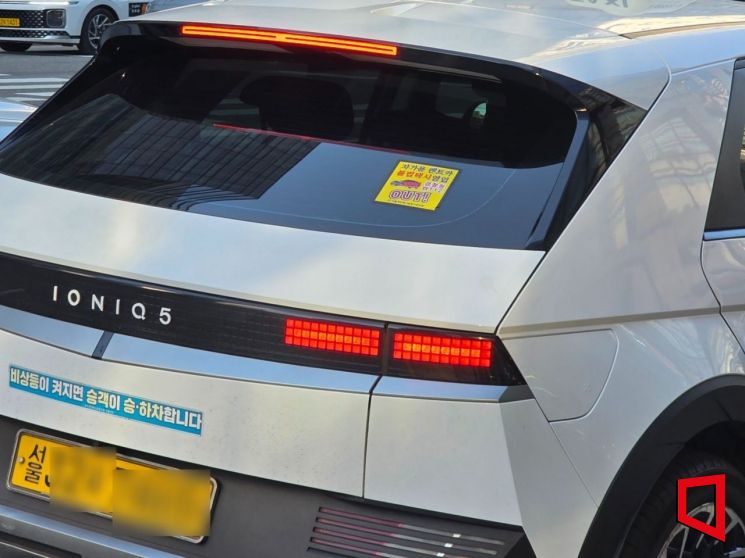 Mr. Park, 75, who has been operating a private taxi in Seoul for 30 years, has a sticker on the back of his vehicle that reads "Opposition to Illegal Private Car Business." Photo by Youngchan Choi
As the number of vehicles engaging in these illegal paid transportation services increases, resistance from domestic legal transportation workers, including taxi drivers, is also intensifying. The Seoul Private Taxi Transportation Association recently produced protest stickers reading "Private Rental Car Illegal Taxi Business OUT" and attached them to vehicles. An official from the Seoul Private Taxi Council stated, "Illegal vehicles with rental car plates operate in front of hotels during the early morning hours, picking up passengers for airport trips, and the situation is extremely serious. Simply attaching stickers is not enough; we hope for stronger enforcement."
However, a major issue is that illegal paid transportation services that are not officially authorized often do not have commercial auto insurance, leaving them outside the scope of proper management and supervision. It is also difficult to obtain insurance coverage in the event of an accident. Experts recommend not only more active enforcement but also the establishment of a proper transportation service system. Choi Jaewon, a professor at Korea Road Traffic Authority, said, "In the short term, it is right to reduce these activities through enforcement, but for a fundamental solution, we should also consider ways to encourage the development of transportation services like Tada or Uber in Korea over the medium to long term."
© The Asia Business Daily(www.asiae.co.kr). All rights reserved.
![From Hostess to Organ Seller to High Society... The Grotesque Scam of a "Human Counterfeit" Shaking the Korean Psyche [Slate]](https://cwcontent.asiae.co.kr/asiaresize/183/2026021902243444107_1771435474.jpg)

















