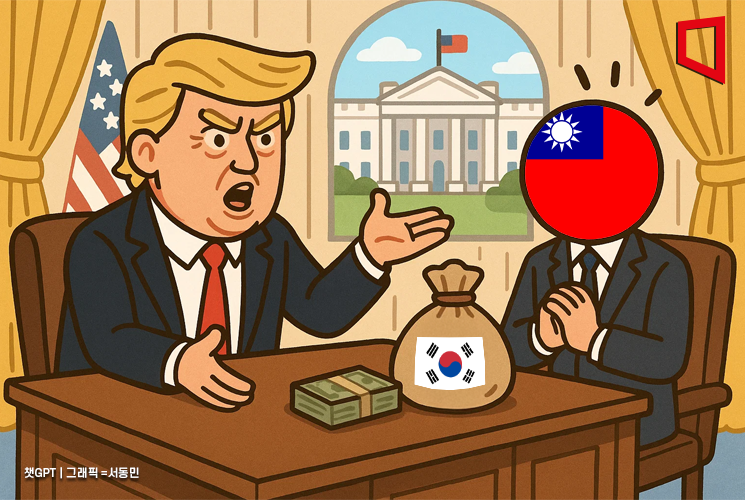
The United States has reportedly demanded an investment of $400 billion (approximately 591 trillion won) from Taiwan during trade negotiations, a figure greater than what was requested from South Korea.
On November 24, Taiwanese media outlets such as China Times and Liberty Times, citing the British daily Financial Times (FT), reported that a trade agreement between the United States and Taiwan is expected to be announced soon, and covered these details.
According to sources, the United States requested a large-scale investment from Taiwan ahead of concluding tariff negotiations. The sources stated that the investment commitment in the draft agreement is expected to be around $400 billion, which falls between the $350 billion pledged by South Korea and the $550 billion pledged by Japan.
The $400 billion figure includes the $165 billion investment in the United States by Taiwan Semiconductor Manufacturing Company (TSMC), the world's largest foundry company.
However, Kung Ming-Hsin, Minister of Economic Affairs, told China Times that nothing has been finalized yet. Taiwan's Office of Trade Negotiations (OTN) under the Executive Yuan stated that the negotiation team is currently continuing discussions with the United States on supply chain cooperation in a "Taiwanese model" through video conferences and written document exchanges. The OTN also emphasized that efforts are being made to secure Most Favored Nation (MFN) status for tariff reductions and for items related to Section 232 of the Trade Expansion Act.
Wu Tsung-Tsong, Minister of the National Science and Technology Council (NSTC) of Taiwan, recently said in an interview with the FT that the two countries agreed that, in exchange for tariff reductions on Taiwanese goods, Taiwan would support the development of the U.S. semiconductor industry. He also added that Taiwan proposed to share its experience in building science parks, which have supported the success of its semiconductor industry, with the United States.
As the trade agreement between the United States and Taiwan has not yet been finalized, U.S. President Donald Trump has decided to impose a 20% tariff on Taiwanese goods. In response, Taiwanese President Lai Ching-te stated that the 20% tariff was a "temporary rate" set at the final stage of negotiations last August, and that it is not Taiwan's goal. He expressed hope that the final agreement would result in a lower rate.
© The Asia Business Daily(www.asiae.co.kr). All rights reserved.


















