175,000 Deaths in Europe Due to Heatwaves
180 Deaths in Pakistan During Monsoon Season in Late June
Dye Poured Into Canals in 10 Italian Cities
Environmental Group: "Demonstrating the Impact of Climate Collapse"
The color of the sea in Venice, Italy, a world-famous tourist destination, suddenly turned green. This occurred as an environmental group staged a protest demanding the phase-out of fossil fuels, dyeing the area around the Grand Canal in Venice green. On the 23rd, Yonhap News, citing AFP and others, reported that the environmental group Extinction Rebellion released green dye into the waters of the Grand Canal in Venice to highlight the massive impact of climate collapse. The group stated that they poured dye into canals, rivers, lakes, and fountains in 10 cities across Italy, including the Grand Canal in Venice, and emphasized that the dye was not harmful to the environment.
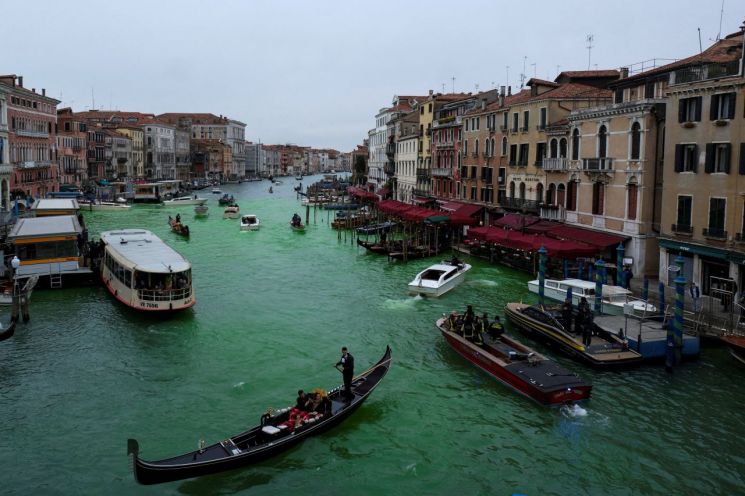 An environmental group sparked controversy by staging a protest demanding the phase-out of fossil fuels, dyeing the area around the Grand Canal in Venice, Italy, green. Photo by Reuters Yonhap News Agency
Paola, an activist from Extinction Rebellion, said, "The most important global summit to address climate and social collapse is coming to a close," adding, "This year, Italy was again one of the countries blocking ambitious proposals." Parties to the United Nations Framework Convention on Climate Change are currently negotiating whether to formally include the phase-out of fossil fuels and other measures, even postponing the closing schedule of the 30th Conference of the Parties (COP30) being held in Belem, Brazil. Climate groups have previously staged performances around the Grand Canal in Venice, splashing dye to raise awareness about the dangers of climate change.
Backlash Grows Against Radical Environmental Protests
In particular, many citizens in Europe have recently experienced inconvenience due to increasingly radical protests by environmental groups. The methods of protest, which are becoming more extreme, often defy common sense. Some groups have thrown paint at luxury stores and splattered food on famous paintings, and certain European environmental organizations have repeatedly blocked busy roads during morning rush hour, disrupting traffic. Some activists have even glued their hands to the seashore to delay police removal.
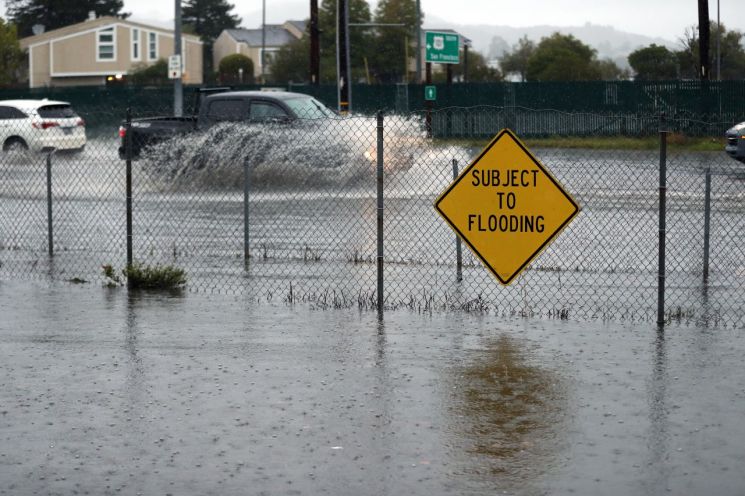 Every year, the Earth records the highest temperatures since meteorological observations began, and large-scale human casualties caused by such abnormal climate are increasing. Photo by AP Yonhap News
As such protests have continued in Germany and across Europe, they have started to backfire. Some citizens have physically removed protesters from roads, and there have even been incidents where people sprayed pepper spray in protesters' faces or assaulted them. Videos of these scenes have been released on social networking services (SNS), with comments praising the citizens who retaliated against the protesters as heroes. As environmental group protests persist, their intended strategy has effectively failed. While protest methods have become more radical in an effort to maintain public attention, public backlash has grown uncontrollably, and even those who were concerned about environmental issues have begun to criticize these tactics. However, some point out that we should not ignore the "inconvenient truth" because of these groups.
Every year, the Earth records the highest temperatures since meteorological observations began, and large-scale human casualties caused by such abnormal climate events are increasing. In particular, in July this year in Korea, a large amount of rain fell in a short period, resulting in a threatening "extreme rainfall" event. As a result, 18 people died and 9 went missing nationwide, while more than 14,000 residents were urgently evacuated due to heavy rain and landslides.
Korea was not the only country to suffer massive casualties from these "water bomb" events. In Pakistan, more than 180 people died nationwide since the start of the monsoon season at the end of June, with more than half of the victims being children. During the same period, heavy rains in New Jersey and New York City in the United States flooded roads and homes, and flooding caused by concentrated downpours in Texas led to 129 deaths and over 160 missing persons.
Meanwhile, Europe suffered from scorching heat during the same period. Southern European countries such as Spain, Italy, and Greece already recorded temperatures exceeding 40 degrees Celsius in June, and in Andalusia, southern Spain, temperatures soared as high as 46 degrees. According to the World Health Organization, 175,000 people die every year in Europe due to heat-related causes.
Above all, while the climate crisis affects all regions, its impact is even greater on economically and socially vulnerable groups. In particular, many of the areas on the front lines of the climate crisis have contributed little to greenhouse gas emissions but are suffering the greatest damage. For example, Pakistan, which endures annual flooding, accounts for only about 1% of global greenhouse gas emissions, yet it is the fifth most disaster-prone country in the world.
© The Asia Business Daily(www.asiae.co.kr). All rights reserved.
![Clutching a Stolen Dior Bag, Saying "I Hate Being Poor but Real"... The Grotesque Con of a "Human Knockoff" [Slate]](https://cwcontent.asiae.co.kr/asiaresize/183/2026021902243444107_1771435474.jpg)












