Research Team from Zhejiang University and Beijing Institute of Technology Publishes Paper
The South China Morning Post (SCMP) reported on November 23 (local time) that China has found a way to neutralize SpaceX's low-Earth orbit (LEO) satellite internet system, Starlink, which has been credited with playing a key role in maintaining communications during the war in Ukraine. China has regarded Starlink as a potential variable that could fundamentally change the course of war and pose a military threat in the event of a Taiwan contingency.
On November 5, a research team from Zhejiang University and Beijing Institute of Technology published a paper in the Chinese academic journal "Systems Engineering and Electronics," presenting simulation results that showed effectively blocking Starlink connections across the entire area of Taiwan (approximately 36,000 square kilometers) would require deploying 1,000 to 2,000 electronic warfare drones at an altitude of about 20 kilometers, distributed in a grid pattern in the air.
 On November 13, 2022 (local time), Ukrainian citizens are standing near a Starlink satellite-based broadband station in Kherson, using their mobile phones. Photo by AFP Yonhap News
SCMP reported that the researchers concluded it is technically possible to disrupt Starlink across a region the size of Taiwan. However, the study demonstrated that such an operation would require a large-scale deployment of 1,000 to 2,000 electronic warfare drones.
According to the paper, Starlink consists of thousands of low-Earth orbit satellites that form a dynamic, high-speed network with ground terminals, utilizing real-time frequency hopping (FH), inter-satellite laser links, and multi-path connections to automatically bypass interference. As a result, it is virtually impossible to disrupt the system using only a few ground-based jammers (devices that interfere with or block radio frequencies, causing drones or unmanned vehicles to crash). Ultimately, the paper argued that a large-scale "network of jammer drones distributed in a grid pattern in the air" is the only viable method to neutralize Starlink.
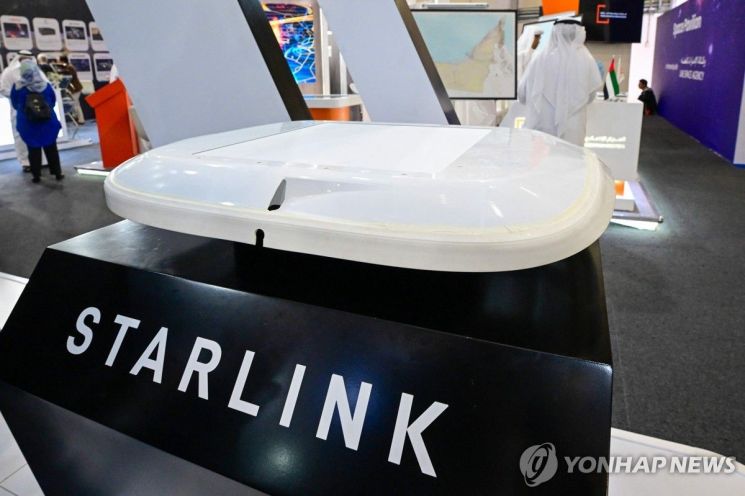
SCMP, citing Chinese military institutions and specialized journals, reported that "physically removing thousands of Starlink satellites with anti-satellite (ASAT) weapons is impossible in terms of cost and time," and that the Chinese military is prioritizing the development of "Starlink killer" technology and accelerating its electronic warfare capabilities. However, the researchers at Beijing Institute of Technology added that "since some core technologies, such as the radiation patterns of Starlink terminals, are not public, these results are preliminary," and that the accuracy of their assessments would improve significantly if actual data were obtained.
For China, which is eyeing a possible invasion of Taiwan, Starlink is the biggest variable. Russia's failure to paralyze Ukraine's communications network in the early stages of the conflict was due to this very factor. After approximately 30,000 Starlink terminals were supplied, the Ukrainian military was able to maintain drone video transmission, reconnaissance, remote strikes, and command and control (C2), thereby sustaining its front lines.
SCMP noted, "The groundbreaking simulation research by Chinese scientists presents the most detailed public analysis to date of how the People's Liberation Army could silence the most resilient communications system in history."
© The Asia Business Daily(www.asiae.co.kr). All rights reserved.