Assessing Changes in Economic, Security, Climate, and Technological Environments
"Korea Should Serve as a Middle-Power Cooperation Architect"
The Korea Maritime Institute (KMI) held an expert seminar on November 20 at The Plaza Hotel in Seoul under the theme "Challenges and Issues in the Indo-Pacific Region and Future Cooperation Measures."
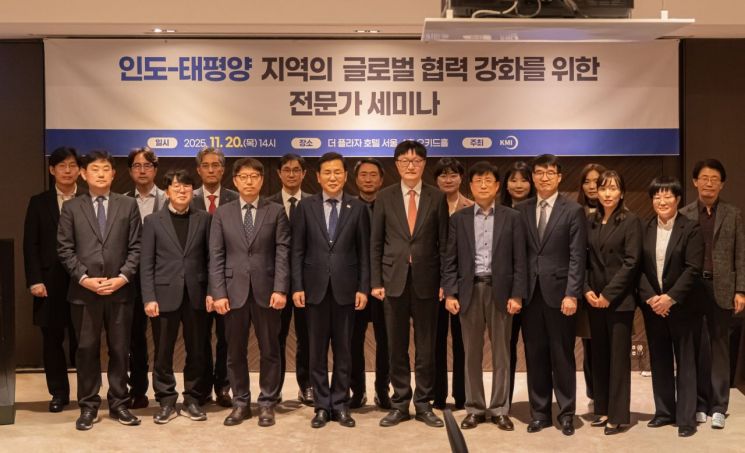 The Korea Maritime Institute held an expert seminar on the theme "Challenges and Issues in the Indo-Pacific Region and Future Cooperation Measures" on the 20th at The Plaza Hotel in Seoul and took a commemorative photo. Provided by the Korea Maritime Institute
This seminar was organized to comprehensively assess strategic environmental changes surrounding the Indo-Pacific-such as the economy, security, technology, and climate-and to discuss sustainable directions for Korea's cooperation amid the evolving international order.
In his opening remarks, KMI President Cho Jeonghee emphasized, "The Indo-Pacific region is a global core axis, home to about 65% of the world’s population and more than 60% of global GDP, as well as the center of international logistics, with half of global maritime cargo passing through. It is a vital hub for maritime transport routes and supply chain competition, while also being at the forefront of geopolitical and geo-economic challenges such as rising sea levels and the melting of Arctic sea ice due to the climate crisis."
The first session featured expert presentations on the evaluation of regional cooperation, future outlook, and strategic diplomatic and economic responses.
Cho Wondeuk, Director of the ASEAN-India Research Center at the Korea National Diplomatic Academy, stressed the need to "expand responsible cooperation based on multilateral and minilateral networks" in the rapidly changing security environment.
Ban Giljoo, Director of the Center for Geopolitical Studies at the Korea National Diplomatic Academy, called for "a multi-layered diplomatic and security strategy that regards the oceans as a global public good amid the intensification of a new Cold War structure."
Lim Haeyong, Professor at Sungshin Women's University, suggested that Korea needs to redefine its response and cooperation strategies in the context of economic security and supply chain restructuring.
The second session discussed sector-specific marine cooperation tasks in response to changes in the geopolitical environment.
Lee Sunmi, Senior Superintendent at the Korea Coast Guard, shared cases of responding to IUU (illegal, unreported, and unregulated) fishing in the high seas of the North Pacific and highlighted the need for cooperation with the United States, Japan, and ASEAN coastal countries.
Kim Minsu, Head of the Arctic Route Support Team at KMI, noted that the pioneering of the Arctic route has created a new maritime strategic space and proposed establishing a maritime strategy that integrates security, industry, and sustainable development agendas.
Park Sujin, Head of the Dokdo and Maritime Norms Research Office at KMI, addressed major maritime issues such as sea level rise and marine pollution, emphasizing the need for a package-type cooperation model that links science, technology, and resources.
The third session featured a roundtable moderated by former Korea Institute for International Economic Policy President Kim Heungchong, with participation from experts in academia, government, and research institutions. The discussants analyzed the structural characteristics and risk factors of the Indo-Pacific and agreed that Korea should establish itself as a "middle-power cooperation architect."
In particular, consensus was reached on the need to identify and continuously pursue actionable cooperation agendas in the areas of maritime security, disaster response, supply chains, energy, critical minerals, digital and AI, and climate and environment.
Concluding the event, President Cho Jeonghee stated, "Changes in the maritime legal order, such as supply chain restructuring, shifts in energy strategy, and the BBNJ Agreement, cannot be addressed through a single country or sectoral approach. KMI will strengthen research and cooperation to realize practical diplomacy centered on national interests and the strategy of becoming a global maritime powerhouse."
This seminar was highly regarded for analyzing the strategic environmental changes in the Indo-Pacific region, which has emerged as a key axis of the global economy and supply chains, and for presenting multi-layered global cooperation directions across the maritime, security, technology, and climate sectors.
© The Asia Business Daily(www.asiae.co.kr). All rights reserved.

















