989 in Gwangju, 1,339 in South Jeolla Join Strike... 368 Schools Provide Alternative Meals
Education Sector Split: "Improve Working Conditions" vs. "Schools Cannot Be Stopped"
Ongoing Issues: High Temperatures in Kitchens, Poor Ventilation, and Staff Shortages
On November 21, irregular school workers in Gwangju and South Jeolla Province launched a general strike, causing partial disruptions to school meal services and after-school care in the region. As the strike demanding wage and working condition improvements continued, long-standing issues in the workplace-such as high temperatures in kitchens, poor ventilation, and staff shortages-were brought back into the spotlight.
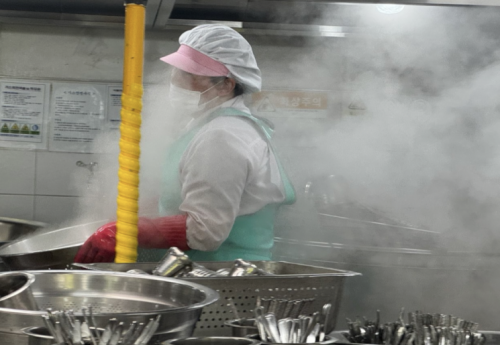 In a school kitchen in Gwangju, a kitchen worker soaked with sweat and steam is washing dishes in the intense heat. Provided by the School Irregular Workers' Union
According to the Gwangju Metropolitan Office of Education, 989 out of 4,251 irregular public school employees in Gwangju (23.3%) participated in the strike on this day. Of the 285 public schools in the city, 145 schools provided alternative meals consisting mainly of bread and milk instead of regular lunches. The South Jeolla Provincial Office of Education reported that 1,339 out of 8,300 irregular public school employees (16.1%) joined the strike, and 223 out of 803 schools serving meals offered alternative meal options.
The regional strike in Gwangju and South Jeolla Province was part of a four-day relay general strike organized by the National School Irregular Workers Solidarity Council (Hakbiyeondae). The council has continued negotiations with the education authorities, demanding the elimination of low-wage structures and welfare disparities, but stated that there had been no progress, calling the strike "unavoidable." The council also warned of additional strikes if an agreement is not reached within the year.
Reactions within the education sector were divided. A coalition of 125 progressive education, labor, and civil society organizations issued a joint statement emphasizing, "The work of those responsible for children's daily lives must be properly respected." In contrast, the Korean Federation of Teachers' Associations condemned the strike, declaring that "schools are essential public goods that cannot be halted," and called for the passage of the 'School Strike Damage Prevention Act.'
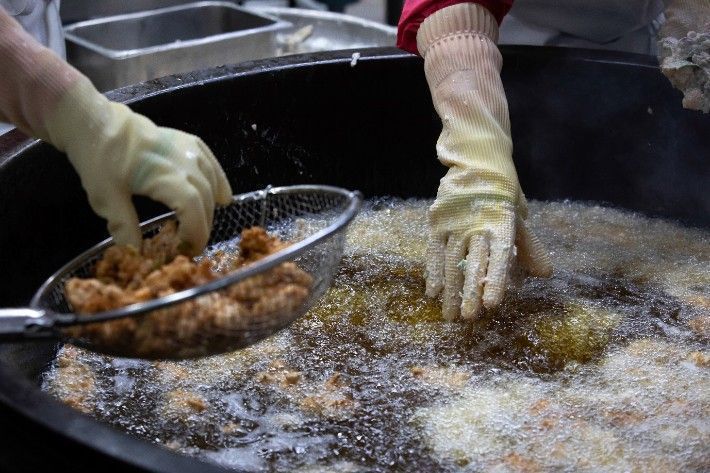 Culinary workers are frying food in the school cafeteria. Provided by the School Irregular Workers Union
Concerns about work intensity and safety have long been raised at schools. Cafeteria kitchen workers have complained that the heat and steam generated during food preparation can raise indoor temperatures to 40 degrees Celsius, with areas around large pots and griddles becoming even hotter. Repeated issues with outdated and malfunctioning ventilation systems have also been reported, with workers saying, "The hood often causes more backflow than suction," and "There have been cases where the ventilation fan and hood operated in reverse."
The Ministry of Education recommends limiting fried foods to no more than twice a week to prevent lung cancer. However, some schools schedule fried and pan-fried dishes more than four times a week, citing food poisoning prevention as the reason. During the summer, workers often experience dehydration due to inadequate air conditioning, with complaints such as "There is no time to drink water during work," and "Almost no schools have ice water dispensers or ion drink machines."
Staff shortages are also cited as a structural issue. A representative from the School Irregular Workers' Union stated, "If five people prepare 500 servings, that's 100 per person, but if one person is absent, it becomes 150 servings each," adding, "The workload increases exponentially." The representative explained that adequate staffing is necessary to allow for shift rotations and breaks, as well as to reduce heat exposure.
The issue of working conditions for irregular school workers is rooted in structural factors rather than being a short-term conflict. There are about 180,000 education support staff working under permanent or irregular contracts, accounting for about 40% of the 450,000 teaching staff. There are more than 80 job categories. While the workforce has expanded to fill necessary roles, improvements in working conditions and safety have not kept pace.
The disruptions to meal and after-school care services caused by the general strike lasted only a day, but the problems that have accumulated at schools remain unresolved. Workers, who have faced criticism for "holding students' meals hostage," say that, in reality, it is their own lives that are being held hostage by the conditions in schools and kitchens.
© The Asia Business Daily(www.asiae.co.kr). All rights reserved.
![From Hostess to Organ Seller to High Society... The Grotesque Scam of a "Human Counterfeit" Shaking the Korean Psyche [Slate]](https://cwcontent.asiae.co.kr/asiaresize/183/2026021902243444107_1771435474.jpg)

















