Surge in Losses from 500 Yen and 500 Won Coin Mix-Ups in Japan
Nearly Identical Size, Weight, and Appearance Make Detection Difficult
Recently, there has been a surge in cases across Japan where 500 won coins from Korea are being passed off as 500 yen coins. This issue has arisen because the two coins are nearly identical in size, weight, and appearance, and despite Japan introducing a new 500 yen coin in 2021, the older version is still widely in circulation. The problem is particularly prevalent in small business sectors such as restaurants and gas stations, where cash transactions are common.
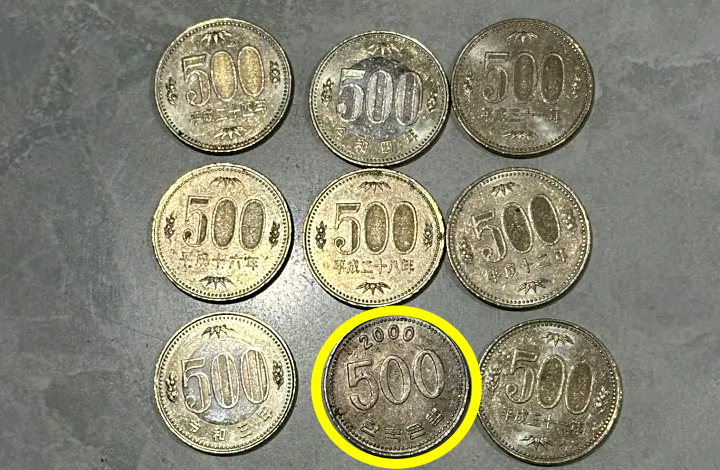
"Given 500 won instead of 500 yen" - Japanese Small Business Owners Frustrated
On November 20, Fuji News Network (FNN) reported that there have been repeated incidents at Japanese restaurants and gas stations where Korean 500 won coins are being fraudulently used as 500 yen coins during payments.
Takashi Ito (age 69), who runs a udon restaurant in Shinjuku, Tokyo, told FNN, "The 500 yen coin from Japan and the 500 won coin from Korea are almost identical in size and weight, making them hard to distinguish." He said he has suffered similar losses about 15 times over the past 10 years. "During busy hours, customers often leave coins on the tray and leave, so it's difficult for staff to check immediately," he explained. "Since the value of 500 won is only about 50 yen, the loss is significant," he added.
FNN also reported similar incidents at a gas station in Osaki, Miyagi Prefecture, and a ramen shop in Nihonmatsu, Fukushima Prefecture. The owner of the affected gas station said, "I received the money directly from the customer, but the coins were mixed together, so I couldn't tell the 500 won apart." The ramen shop owner commented, "With ingredient costs rising, it was quite a shock," and added, "I suspect the person who paid with the 500 won coin was likely a Japanese office worker. Given how naturally they used the 500 won coin, I wonder if they might be a repeat offender."
Hard to Distinguish by Sight Alone... Elderly Especially Vulnerable
The 500 yen and 500 won coins both have a diameter of 26.5 mm. Until 1999, they were even made from the same material: cupronickel (a copper-nickel alloy). While the 500 won coin is 0.5g heavier, the difference is nearly impossible to detect by touch. Elderly people in particular are frequently mistaken, confusing 500 won coins for 500 yen coins.
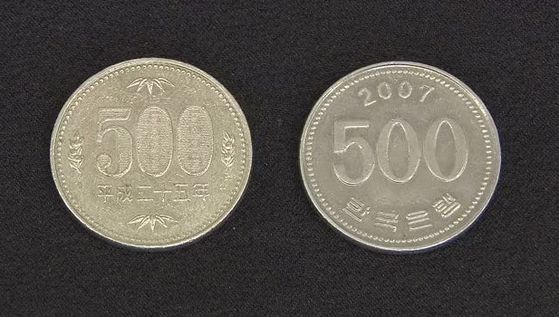
The issue of mixing up the two coins has caused controversy in the past as well. In the 1990s, the so-called "500 won coin scam" swept across Japan. At that time, criminals would shave down the surface of the 500 won coin or drill holes in it to match the weight of the 500 yen coin. These altered 500 won coins would then be inserted into vending machines, which would recognize them as 500 yen coins. The criminals would either press the return lever to retrieve genuine 500 yen coins or make purchases and collect the change, thereby profiting illegally. In 1997 alone, Japanese police confiscated as many as 14,000 500 won coins.
New Coin Not Enough... Face-to-Face Payments Still at Risk
In response, the Japanese Ministry of Finance began issuing a new 500 yen coin in 2021. The new coin maintains the same diameter but is slightly heavier at 7.1g, an increase of 0.1g. The edge, previously uniformly serrated diagonally, was modified with variations in the vertical and horizontal directions. The word 'JAPAN' is engraved on the top and bottom edges, while '500 YEN' appears on the left and right. The number '0' in '500' changes to display 'JAPAN' or '500YEN' depending on the angle. As a result, fraudulent use through machines such as vending machines has been blocked, but losses continue to occur in face-to-face transactions that rely on human eyes and hands.
© The Asia Business Daily(www.asiae.co.kr). All rights reserved.
![Clutching a Stolen Dior Bag, Saying "I Hate Being Poor but Real"... The Grotesque Con of a "Human Knockoff" [Slate]](https://cwcontent.asiae.co.kr/asiaresize/183/2026021902243444107_1771435474.jpg)

















