AMCHAM and KCCI Hold 'U.S. Market Entry Seminar'
Providing Information and Strategies for Companies Targeting the U.S. Market
Emphasizing Market Monitoring and Visa Preparation Tailored to Business Objectives
Domestic and international experts emphasized that for Korean companies to successfully enter the U.S. market, it is essential to have an accurate understanding of the market situation and to be thoroughly prepared, including with regard to visas.
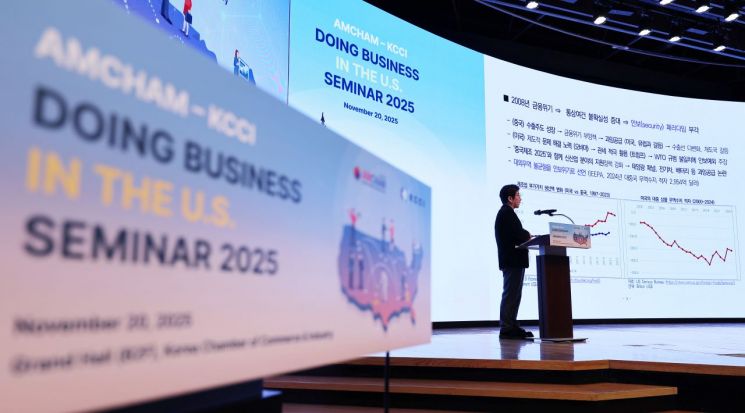 At the Korea Chamber of Commerce and Industry International Conference Hall in Jung-gu, Seoul, on the 20th, Kim Jongdeok, Director of the Trade, Commerce, and Security Office at the Institute for Foreign Policy, is presenting on the outlook for the U.S. economy, trade policies, and the global trade environment in 2026 at the Korea Chamber of Commerce and Industry and American Chamber of Commerce's "2025 U.S. Market Entry Seminar." Photo by Yonhap News
The American Chamber of Commerce in Korea (AMCHAM), together with the Korea Chamber of Commerce and Industry, held the "2025 U.S. Market Entry Seminar" at the International Conference Hall of the Korea Chamber of Commerce and Industry on the afternoon of the 20th. This year marked the seventh edition of the seminar. The event has provided practical information and strategies for Korean companies preparing to enter the U.S. market or seeking to expand their local operations.
This year’s seminar drew significant attention, especially as U.S. visa issues have recently become a hot topic and the global trade order is undergoing rapid changes. Attendees agreed that companies now need to be more thoroughly prepared than ever before when entering the U.S. market.
James Kim, Chairman and CEO of AMCHAM, stated, "It is more important than ever to maintain the positive momentum formed through recent Korea-U.S. economic discussions," adding, "The Korea-U.S. joint fact sheet announced last week following the summit between the two countries serves as an important milestone, demonstrating that economic cooperation between Korea and the U.S. is advancing to the next level."
Park Dongmin, Executive Vice President of the Korea Chamber of Commerce and Industry, said in his welcoming remarks, "The expansion of protectionism, the shift in industrial policies, and the reorganization of supply chains are all happening simultaneously, creating greater uncertainty for companies than ever before." He continued, "The Korea-U.S. joint fact sheet announced in this context is a clear signal that the two countries will strengthen cooperation across strategic industries such as shipbuilding, semiconductors, space, and artificial intelligence (AI)."
James Heller, Deputy Chief of Mission at the U.S. Embassy in Korea, also emphasized the solid foundation of Korea-U.S. economic cooperation in his congratulatory remarks and pledged that the embassy would continue to provide close support to ensure that Korean companies entering the U.S. market can establish themselves and grow stably.
In the first session, Kim Jongdeok, Director of the Trade, Commerce and Security Office at the Korea Institute for International Economic Policy (KIEP), presented an outlook for the U.S. economic and trade environment for the coming year. He said, "With negotiations between Korea and the U.S. concluded at the Asia-Pacific Economic Cooperation (APEC) summit, some uncertainties appear to have been alleviated." However, he added, "It is difficult to expect significant changes, as U.S. foreign economic policy is intertwined with structural issues such as weakening manufacturing competitiveness, growing income inequality, and checks on China." He further noted, "This suggests that the global economy and export environment next year may not be entirely favorable for Korea," and advised, "Going forward, companies need to strengthen their monitoring of the U.S. political situation and policy direction, negotiation trends and outcomes with major countries, key economic indicators, and conditions in the U.S. financial markets."
Kim Sunhyeong, Director at Deloitte Anjin, stated, "The U.S. 15% reciprocal tariff regime and the reorganization of global supply chains are demanding significant changes in the cost structure and overall price competitiveness of Korean companies." She particularly pointed out, "Mid-sized companies are facing an environment where tariffs, transfer pricing, and regulatory responses are intricately intertwined. In the short term, it is essential to accurately assess the impact of tariffs and revise transfer pricing strategies, while in the medium to long term, optimizing production and procurement structures within the United States is necessary."
In the second session, many speakers stressed the importance of carefully considering legal and tax matters when formulating market entry strategies. In particular, in light of the crackdown at the Hyundai Motor-LG Energy Solution joint battery plant in Georgia last September, there were calls for companies to be especially prepared for visa issues.
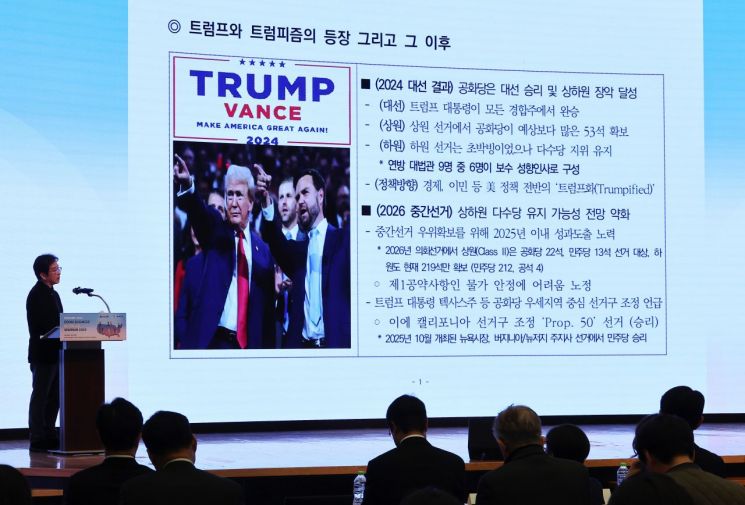 At the Korea Chamber of Commerce and Industry International Conference Hall in Jung-gu, Seoul on the 20th, Kim Jongdeok, Director of the Trade, Commerce and Security Office at the Institute for Foreign Policy, is giving a presentation on the outlook for the U.S. economy, trade policies, and the global trade environment in 2026 at the Korea Chamber of Commerce and Industry and American Chamber of Commerce's "2025 U.S. Market Entry Seminar." Photo by Yonhap News Agency
Jung Manseok, Managing Partner and Foreign Attorney at Dayang Immigration Law Firm, emphasized, "Selecting a visa appropriate for the intended purpose is crucial," and added, "Since the scope of permissible work and approval depend on the visa type, it is essential to understand these differences clearly and prepare thoroughly."
Jung Youngho, former Consul General in Houston, noted, "Texas is attracting attention as one of the fastest-growing markets in the United States," and advised, "Korean companies should understand the characteristics of the local market and develop strategies that reflect these factors." Yoo Hyunki, U.S. Attorney at Lee & Ko, stressed, "From the initial stage, it is essential to review transaction structures with tax issues in mind and to conduct prior reviews of key items such as the Committee on Foreign Investment in the United States (CFIUS) review, which can directly affect transaction closing schedules." Kim Taejoo, Executive Director at Samjong KPMG, stated, "Companies must establish strategies for global transfer pricing and origin management, along with continuous monitoring, to proactively secure competitiveness in response to U.S. tariff policies."
Various programs related to entering the U.S. market were also introduced. Kim Sungyi, Director of the Center for Innovation and Entrepreneurship at George Mason University Korea Campus, explained that the Center for Innovation and Entrepreneurship (CIE) at the university can provide Korean companies with sustainable business opportunities in the Eastern U.S. market. Shin Heejung, President of the Association of State Offices in Korea (ASOK), introduced the incentive programs offered by each U.S. state government and suggested ways companies could utilize them. Park Soyeon, Manager of the International Trade Division at the Korea Chamber of Commerce and Industry, introduced the "Job Platform for U.S. Forces Korea Veterans." She explained that this platform not only helps companies secure talent but also offers ways to foster a favorable business environment at the national level, strengthen partnerships with local governments, and contribute to Korea-U.S. economic growth.
© The Asia Business Daily(www.asiae.co.kr). All rights reserved.
![Clutching a Stolen Dior Bag, Saying "I Hate Being Poor but Real"... The Grotesque Con of a "Human Knockoff" [Slate]](https://cwcontent.asiae.co.kr/asiaresize/183/2026021902243444107_1771435474.jpg)

















