Calls to Ease the Reconstruction Excess Profit Reclamation System
"REPRS Is the Biggest Obstacle to Reconstruction"
"50% Reduction Needed for Public Participation Projects"
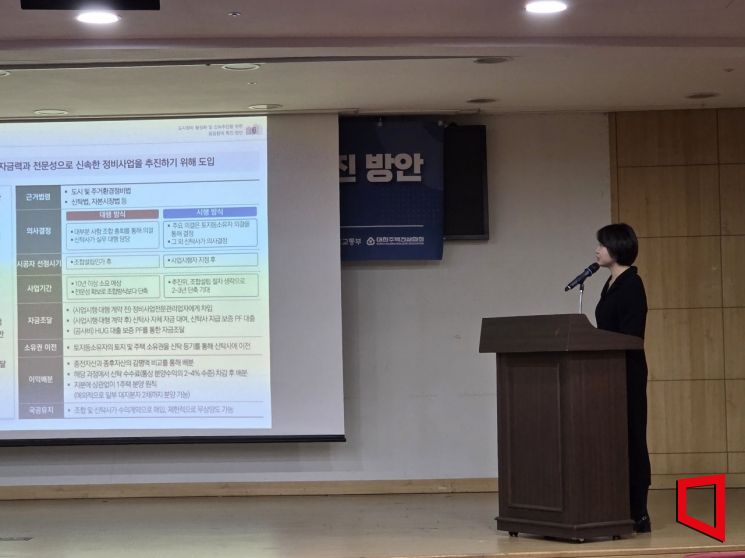 Lee Jihyun, Director of Urban Maintenance at the Korea Housing Institute, is presenting at the seminar on "Measures to Revitalize Urban Maintenance and Promote Public Participation" held on the 19th. Photo by Lee Jungyoon
There has been a call to significantly improve the methods of public participation in public-led urban renewal projects in order to increase resident acceptance.
At the seminar on "Measures to Revitalize Urban Maintenance and Promote Public Participation" held at the National Assembly on the 19th, the Korea Housing Institute (KHI) proposed the introduction of a "public agency-led urban renewal system." This system would leverage the expertise of public institutions, guarantee residents' decision-making rights on key issues, and expand incentives for public participation.
Lee Jihyun, Director of Urban Maintenance at KHI, stated, "At a time when expanding housing supply in major city centers is critical, it is urgent to devise special measures to accelerate urban renewal projects and enhance resident acceptance." She added, "An optimal alternative is needed to address the resistance of association members to the public-led implementation model."
Director Lee identified the causes of this resistance as the exclusion of members from decision-making on major issues, concerns about infringement on members' interests due to prioritization of public interest, and decreased project profitability resulting from increased public contributions.
According to a survey conducted this month by KHI targeting 48 urban renewal project promotion committees and association executives in Seoul, 78.7% responded that public participation is necessary. However, only 31.9% said they would apply the current public implementation method.
The main reasons for not favoring the public implementation model were "concerns about infringement on members' interests" (45.8%), "issues with reduced decision-making rights for members" (43.7%), and "decreased project profitability due to increased public contributions" (39.6%).
Regarding necessary improvements for promoting public participation, respondents suggested that "the association should retain major decision-making rights" (52.1%), "public institutions should handle areas requiring expertise" (50.0%), "public contribution standards should be the same as or lower than those of the association" (37.5%), and "establishment of an integrated management system led by public institutions" (37.5%).
Director Lee proposed the introduction of a public agency-led urban renewal system as a solution to these issues. In this model, the public agency would handle contractor selection, but the association's general assembly would retain the final decision-making authority regarding construction quality and final choices. She also suggested that while the public agency would negotiate unavoidable construction cost increases, final decisions would require resident approval.
For the selection of over 100 service providers, such as for appraisal and environmental impact assessments where specialized expertise is not required, the association would continue to select providers as currently done. For areas requiring specialized expertise, such as traffic or disaster impact assessments, the public agency would be responsible for selection.
Additionally, the proposed system includes measures to minimize infringement on members' interests, such as setting the construction costs for general sales units equal to those for association members. It also offers incentives, including support for project financing, to encourage the adoption of the public agency-led model.
At the seminar, there were also calls for fundamental changes to urban renewal projects, such as easing regulations like the Reconstruction Excess Profit Reclamation System (REPRS). Lee Hyunseok, Professor of Real Estate at Konkuk University, stated, "The most representative supply regulation is REPRS," and added, "Because redevelopment and reconstruction are often viewed as speculation, continuous restrictions have been imposed on the assets held by association members."
He went on to say, "Those who purchase general sales units benefit the most, while association members are often forced to accept losses." REPRS is a system that reclaims up to 50% of the excess profit as a fee if the profit per association member from reconstruction exceeds 80 million won. It was introduced in 2006, suspended, and then reinstated in 2018 under the Moon Jae-in administration. Recently, the ruling party has also discussed easing or abolishing REPRS.
Director Lee also commented, "Currently, the biggest obstacle to reconstruction is REPRS," and explained, "For public-led or public agency-led urban renewal projects, a 50% reduction in REPRS should be applied to facilitate swift project execution."
© The Asia Business Daily(www.asiae.co.kr). All rights reserved.
![Clutching a Stolen Dior Bag, Saying "I Hate Being Poor but Real"... The Grotesque Con of a "Human Knockoff" [Slate]](https://cwcontent.asiae.co.kr/asiaresize/183/2026021902243444107_1771435474.jpg)
















