National School Irregular Workers' Solidarity Council to Begin "Relay Strikes" from November 20
Ministry of Education and Local Offices Aim to Prevent Disruptions in Meals and Care Services
"Prompt Response to Emergencies"
As non-regular workers responsible for school meals and care at kindergartens, elementary, middle, and high schools nationwide have begun region-by-region "relay strikes," the Ministry of Education and each metropolitan and provincial office of education have started to respond. To address potential gaps in care services, substitute programs are being implemented, and to prepare for disruptions in meal services, substitute meals such as bread are being provided, with the aim of minimizing the impact of the strike on students.
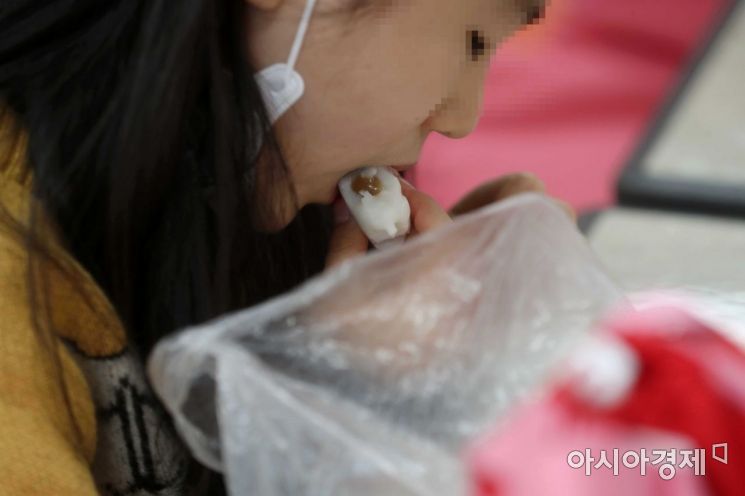 On the 2nd, non-regular school workers responsible for meal services and childcare, who have entered their second general strike demanding better treatment, are seen at Ahyeon Elementary School in Mapo-gu, Seoul, where students are eating bread, rice cakes, and juice prepared as substitute meals. Photo by Moon Honam munonam@
On November 19, the Ministry of Education and the 17 metropolitan and provincial offices of education announced that they had set up situation rooms to respond promptly to emergencies in preparation for the general strike announced by the National School Irregular Workers' Solidarity Council (composed of three union federations: the Korean Confederation of Trade Unions National School Irregular Workers' Union, the Korean Public Service and Transport Workers' Union National Education Public Workers' Headquarters, and the Korean Women's Union).
The education authorities have been conducting collective wage negotiations with the National School Irregular Workers' Solidarity Council since August, but failed to narrow their differences, resulting in the breakdown of talks. While the council demanded wage increases and improved welfare benefits, the authorities stated that budget constraints made it difficult to accept these demands.
As a result, the council has announced a total of four relay strikes scheduled for November 20, November 21, December 4, and December 5. The strike will take place in Seoul, Incheon, Gangwon, North Chungcheong, and Sejong on November 20; in Gwangju, South Jeolla, North Jeolla, and Jeju on November 21; in Gyeonggi, Daejeon, and South Chungcheong on December 4; and in South Gyeongsang, North Gyeongsang, Daegu, Busan, and Ulsan on December 5. As a result, disruptions to care and meal services are expected to be unavoidable.
The Ministry of Education and the metropolitan and provincial offices of education plan to respond to meal service disruptions by providing substitute meals at each school, address care service gaps by operating substitute programs, and implement measures for special education such as shortened classes.
Minister of Education Choi Gyojin stated, "While we respect the unions' right to collective action, we hope that a reasonable agreement can be reached quickly through labor-management consultations to protect students' educational activities and health and to prevent inconvenience for parents," adding, "We ask for thorough efforts to ensure stable school operations."
© The Asia Business Daily(www.asiae.co.kr). All rights reserved.
![Clutching a Stolen Dior Bag, Saying "I Hate Being Poor but Real"... The Grotesque Con of a "Human Knockoff" [Slate]](https://cwcontent.asiae.co.kr/asiaresize/183/2026021902243444107_1771435474.jpg)
















