"Memory Prices Expected to Continue Rising with AI Growth"
It has been analyzed that Samsung Electronics reclaimed the top position in the global DRAM market by sales in the third quarter of this year.
According to the market research firm China Flash Market (CFM) on November 19, Samsung Electronics' DRAM sales revenue for the third quarter of this year recorded $13.942 billion, an increase of 29.6% compared to the previous quarter. Its market share expanded to 34.8%, allowing the company to regain the number one spot by sales. CFM analyzed, "In the third quarter, Samsung Electronics' high bandwidth memory (HBM) bit shipments increased by 85% compared to the previous quarter, and the company achieved record sales thanks to the rise in general-purpose DRAM prices."
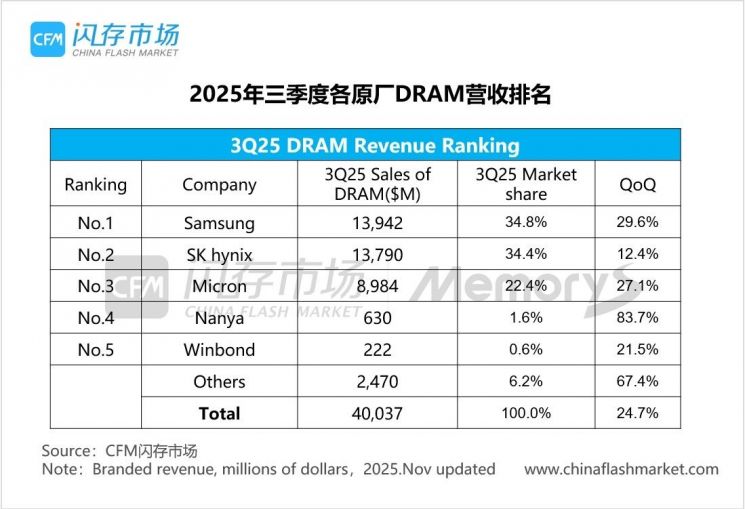 According to the market research firm China Flash Market (CFM), Samsung Electronics' DRAM sales revenue for the third quarter of this year reached 13.942 billion dollars, an increase of 29.6% compared to the previous quarter. CFM
During the same period, SK Hynix recorded DRAM sales of $13.79 billion, ranking second with a market share of 34.4%. Micron ranked third with sales of $8.984 billion and a market share of 22.4%.
Samsung Electronics had previously lost its top position in the global DRAM market to SK Hynix this year due to sluggish HBM performance. However, the company has recently regained its leadership thanks to the recovery of its HBM business and the overall increase in memory prices. The total DRAM market size in the third quarter of this year reached $40.037 billion, growing by 24.7% compared to the previous quarter.
Samsung Electronics also ranked first in the global NAND market by recording sales of $5.366 billion and a market share of 29.1%. SK Hynix followed with $3.536 billion (19.2%), Kioxia with $2.046 billion (16.5%), Western Digital with $2.308 billion (12.5%), and Micron with $2.252 billion (12.2%).
The total memory market size in the third quarter of this year reached an all-time high of $58.459 billion. CFM analyzed, "As artificial intelligence (AI) shifts from the training phase to the inference phase and major cloud service providers continue to invest, demand for AI data center memory is surging." "There is a significant shortage of memory supply across all sectors, and suppliers' inventories are also declining, leading to an overall increase in prices," the firm added.
© The Asia Business Daily(www.asiae.co.kr). All rights reserved.

















