Some Suspect CG Due to Ceiling Lights and Other Factors
UBTECH: "The Video Is Real, High Quality Led to Misunderstanding"
A video showing "hundreds of humanoid robots moving simultaneously," released by a Chinese robotics company, is drawing significant attention. In the wake of the video's release, some have raised suspicions of computer graphics (CG) manipulation, as the robots' movements and appearance seem almost flawless. On November 14 (local time), British media outlet The Sun reported that Chinese company UBTECH Robotics released a video of the mass shipment of its second-generation model, the Walker S2, sparking widespread debate over the video's authenticity.
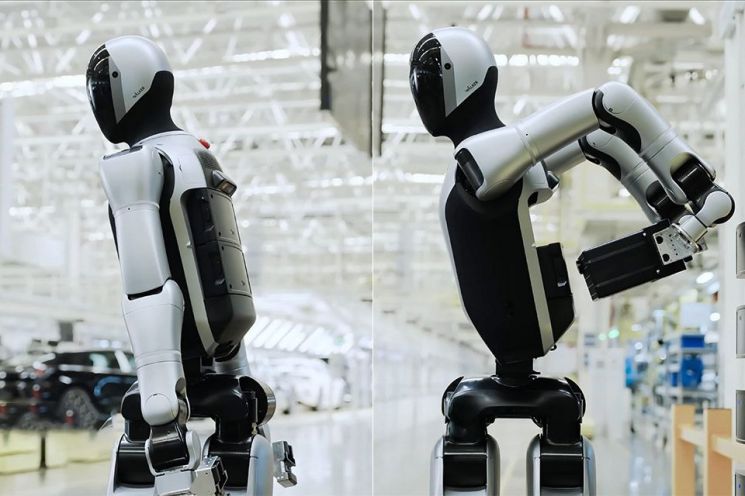 Eun is the second-generation model 'Walker S2' introduced by Chinese company UBTECH Robotics. YouTube channel 'UBTECH Robotics'
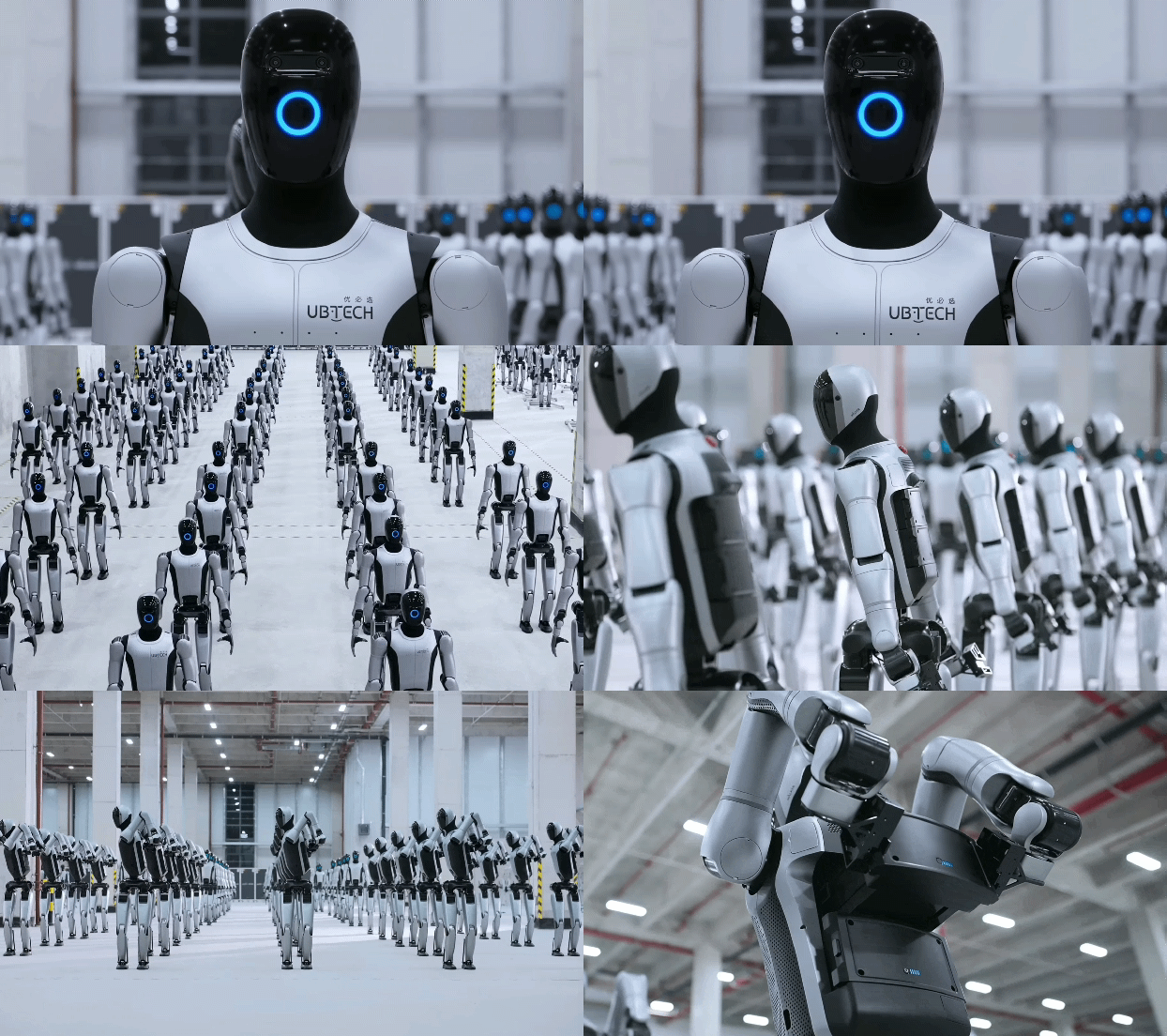
The video shows robots arranged in precise formation across a large space, marching in unison toward a container. The footage also depicts robots autonomously swapping their batteries and squatting down and standing up at the same speed. Some have interpreted this as the beginning of the "era of mass production." However, as soon as the video was released, suspicions of CG manipulation began to circulate. AI robotics expert Brett Adcock analyzed, "There is a clear difference in light reflections between the robots in the front row and those in the back," adding, "It appears that only some of the robots at the front were actually filmed, while most seem to have been composited using CGI."
He specifically pointed out that the overly uniform ceiling lights reflected on the robots' heads and the sudden blurring of details in the robots at the back are "common features of CG videos." As the controversy grew, UBTECH strongly refuted the allegations, stating, "There was no manipulation involved." The company released additional on-site photos showing employees alongside the Walker S2, emphasizing, "The robots are so well-made that they may appear computer-generated, but these scenes are real."
UBTECH explained that the Walker S2 has already secured orders worth approximately 160 billion won, with additional contracts underway. The company also stated that mass shipments are progressing faster than originally planned and that it is continuously expanding its production lines. Since being listed on the Hong Kong Stock Exchange this year, UBTECH's stock price has risen by more than 150 percent. This is seen as a reflection of investor sentiment that the era of robotics is truly beginning.
62.5% of Companies Name China as Top Export Competitor This Year
As China's robotics industry rapidly advances, there are growing predictions that, following steel and displays, South Korea's top ten export industries-including semiconductors, electrical and electronic products, and shipbuilding-will all lag behind China in competitiveness within five years. This is because it is increasingly difficult for domestic companies to keep up with the relentless progress of Chinese manufacturers, who leverage cost competitiveness and production innovation. Some analysts even warn that the brand value of Korean companies and products, long symbolized by the letter "K," could be overtaken by China within a few years, making it crucial for Korea to maintain its technological and manufacturing edge as China quickly narrows the gap.
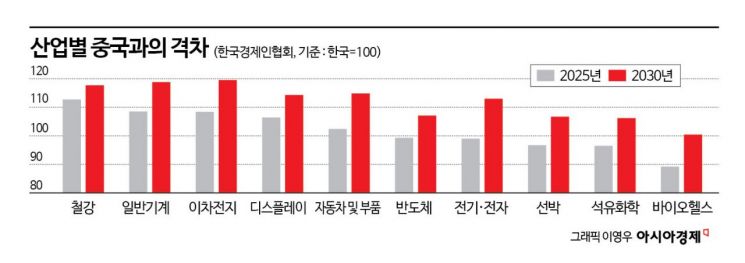
Additionally, there are views that the decisions by major groups such as Samsung and SK to invest hundreds of trillions of won in strengthening next-generation production capabilities-including semiconductors, artificial intelligence (AI), and robotics-will help secure a significant lead over China. According to a "Competitiveness Status and Outlook for Korea, the US, Japan, and China" survey conducted by the Federation of Korean Industries on the top 1,000 companies by revenue in Korea's main export industries (with responses from 200 companies) on November 17, China is already ahead in five sectors: steel, general machinery, secondary batteries, displays, and automobiles and parts. While Korea currently holds an advantage in semiconductors, electrical and electronic products, shipbuilding, petrochemicals, bio, and health, many expect China to surpass Korea in these industries by 2030. The ten key export industries surveyed were selected based on export and import trends from the Ministry of Trade, Industry and Energy.
This survey was conducted to gauge the level of competition that Korean companies actually feel, amid growing awareness of intensifying competition with Chinese firms in the global market. Among responding companies, 62.5 percent identified China as their top export competitor this year. The proportion naming China as the main competitor in 2030 rose to 68.5 percent. When asked to rate the competitiveness of each country, assuming Korea is at '100,' responses for this year were: the United States at 107.2, China at 102.2, and Japan at 93.5. For 2030, the projections were: the United States at 112.9, China at 112.3, and Japan at 95.0.
© The Asia Business Daily(www.asiae.co.kr). All rights reserved.



















