Takaichi Signals Large-Scale Economic Stimulus
"Monetary Easing Policies of the Abe Era Unlikely"
Japan's large-scale economic stimulus package under the Takaichi Cabinet may exert additional short-term downward pressure on the yen, but securities industry experts predict that the likelihood of a 'super-yen depreciation' recurring is low.
On November 18, Park Sanghyun, a researcher at iM Securities, stated, "If the super-yen depreciation phenomenon does not recur, the impact on the won-dollar exchange rate will be limited."
"Short-term Additional Downward Pressure on Yen... Super-Yen Depreciation Unlikely"
Currently, Japan is reportedly coordinating an economic stimulus package worth 17 trillion yen (about 160 trillion won), which includes increased winter electricity and gas bill subsidies, the abolition of the provisional gasoline tax rate, and the distribution of rice vouchers. Some projections suggest the stimulus could approach 20 trillion yen.
A stimulus package in the range of 17 trillion to 20 trillion yen amounts to 2.8% to 3.3% of Japan's gross domestic product (GDP), and to fund this, the Japanese government is discussing an additional supplementary budget of 14 trillion yen. This is the largest scale since 2013, during the Abe Cabinet.
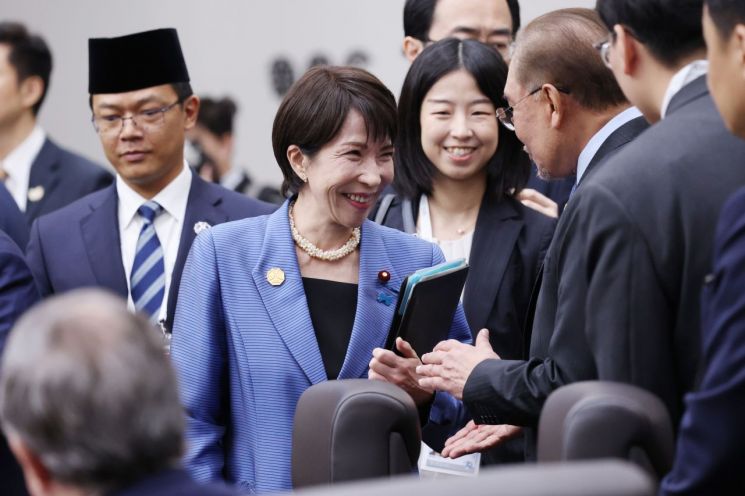 Sanae Takaichi, Prime Minister of Japan, is seen conversing with Anwar Ibrahim, Prime Minister of Malaysia, during the second session of the 2025 Asia-Pacific Economic Cooperation (APEC) Summit held at the Gyeongju HICO Convention Center on the 1st. Photo by Yonhap News
Regarding this, Park commented, "The large-scale supplementary budget, including the stimulus package, may act as additional short-term downward pressure on the yen, but the likelihood of a super-yen depreciation recurring is low." He explained, "The reason for the heightened short-term downward pressure on the yen is the expansion of fiscal burdens."
He also mentioned the possibility of an increase in government bond issuance to finance the large-scale supplementary budget. While Japan's fiscal deficit and government debt had been shrinking recently, a large supplementary budget is expected to increase the fiscal deficit burden. In fact, Japan's 30-year government bond yield is nearing an all-time high, and on the 17th, the 10-year bond yield rose to 1.73% during the session, marking the highest level since 2008.
Park added, "However, as previously mentioned, it is uncertain whether the large-scale supplementary budget and other stimulus measures will lead to a super-yen depreciation," citing that "it is difficult to expect monetary easing policies as in the Abe Cabinet era." He continued, "While the timing of the Bank of Japan's next rate hike may be delayed, it is difficult to expect liquidity expansion policies alongside fiscal expansion as before. The Bank of Japan is shifting to tightening, including reducing its asset holdings."
Limited Impact on Won-Dollar Exchange Rate
He analyzed, "Considering the levels of inflation and interest rates, it is difficult to pursue additional fiscal expansion policies," adding, "Japan has already entered an inflationary phase, and government bond yields have risen significantly."
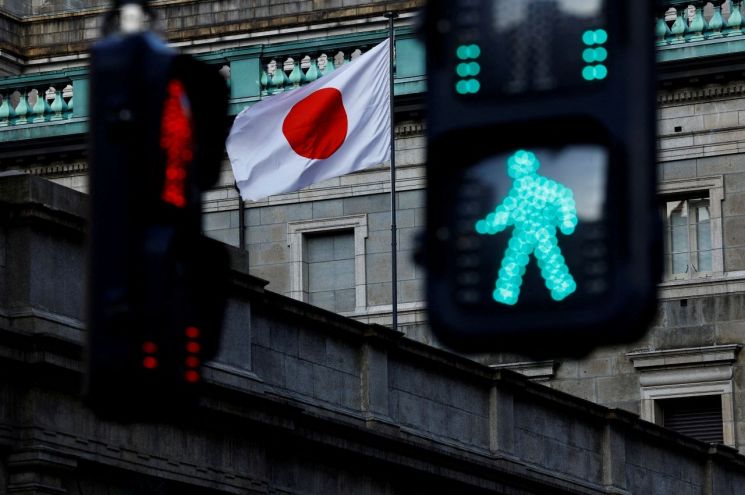 The traffic light in front of the Bank of Japan in Tokyo, Japan, is turning green. Photo by Reuters Yonhap News
As the trend of synchronization between the won and the yen continues, the large-scale stimulus package is expected to have an indirect impact on the value of the won through the yen. Park said, "The additional weakness of the yen following the stimulus package will act as a factor for further weakness in the won," and projected, "Although the won-dollar exchange rate has paused for now at 1,470 won due to government intervention, volatility could increase depending on external variables."
He added, "However, as the end of the year approaches, the uncertainty surrounding the US Federal Reserve's interest rate policy is likely to ease, and the yen's weakness triggered by the Takaichi Cabinet may also subside. The won-dollar exchange rate is expected to converge toward the 1,400 won level."
© The Asia Business Daily(www.asiae.co.kr). All rights reserved.
![Clutching a Stolen Dior Bag, Saying "I Hate Being Poor but Real"... The Grotesque Con of a "Human Knockoff" [Slate]](https://cwcontent.asiae.co.kr/asiaresize/183/2026021902243444107_1771435474.jpg)

















