Enforcement Remains Inconsistent, Reporting Rate at 12%
Danger Zones Found Throughout the City
A street in Jangsa-dong, Jongno-gu, Seoul. Fire hydrants are installed on every street, but vehicles are parked or stopped around them. Kim Yongbeom, a 36-year-old office worker, said, "Every time I pass by here, I see the area filled with illegally parked vehicles. Perhaps people have no other choice because there is nowhere else to park, but I worry that if a fire were to break out, it could cause problems for firefighting efforts."
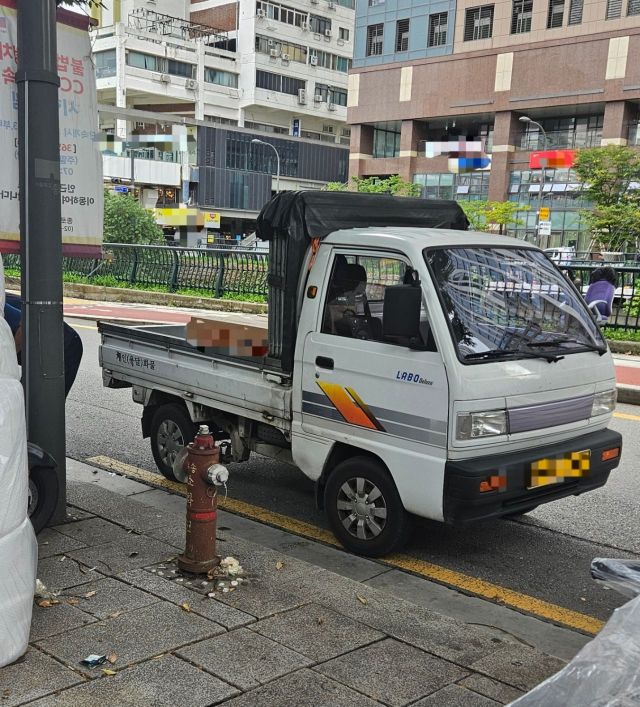 A vehicle is illegally parked in front of the fire water facility in Jangsa-dong, Jongno-gu, Seoul. Photo by Seungwook Park
The situation was the same along the main road in Nogosan-dong, Mapo-gu. Vehicles ranging from moving trucks to delivery vans were stopped near the fire hydrants. In particular, because of cars parked right next to the hydrant, it seemed that firefighters would have difficulty even approaching with hoses in the event of a fire.
With illegal parking continuing around fire water facilities, which are critical for firefighting, public safety is being put at risk. Experts point out that, in a situation where both reporting and enforcement are difficult, awareness of the dangers of illegal parking needs to be raised.
According to the Fire and Disaster Headquarters on November 30, the total number of illegal parking enforcement cases around fire water facilities in Seoul from 2022 to August this year was 1,361. By district, Jongno-gu had 95 cases, Mapo-gu 75, Seongdong-gu 72, and Gangdong-gu 71, among others.
According to the Road Traffic Act, parking or stopping a vehicle within 5 meters of a fire water facility is strictly prohibited. Violators are fined 40,000 won for passenger cars and 50,000 won for vans. If there is a safety sign near the fire water facility, the fine increases to 80,000 won for passenger cars and 90,000 won for vans. Fire water facilities refer to installations such as hydrants, water supply towers, and reservoirs that supply or store water needed for firefighting operations.
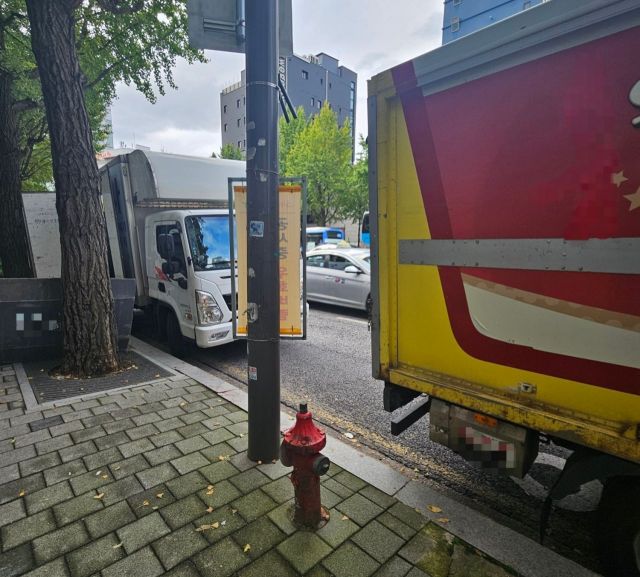 Two vehicles are illegally parked near the fire water facility along the main road in Nogosan-dong, Mapo-gu, Seoul. Photo by Seungwook Park
The main issue is that most enforcement relies on on-site crackdowns. Of the 1,361 enforcement cases, 1,187 (87.2%) were on-site, while only 174 cases (12.8%) were reported by citizens through the National Sinmungo online portal.
It is difficult for firefighting personnel, who must frequently respond to emergencies, to also take full responsibility for enforcement. As a result, the number of enforcement cases fluctuates each year: 559 in 2022, 293 in 2023, 382 last year, and 127 from January to August this year.
Increasing the reporting rate is necessary to solve the manpower issue, but this is also challenging. While illegal parking in general is often reported due to inconvenience such as business obstruction or infringement of designated parking spaces, reports are low around fire water facilities due to a lack of public awareness.
Lee Youngjoo, a professor in the Department of Fire and Disaster Protection at the University of Seoul, said, "People should always keep in mind that fires can occur at any time, and we need to increase public awareness about the issue of illegal parking around fire water facilities through more promotional activities. Based on this, we can raise the reporting rate, and the fire department should also utilize volunteer organizations such as the volunteer fire brigade and autonomous disaster prevention teams to increase on-site enforcement and guidance."
© The Asia Business Daily(www.asiae.co.kr). All rights reserved.


















