13 Drug Seizures in Less Than Two Months
Silver Packages Marked with the Chinese Character for "Tea"
Drugs disguised in tea bags have once again been discovered along the coast of Jeju Island. In less than two months since the end of September, there have already been 13 cases of drug seizures.
According to the Jeju Provincial Police Agency on November 17, at around 4:30 p.m. the previous day, a silver package with the Chinese character for tea (茶) written on it was found along the coast of Seongsan-eup, Seogwipo City, Jeju.
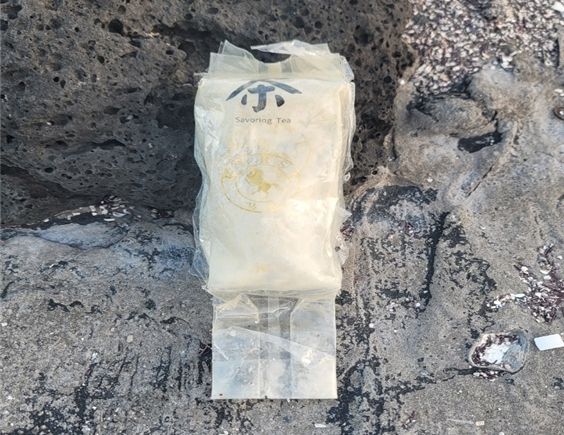 Packaged drugs were found in Chabongji, along the coast of Seongsan-eup, Seogwipo City, Jeju. Jeju Police Agency.
A police officer from the Jeju Coast Guard suspected the object was a drug disguised as something else and collected it. A preliminary reagent test confirmed that it was 1 kilogram of ketamine.
With this latest case, a total of 13 instances of drugs disguised in tea bags have been discovered since the end of September in various locations, including Jeju Port, Aewol-eup, Jocheon-eup, Gujwa-eup, Yongdam Port, and Udo coast in Jeju City, as well as Gwangchigi Beach in Seongsan-eup, Seogwipo City. All the substances tested positive for ketamine in preliminary tests, with the total amount found reaching 32 kilograms. Based on a standard single dose of 0.03 grams, this is enough for approximately 1.07 million people to use at the same time.
Ketamine is a type of anesthetic. When inhaled in large quantities, it can cause hallucinations and memory impairment, which is why it is classified as a new type of drug.
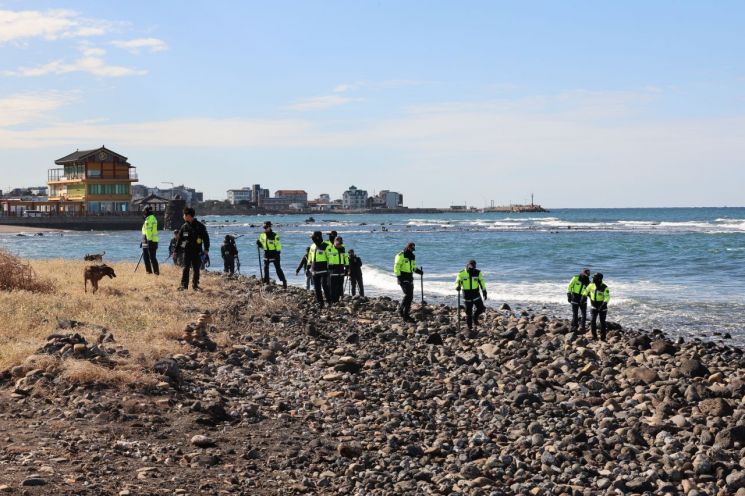
The police and coast guard are focusing their investigation on the hypothesis that the drugs drifted in from Southeast Asia, carried by the Kuroshio Current.
The tea bag drugs discovered in Jeju have also recently been found three times in Pohang and twice on Tsushima Island, Japan. The coast guard believes, based on the packaging with the Chinese character for tea (茶), that the drugs were distributed within Chinese character-using cultural regions. On the morning of November 17, seven related agencies-including the coast guard, police, Marine Corps 9th Brigade, customs, and the Jeju Provincial Police Agency-deployed over 420 personnel to conduct an intensive search, focusing on the northern coast of Jeju where the drugs have mainly been found.
© The Asia Business Daily(www.asiae.co.kr). All rights reserved.
![Clutching a Stolen Dior Bag, Saying "I Hate Being Poor but Real"... The Grotesque Con of a "Human Knockoff" [Slate]](https://cwcontent.asiae.co.kr/asiaresize/183/2026021902243444107_1771435474.jpg)

















