Increase of 127.7 Billion Won, Up 7.53% from Previous Year's Original Budget
Yangsan City in South Gyeongsang Province is preparing for a new leap forward by confirming its 2026 budget at a record-high 1.8241 trillion won, the largest in the city's history.
Yangsan City formulated its 2026 budget proposal and submitted it to the Yangsan City Council on November 14.
The total budget is set at 1.8241 trillion won, an increase of 127.7 billion won (7.53%) compared to this year's original budget. By accounting classification, the general account stands at 1.6508 trillion won, up 123.9 billion won (8.11%) from the previous year, while the special account is 173.3 billion won, up 3.8 billion won (2.25%).
For the 2026 revenue budget, despite ongoing delays in the real estate market recovery and sluggish domestic demand, the city partially reflected increases in certain tax items, setting local tax revenue at 330.3 billion won, an increase of 9.1 billion won (2.83%).
On the other hand, non-tax revenue was set at 148.4 billion won, a decrease of 41.1 billion won (21.69%). The city also allocated 317.9 billion won in local allocation tax (up 21.9 billion won), 86.9 billion won in adjustment grants (up 5.6 billion won), and 704.9 billion won in national and provincial subsidies (up 37.1 billion won).
While reflecting the city's fiscal conditions, Yangsan City distributed its budget evenly to ensure the stable implementation of policies across all sectors-focusing on the recovery of the local economy, balanced regional development, welfare, culture, environment, and urban development.
By sector, the social welfare budget is 656.6 billion won, an increase of 47.3 billion won from the previous year, accounting for 35.99% of the total budget. This is followed by 283.2 billion won for the environment sector (15.52%), 253.8 billion won for transportation and logistics (13.91%), 103.1 billion won for general public administration (5.65%), 85.4 billion won for culture and tourism (4.68%), 77.3 billion won for agriculture, forestry, maritime, and fisheries (4.24%), 68.6 billion won for land and regional development (3.76%), and 34 billion won for industry, small and medium enterprises, and energy (1.86%).
Among these, the culture and tourism sector saw the largest increase (up 20.9 billion won), attributed to various policies and major cultural facility construction projects being launched in celebration of the city's 30th anniversary and the Year of Visiting Yangsan in 2026.
Investments in key projects in the eastern Yangsan area are also noteworthy. The city will actively invest in ongoing projects such as the Jujin Light Park, the widening of the Hoeya Riverside Road and creation of cultural spaces, and the construction of the arboretum.
The city boldly allocated funds for large-scale road expansion projects, including the opening of the city planning road between National Road No. 7 and the Myeonggok Interchange (Line D3-10), and between Soju National Rental Housing and Junam Shinwon Achim City Apartments (Line G3-3). In addition, 600 million won was allocated for the construction of the Eastern Yangsan Youth Culture Center, focusing on achieving balanced development among regions and sectors.
Looking at the main projects by sector, the social welfare sector includes: ▲ Basic Pension at 185.6 billion won ▲ Livelihood and housing benefits for National Basic Livelihood Security recipients at 98.1 billion won ▲ Childcare fees for infants and toddlers at 38.1 billion won ▲ Disability activity support benefits at 33.6 billion won ▲ Child allowance at 27.4 billion won ▲ Senior job creation and social activity support projects at 26 billion won ▲ Parental allowance at 25.9 billion won, among others.
For the environment sector: ▲ Installation of fall prevention facilities in key management areas at 16.4 billion won ▲ Subsidies for electric vehicle and truck purchases at 8.1 billion won ▲ Installation of stormwater runoff reduction facilities in the Soto District at 7 billion won ▲ Nonpoint source pollution reduction project (Bukjeong Rainwater Pump Station) at 6.3 billion won ▲ Emission reduction project for operating diesel vehicles at 4 billion won ▲ Hydrogen fuel cell vehicle distribution project at 2.6 billion won, all aimed at improving the living environment and expanding eco-friendly vehicle adoption as part of a green city strategy.
In the transportation and logistics sector: ▲ Construction and operation of the Yangsan Urban Railway at 98.8 billion won ▲ Fuel subsidies for the transportation industry at 45 billion won ▲ City planning road construction between National Road No. 7 and Myeonggok Interchange (Line D3-10) at 8.8 billion won, and a total of 21.4 billion won for city planning road construction ▲ Baekho Village public parking lot construction at 14.2 billion won ▲ Nam-Mulgum Hi-Pass IC installation project at 2.7 billion won ▲ Expansion of the New Town-Industrial Complex access road (Line D3-1) at 2.7 billion won, investing in the diversification of transportation means and continuous expansion of infrastructure.
For culture and tourism: ▲ Construction of the Sasong Community Sports Center and public library at 9.4 billion won ▲ Nakdong Sunset Bike Park project at 6.9 billion won ▲ Construction of the Tongdosa Cultural Space at 6 billion won ▲ Restoration of the main hall at Yangsan Sinheungsa Temple at 2.3 billion won ▲ Remodeling of the main stadium restroom at the General Sports Complex at 1.8 billion won ▲ Samjangsu Village tourism resource development project at 1.8 billion won ▲ National Heritage Media Art project at 1.4 billion won ▲ Yangsan Eoullimgil Trail Courses 3 and 5 at 700 million won, focusing on expanding cultural infrastructure and enhancing citizens’ access to culture in daily life.
In agriculture, forestry, maritime, and fisheries: ▲ School meal support at 14.5 billion won ▲ Improvement of natural disaster risk area in Gachon 6 at 5.4 billion won ▲ Smart education center for farmers at 3.3 billion won ▲ Construction of Yangsan Arboretum at 3 billion won ▲ Hwangsan Local Garden at 1.7 billion won, with a long-term plan to register Hwangsan Park, Yangsan's landmark, as a national garden.
For land and regional development: ▲ Jujin Light Park construction project at 10 billion won ▲ Hoeya Riverside Road widening and cultural-historical space creation at 5 billion won ▲ Mulgeum-eup Mulgeum District New Village project at 2.8 billion won ▲ Chunchu Park construction at 2 billion won.
In the industry, small and medium enterprises, and energy sector: ▲ Operation of the Yangsan Love Gift Certificate at 14.2 billion won ▲ Support for small businesses at 4.4 billion won ▲ Construction of a public rental knowledge industry center at 3.5 billion won ▲ Promotion of earthquake safety industry facilities at 1.4 billion won, aiming to vitalize the local economy and commercial districts, and establish a sustainable regional foundation through industrial development in various fields.
Additionally, the city allocated ▲ 10 billion won for the Sandbul District disaster risk improvement project ▲ 9 billion won for the Northern Natural Disaster Risk Improvement District project ▲ 5.7 billion won for the construction of Seokgeumsan Middle School multi-purpose facility, ensuring balanced budget allocation for disaster management, safety, and education.
Mayor Na Dongyeon stated, "The 2026 budget proposal is designed to efficiently utilize resources while continuously promoting essential projects and boldly investing in key initiatives that improve citizens’ quality of life. We have strived to ensure a balanced budget so that no region or group is left behind."
He added, "2026 marks the 30th anniversary of Yangsan’s elevation to city status, making it a crucial period for a new leap forward. We will do our utmost to implement projects that make Yangsan a happier and prouder city for its citizens."
The 2026 budget proposal will be finalized in mid-December after review at the second regular session of the Yangsan City Council, which begins on November 25.
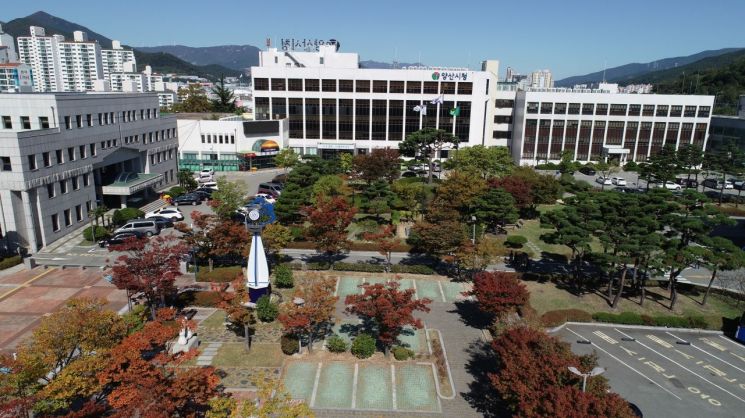 Yangsan City Hall.
© The Asia Business Daily(www.asiae.co.kr). All rights reserved.
![User Who Sold Erroneously Deposited Bitcoins to Repay Debt and Fund Entertainment... What Did the Supreme Court Decide in 2021? [Legal Issue Check]](https://cwcontent.asiae.co.kr/asiaresize/183/2026020910431234020_1770601391.png)














