Subtle Price Hike Tactics: "Sneakflation"
Free Services Like Wi-Fi Now Come With a Fee
Hard for Consumers to Notice Right Away
In the United States, the spread of companies’ subtle price increase strategies has led to growing consumer warnings about so-called “sneakflation.” This refers to tactics that increase consumer costs in inconspicuous ways-such as switching to cheaper ingredients or reducing services and benefits-without directly raising product prices.
"Sneakflation Driven by Inflation and Tariffs"
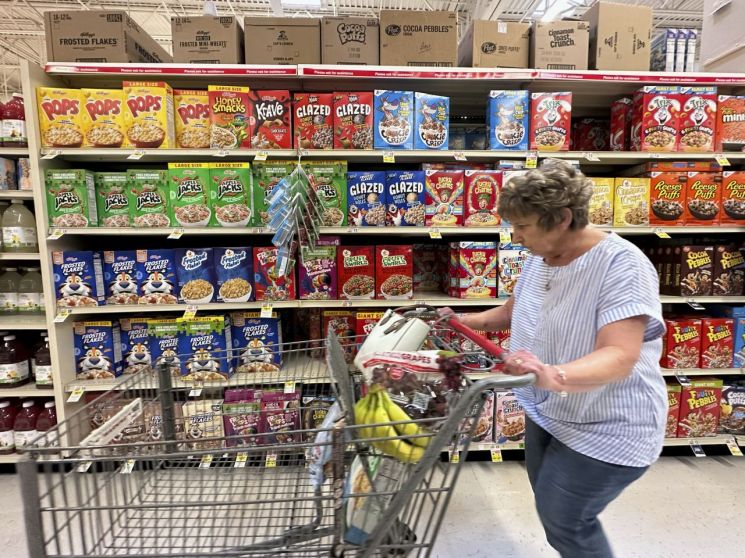 A woman is shopping at a supermarket in Springfield, Pennsylvania, USA, last July. Photo by AP Yonhap News
According to a recent report by the Washington Times, sneakflation is rapidly spreading, particularly in the airline, hotel, food, and streaming industries. The term “sneakflation”-a combination of “sneak” and “inflation”-describes a method where companies quietly shift the burden to consumers by reducing services or benefits. Consumer expert Alexander Keter explained, “Sneakflation is a phenomenon where everyday value is eroded,” adding, “It is generally a strategy chosen by companies during tough economic conditions.”
For example, airlines have begun charging for seat selection, which was once free, and hotels are now imposing fees for amenities like Wi-Fi and pool access. Services that consumers once took for granted are increasingly being offered only for an extra charge. As basic services are reclassified as “add-ons,” consumers are experiencing a higher perceived cost.
Matthew A. Gilbert, a marketing professor at Coastal Carolina University, stated, “High inflation and new tariffs have prompted companies to hide price increases in creative ways,” adding, “Consumers are now starting to recognize these practices in earnest.” He also noted, “As these examples are easily shared on social media, what was once a quiet trend has now become a visible problem.”
The Washington Times reported that in recent years, there has been a rise in sneakflation cases, such as new fees for hotel amenities and the addition of ads to streaming services. The outlet pointed out, “Some airlines are ending their policy of providing one free checked bag,” and “Amazon Prime Video has started inserting ads without lowering its prices.” This trend is attributed to rising labor, transportation, and raw material costs, as well as tariff policies under President Donald Trump, all of which have increased companies’ operating expenses. As a result, companies are quietly passing these costs on to consumers.
Difference from 'Shrinkflation,' Which Reduces Product Size
Sneakflation is often confused with the concept of “shrinkflation.” While both lead to the effect of higher prices, there are differences in how companies shift costs to consumers.
Shrinkflation involves reducing the size or quantity of a product while keeping the price the same. For example, the amount of snacks or the volume of a beverage may decrease, but the price remains unchanged. Since the physical quantity is reduced, consumers perceive a lower value for money, making this a relatively direct and straightforward form of price increase.
In contrast, sneakflation keeps the product quantity the same but lowers value in less visible ways or introduces new costs. This includes using lower-quality ingredients, converting previously free services to paid ones, or adding extra fees. Because sneakflation involves adjusting less visible aspects like product quality, it is considered a more subtle and sophisticated strategy than shrinkflation.
"Tariff Burdens Passed on to Consumers Unnoticed"
Covert price increase strategies like sneakflation are expected to become even more widespread in the future. Back in August, CNN ran an article titled “Sneakflation: Trump Tariffs Are Gradually Increasing Costs for American Consumers,” reporting that “sneakflation caused by tariffs is progressing slowly.”
Heather Long, Chief Economist at Navy Federal Credit Union (NFCU), said in an interview with CNN, “Retailers and major brands are well aware that many Americans live paycheck to paycheck,” adding, “That’s why they break up the burden of tariffs into small increments and reflect them in prices, using sneakflation so that consumers do not immediately notice.”
© The Asia Business Daily(www.asiae.co.kr). All rights reserved.


















