Distribution Law Amendment Passes National Assembly on the 13th
Third Extension Cited as Protection for Traditional Markets and Small Businesses
SSM Franchise Stores Account for 47%... Criticism Over Restricting Small Business Owners
Industry Questions Whether Extension Was Based on Thorough Evaluation
As the amendment to the Distribution Industry Development Act, which extends business regulations on hypermarkets and Super Supermarkets (SSMs) for another four years, passed the National Assembly plenary session, concerns have been raised that the irrational extension of regulations will further harm SSM franchisees.
According to the retail industry on November 14, the National Assembly passed a bill the previous day to extend the sunset clause (Article 48-2) on SSM regulations until 2029. An additional provision was also added, requiring a comprehensive analysis on the necessity of maintaining these regulations to be reported to the National Assembly at least three months before the law expires.
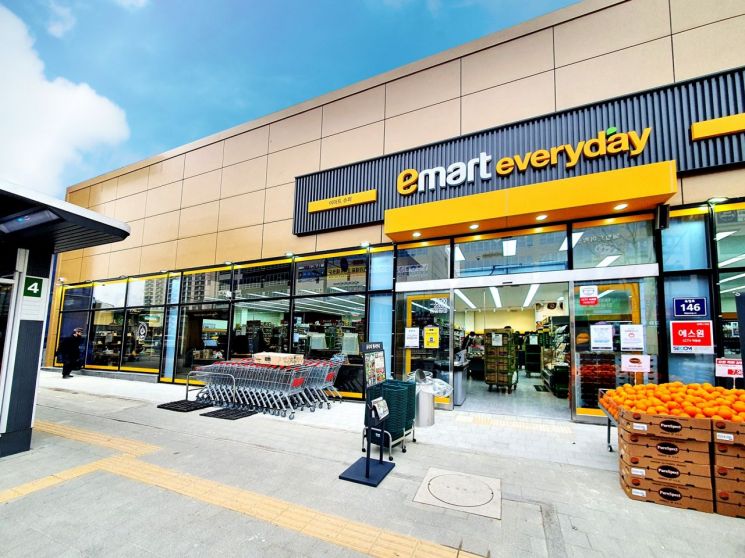
The law regulating SSMs was first introduced in 2010 and was extended for five years each in 2015 and 2020. This is the third extension. With this extension, hypermarkets and SSMs will continue to face restrictions on opening new stores within a one-kilometer radius of traditional markets and traditional shops. They will also remain subject to the same rules as hypermarkets, including restrictions on late-night operations and mandatory closures twice a month.
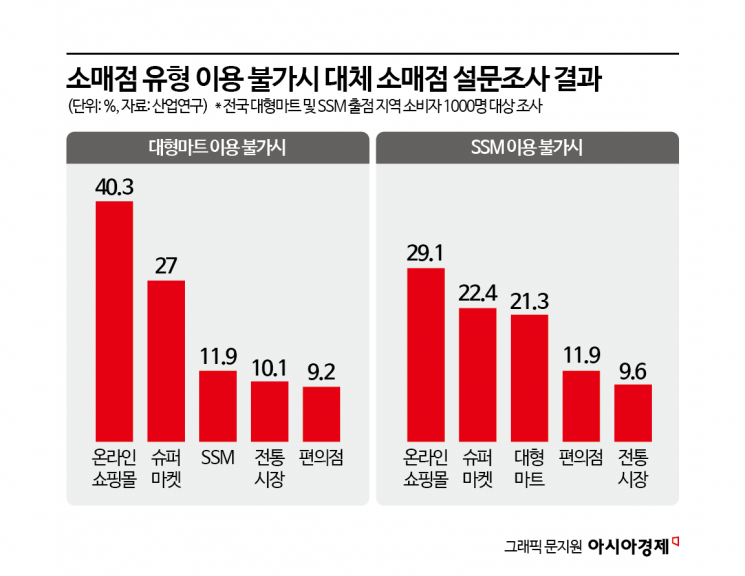
The main reason cited for the amendment is the need to further protect and support small- and medium-sized retailers, given that traditional market merchants and nearby small business owners are facing business crises due to the spread of online shopping malls and changes in domestic and global economic conditions.
However, the industry is concerned that the continued expansion of the online market will further shrink the offline market, making it even harder for nearby small business owners. Park Jungeun, a professor at Ewha Womans University School of Business, stated, "Hypermarkets serve as anchor tenants that help revitalize surrounding commercial districts, but with these regulations, small business owners are suffering alongside them," adding, "Online markets operate 24 hours a day, 365 days a year, so forcing offline stores to close is not only unfair but also incompatible with the principles of free market competition."
There is also criticism that the extension of the sunset clause is contradictory, as the proportion of SSM franchise stores is rapidly increasing, meaning the regulation now targets small business owners themselves. The business regulations for SSMs apply equally to both company-owned and franchise models. The proportion of SSM franchise stores operated by small business owners has reached 47%. Major operators such as GS The Fresh, Lotte Super, Emart Everyday, and Homeplus Express had 225 franchise stores in 2013, but this number increased to 668 last year. The number of company-owned stores decreased from 1,068 to 765.
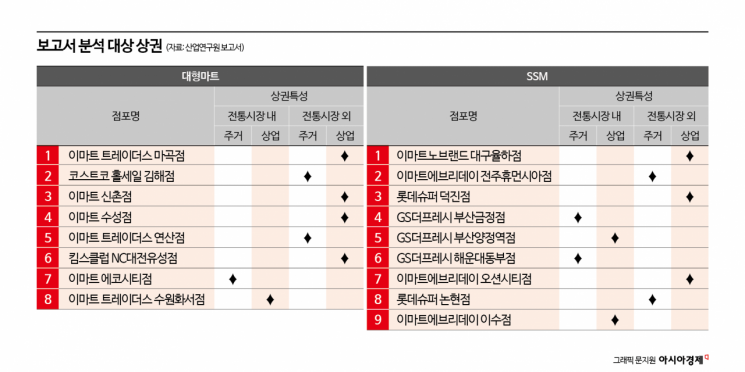
In particular, there are growing voices questioning the legitimacy of the legislation, as the Korea Institute for Industrial Economics and Trade's commissioned report-used as the basis for extending the sunset clause-was reportedly conducted in a hasty manner. The report, which analyzed the effects of business regulations on hypermarkets and SSMs, was carried out over a short period and targeted only a small number of stores, resulting in inconsistent conclusions and controversy. An industry insider criticized, "This decision completely disregards the changed retail ecosystem," and added, "The law should be extended or allowed to expire based on a thorough evaluation at the sunset point, but it was passed in the most convenient way without considering the current situation."
An expert, speaking on condition of anonymity, said, "The regulations should be improved to give struggling SSM franchisees and the offline market some breathing room, but it is unfortunate that this was not achieved. For SSM franchise operators, detailed legislation is needed to improve the regulations."
© The Asia Business Daily(www.asiae.co.kr). All rights reserved.
![A Woman Who Jumps Holding a Stolen Dior Bag... The Mind-Shaking, Bizarre Con of a "Human Knockoff" [Slate]](https://cwcontent.asiae.co.kr/asiaresize/183/2026021902243444107_1771435474.jpg)


















