Forum on "Seeking Solutions for Building a Local Healthcare Ecosystem"
Local Hospitals Trapped in a Vicious Cycle of Workforce, Facilities, and Finances
Need for Tailored Institutional Design and Targeted Support Reflecting Local Realities
The collapse of local healthcare is a structural issue stemming from policies centered on the Seoul metropolitan area and inadequate regional healthcare systems. Experts have suggested that it is necessary to move beyond the current healthcare policy framework based on national health insurance and establish a multi-layered regional healthcare system.
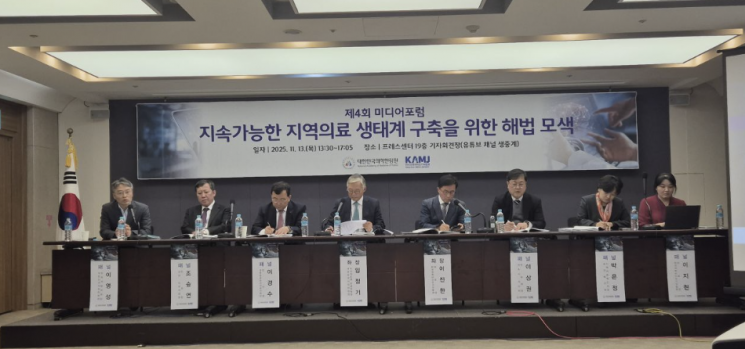 On the 13th, participants are engaged in a panel discussion at the forum titled "Seeking Solutions for Building a Sustainable Local Healthcare Ecosystem," held at the Korea Press Center in Jung-gu, Seoul. Photo by Korea Medical Biojournalists Association
The Korea Medical Biojournalists Association and the National Academy of Medicine of Korea held a media forum on November 13 at the Korea Press Center under the theme "Seeking Solutions for Building a Sustainable Local Healthcare Ecosystem," presenting policy directions focused on these issues.
Cho Huisook, Head of the Public Healthcare Support Group for Gangwon Special Self-Governing Province and Professor at the Department of Healthcare Management at Kangwon National University College of Medicine, stated, "Regional hospitals lack the capacity to provide final treatment for critically ill patients. Combined with a declining population, a fee-for-service system based on treatment volume, and the outflow of medical personnel from local areas, even if infrastructure is established, hospitals soon face management crises." She diagnosed, "As a result, there is a vicious cycle in which both patients and medical resources become concentrated in large hospitals in the Seoul metropolitan area." This leads to a situation where there are no patients in local hospitals, and for patients, there are no hospitals available.
Director Cho emphasized, "The collapse of local healthcare is not simply a matter of physician shortages, but a failure of the healthcare system itself." She pointed out, "It is a multi-layered and structural problem, caused by policies and insurance structures designed as a single nationwide framework during the period of rapid growth, a fee-for-service insurance model, development focused on the metropolitan area, and the expansion of large-scale transportation networks." She added, "In vulnerable areas that have been left to market forces within the national health insurance system and have withered as a result, targeted and intensive support is needed, beyond one-time project funding or simple fee increases. In the mid- to long-term, we must redesign the patient care system and provide integrated support for personnel, facilities, and finances to enhance local treatment capacity."
Woo Bongsik, former Director of the Korean Medical Association’s Medical Policy Research Institute, referenced regional healthcare policy cases from the United States, Japan, Germany, and the United Kingdom, urging, "We should recognize local healthcare issues not as sources of conflict, but as joint challenges for achieving a sustainable healthcare system, and advance the discussion toward multi-layered and balanced policy solutions."
Former Director Woo explained, "Advanced countries are implementing complex policy packages, including financial incentives, mandatory regional service, enhanced clinical education, utilization of non-physician personnel, and telemedicine." He assessed, "While the overall level of healthcare in Korea is high, there is a need to address regional disparities in healthcare and mortality rates from treatable conditions." He noted, "Simply expanding public medical schools and hospitals, as currently being discussed, is not sufficient. We need to design systems suitable for Korea’s circumstances, such as regional quota systems, support for patients traveling for treatment, and strengthening local training programs."
Park Euncheol, Vice President of the National Academy of Medicine of Korea and Professor at the Department of Preventive Medicine at Yonsei University College of Medicine, also argued, "Policies to nurture regional doctors through public medical schools cannot be a fundamental solution." While the establishment of public medical schools has been discussed as a way to address regional healthcare imbalances and essential medical service gaps, he pointed out that, compared to existing policies such as regional talent admissions, contract-based essential doctor programs, senior physician support projects, and the public health doctor system, this approach does not fare well in terms of cost, effectiveness, or timeliness.
Vice President Park asserted, "To restore local healthcare, we must first establish and intervene in medical service areas, improve patient transfer systems, strengthen the responsibility of regional tertiary hospitals for local healthcare, and utilize information and intelligent technologies."
Lee Youngseong, Chair of the Policy Development Committee at the National Academy of Medicine of Korea and Professor of Medical Informatics and Management at Chungbuk National University College of Medicine, remarked, "Rather than insisting on building hospitals or hiring doctors simply because there are no hospitals in a region, we need to precisely analyze the shortage of specific medical specialties or services at the local level and supply them in a tailored manner, down to the medium and small medical service areas."
Cho Seungyeon, former President of Seongnam and Incheon Medical Centers and Professor of Surgery at Yeongwol Medical Center, emphasized, "The most important factor in building a local healthcare ecosystem is strengthening public healthcare institutions and clarifying their cooperation and linkage systems." He stressed the need to expand the functions of regional responsibility medical institutions (national university hospitals) and local responsibility medical institutions (local medical centers), provide support for strengthening public healthcare governance, transfer national university hospitals to the Ministry of Health and Welfare, increase the number of faculty positions, and provide management support.
© The Asia Business Daily(www.asiae.co.kr). All rights reserved.

















