This phenomenon has intensified since 2008
Global trade is shaped by the dollar-based financial structure
Study: "The Financial Channel of the Exchange Rate and Global Trade"
A recent study has found that fluctuations in the value of the US dollar function not merely as an exchange rate issue that changes import and export prices, but as a financial mechanism that regulates the entire flow of global trade. When the dollar strengthens, companies in countries with significant dollar-denominated foreign debt face higher funding costs, leading them to raise export prices, which ultimately results in a decrease in export volumes. This is described as the operation of a "financial channel." The researchers interpret this as evidence that global trade is governed by a dollar-based financial structure, going beyond the traditional "Dominant Currency Pricing" theory, which holds that international trade prices are set in dollars.
This conclusion was presented in the paper "The Financial Channel of the Exchange Rate and Global Trade," published in June by Sai Ma and Tim Schmidt-Eisenlohr, researchers at the Federal Reserve Board, in The Review of Financial Studies, an academic journal from Oxford University Press.
Analyzing trade data from more than 40 countries between 1990 and 2018, the researchers found that when the value of the dollar rises, countries with a higher proportion of dollar-denominated debt see a greater increase in export prices and a sharper decline in export volumes. This phenomenon has become even more pronounced since the 2008 global financial crisis.

 Researchers Sai Ma (left) and Tim Schmidt-Eisenlohr (right) from the Federal Reserve Board of the United States. (Photo by Federal Reserve Board)
According to the study, the volatility of global trade in response to exchange rate fluctuations is driven by a chain reaction: "rising dollar value → increased external debt burden for corporations and financial institutions → contraction in trade finance → higher export prices and lower export volumes." While international trade transactions may appear to be simply a matter of product prices and exchange rates, in reality, trade finance-which provides the upfront capital needed for production, shipping, and transportation-is essential at the transaction stage. The issue is that a significant portion of this trade finance is borrowed in dollars. When exporters or the financial institutions that support them hold dollar-denominated debt, a stronger dollar translates directly into balance sheet risks.
According to the paper, the funding pressure faced by exporters is immediately reflected in both prices and volumes. Exporters are forced to pass on increased funding costs to prices or even reduce exports altogether. This suggests that exchange rate fluctuations do not merely adjust the terms of trade, but rather operate through a financial channel defined by the "availability of funding."
The researchers particularly emphasized that "the scale of dollar-denominated debt in exporting countries" is the key variable determining the trade shock from a stronger dollar. It is the "financial structure" of the exporting country, not that of the trading partner (importing country), that explains the impact of dollar fluctuations. This finding differs from the traditional Dominant Currency Paradigm, which attributes the shock to the use of the dollar as a settlement currency and its effect on importers. The study reveals that the core of the dollar shock is not "pricing in dollars," but rather "financial dependence on the dollar."
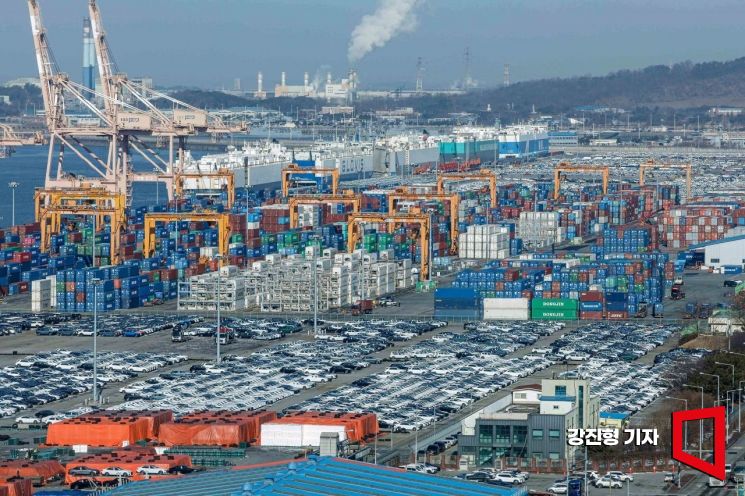 Following President Donald Trump’s signing of a proclamation imposing a 25% tariff without exceptions on steel and aluminum products imported into the United States, and his announcement that tariffs on automobiles and semiconductors are also under consideration, export vehicles are awaiting shipment at Pyeongtaek Port, Gyeonggi Province on February 13, 2025. Photo by Kang Jinhyung
The study also highlights that the movement of the dollar mediates the global financial environment as a whole. Dollar appreciation raises global funding costs, triggering credit tightening, especially in emerging markets. In this process, it is not simply that export prices rise; rather, the balance sheets of exporting countries' corporations and financial institutions deteriorate, reducing their capacity to supply credit. Consequently, a "chain contraction effect" occurs, shrinking trade itself.
To test the causal relationship between the value of the dollar and trade, the researchers used the number of housing permits issued in the United States as an "instrumental variable." Fluctuations in the US housing market affect the value of the dollar, but do not directly impact trade between third countries. Using this approach, the researchers found clear evidence that dollar appreciation significantly leads to higher export prices and lower export volumes.
Notably, the pace of global trade contraction during periods of dollar strength was steeper in exporting countries with higher dependence on dollar-denominated debt. This provides a valid explanation for the "export stagnation → increased debt burden → slower growth" vicious cycle observed in some emerging markets, resource-dependent countries, and parts of Latin America since the global financial crisis.
The researchers pointed out that the strengthening of this financial channel is likely to further solidify the dollar's role as the "central node of international finance" in the future. As long as the dollar-centric international financial structure persists, global trade is at a historical turning point where "the ability to secure dollar funding" outweighs price competitiveness. The researchers emphasized, "The dollar is no longer just a settlement currency, but now functions as a 'lever that regulates global trade.'"
© The Asia Business Daily(www.asiae.co.kr). All rights reserved.



















