Manufacturing and Construction Jobs Decline for 16?18 Consecutive Months
Employment Rate for Those Aged 60 and Over Rises to 48.1%, Up 0.7 Percentage Points
Youth Employment Rate Falls by 1.0 Percentage Point, Marking a Stark Contrast
The employment rate for those aged 60 and over reached an all-time high in October. This is attributed to the expansion of jobs for the elderly, mainly through government-funded projects and positions in the care and social welfare sectors. In contrast, the employment rate for young people (aged 15-29) continued to decline for the 18th consecutive month, the longest period since the global financial crisis. Analysts point to the sluggish conditions in industries such as manufacturing, where many young people are employed, as a key factor.

According to the "October 2025 Employment Trends" released by the National Data Office on November 12, last month’s employment rate for those aged 60 and over was 48.1%, up 0.7 percentage points from the same month last year. By age group, the number of employed people aged 60 and over increased by 334,000 year-on-year. The number of employed people aged 65 and over rose by 363,000, those aged 70 and over by 192,000, and those aged 75 and over by 75,000. The employment rate for people aged 60 and over has been steadily rising for ten consecutive months since January this year. In particular, in September, the employment rate for those in their 60s reached the highest level since statistics began being compiled in the first quarter of 2018. This is seen as the result of a combination of factors, including a growing population of people in their 60s and over, and an increasing number of elderly people working even after retirement age.
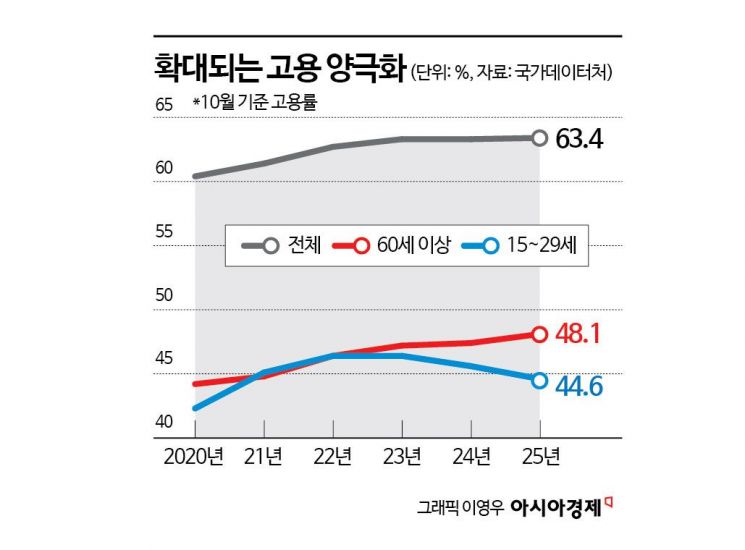
In contrast, youth employment continued to show weak performance. The decline in the youth employment rate, which began in May last year, persisted for 18 consecutive months through October this year. Last month, the number of employed young people decreased by 163,000, and the youth employment rate fell to 44.6%, down 1.0 percentage point from a year earlier.
The main reasons for the sluggish youth employment are cited as a decrease in jobs in manufacturing and construction, and a growing preference among companies for experienced workers. Last month, the number of people employed in manufacturing dropped by 51,000 (-1.2%), while construction jobs fell by 123,000 (-6.0%). Structural factors such as reduced construction investment, adjustments in the real estate market, and delayed recovery in manufacturing exports all played a role. Kong Misook, Director General of Social Statistics at the National Data Office, explained, "Hiring practices focused on experienced workers and rolling recruitment are working against young people," adding, "It is also due to poor business conditions in industries such as manufacturing, where many young people are employed."
The total number of employed people continues to increase. Last month, the number of employed people stood at 29.04 million, up 193,000 from a year earlier. The overall employment rate for those aged 15 and over also rose by 0.1 percentage point to 63.4%. The employment rate for the working-age population (aged 15-64) increased by 0.3 percentage point to 70.1%. By industry, the health and social welfare services sector saw an increase of 280,000 jobs, and the arts, sports, and leisure sector also added 70,000 jobs. Wholesale and retail trade recorded an increase for the second consecutive month, with 46,000 additional jobs. The health and social welfare sector, in particular, is an industry with a high proportion of jobs for the elderly, and the expansion of employment for older workers is seen as having driven growth in this sector.
 On October 13, the number of employed people increased by 83,000 compared to the same month last year, dropping below 100,000 for the first time in four months. A job seeker visiting an employment center in Seoul is looking at the recruitment board. Photo by Kang Jin-hyung
On the other hand, the number of people employed in agriculture, forestry, and fisheries decreased by 124,000, marking the seventh consecutive month of declines in the 100,000 range. Construction (-123,000) and manufacturing (-51,000) also continued their negative trends for 18 and 16 consecutive months, respectively. In the case of construction, the decline widened compared to the previous month (-84,000), due to heavy rainfall last month. In high value-added sectors such as professional, scientific, and technical services and information and communications, the number of employed people either decreased or stagnated.
There are also signs of concern on the labor supply side. Last month, the economically inactive population reached 16.121 million, up 38,000 from a year earlier. In particular, the number of people classified as "taking a break" was 2.58 million, an increase of 135,000 (5.5%). Among them, the number of people in their 30s "taking a break" reached a record high of 334,000 since statistics were first compiled. The number of young people "taking a break" was 409,000, down 9,000 from a year earlier, but this is attributed more to transitions such as "studying, preparing for exams, or seeking new jobs" rather than an increase in employment. Director Kong explained, "While employment among people in their 30s is not bad, it appears that economically inactive people who were previously engaged in childcare or housework have shifted to being classified as 'taking a break.'"
© The Asia Business Daily(www.asiae.co.kr). All rights reserved.

![Clutching a Stolen Dior Bag, Saying "I Hate Being Poor but Real"... The Grotesque Con of a "Human Knockoff" [Slate]](https://cwcontent.asiae.co.kr/asiaresize/183/2026021902243444107_1771435474.jpg)
















