Breaking Away from the Entrenched Seniority-Based System
Advocating a Shift to a Job and Performance-Based Structure
in Line with the Principle of "Equal Pay for Equal Work"
The business community has called for a reform of the seniority-based wage system in discussions over extending employment for workers, including the legal retirement age. While the Democratic Party of Korea has pledged to complete legislation to extend the retirement age to 65 by the end of the year, it has not taken a position regarding wages. In response, business leaders have insisted that wage issues must be addressed together.
They argue that, in line with the Lee Jaemyung administration's national policy of "equal pay for equal work," the wage system should be changed to reflect job responsibilities and performance, thereby laying the foundation for sustainable employment.
Lee Donggeun, Vice Chairman of the Korea Employers Federation, said on November 11, "Extending the retirement age must go hand in hand with labor market flexibility," adding, "We need to resolve rigidity in our labor market so that entry and exit from the job market become easier and wages can be adjusted according to job roles." He emphasized that the ongoing debate over extending the retirement age should also include a review of a performance-based wage system.
The business community believes that the current discussions on extending the retirement age present an opportunity to overhaul the seniority-based wage system that has been in place for over half a century. The seniority-based wage system originated from the pay grade system introduced in the 1950s to encourage long-term employment. This system, which effectively guaranteed lifetime employment, allowed companies to accumulate a skilled workforce over many years and served as a catalyst for rapid economic growth.
However, this has also made the labor market rigid. According to the National Assembly Futures Institute, the average wage of regular employees in South Korea with over 30 years of service is 2.95 times higher than that of employees with less than one year of service. This is a significant difference compared to Japan (2.27 times) and Germany (1.8 times).
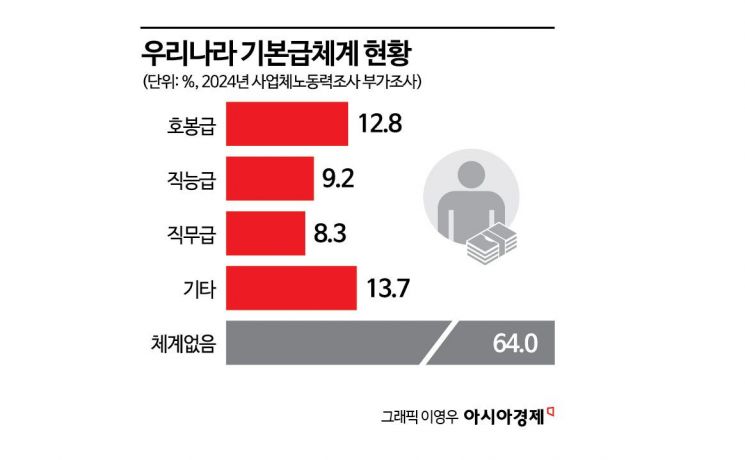
In particular, the pay grade system is strongly enforced only in some large corporations with powerful labor unions, the public sector, and the financial sector. In more than 60% of workplaces, there is no wage system in place at all. This dual structure and rigid wage system have hindered labor market reform since the transition to a low-growth era following the financial crisis.
Institutionalizing 'Reemployment After Retirement' Hopes to Mark a Starting Point for Labor Market Flexibility
The business community sees the current momentum in the retirement age debate as a chance to reform the wage system. They expect that institutionalizing "reemployment after retirement" for older workers and changing the wage system will serve as a starting point for labor market flexibility.
They particularly argue that, during the reemployment process, both labor and management should be open to wage adjustments based on job roles or working hours, rather than imposing uniform wage cuts. If employees over 60 are assigned to roles involving simple tasks or reduced working hours, companies can reduce their labor costs. This, they explain, can minimize side effects such as reduced hiring of young people or the creation of high-cost structures within companies that may result from increased employment of older workers.
An official from the Korea Employers Federation said, "In reality, some large companies such as Hyundai Motor Company already reemploy retirees as contract workers at about 70% of their previous wages, which should be taken into account." The official added, "By enacting a so-called Special Act on Reemployment After Retirement to enhance the legal stability of reemployment and including government support measures, we should incentivize companies to hire more older workers."

The government has also expressed a positive stance on labor market flexibility. President Lee Jaemyung, in a meeting with the leaders of the two main labor unions in September, stated, "For our society to make a fundamental leap forward, we need to openly discuss issues such as the social safety net, the burden on companies, and the stability and flexibility of employment." This signaled his willingness to pursue labor market flexibility. Within the labor community, there have also been proposals to introduce job-based pay systems by industry through labor-management autonomy, alongside calls for extending the retirement age.
Japan, which also has a legal retirement age, found a solution to wage system reform by easing the procedures for changing employment rules. In 2006, Japan maintained the legal retirement age at 60 but implemented measures to secure employment up to 65. The Labor Contract Act was amended so that, in cases of "socially reasonable" changes to employment rules, modifications could be made without labor-management agreement.
To alleviate companies' cost burdens while addressing the issue of reduced wages for workers, Japan adopted a social burden-sharing approach. Through the "Continued Employment Benefit for the Elderly" system, if post-retirement wages (after age 60) fell below 75% of pre-retirement wages, employment insurance would provide monthly support equivalent to 10-25% of wages. As a result, according to a survey by Japan's Ministry of Health, Labour and Welfare at the end of last year, 67.4% of companies with 21 or more employees and 79.4% of companies with 301 or more employees had introduced reemployment systems for older workers.
Experts point out that, during discussions on extending employment, the labor sector should proactively consider wage system reform. Park Jisoon, a professor at Korea University's Graduate School of Labor Studies, said, "Since companies have no choice but to reflect the costs of employing older workers in product prices, a vicious cycle may occur where they try to cut costs by introducing robots or artificial intelligence (AI) or by outsourcing again." He added, "From the labor union's perspective, maintaining employment is a greater benefit, so there should be room for compromise."
© The Asia Business Daily(www.asiae.co.kr). All rights reserved.
![Clutching a Stolen Dior Bag, Saying "I Hate Being Poor but Real"... The Grotesque Con of a "Human Knockoff" [Slate]](https://cwcontent.asiae.co.kr/asiaresize/183/2026021902243444107_1771435474.jpg)


















