A nanobody-based "ultra-precise biosensor" capable of early cancer diagnosis has been developed.
The Korea Research Institute of Bioscience and Biotechnology (KRIBB) announced on the 12th that Dr. Woo Uijeon and his research team at the Bio-Design and Correction Research Center have developed a nanobody-based biosensor capable of precisely detecting "interleukin-6 (IL-6)," a key diagnostic marker for cancer and inflammatory responses.
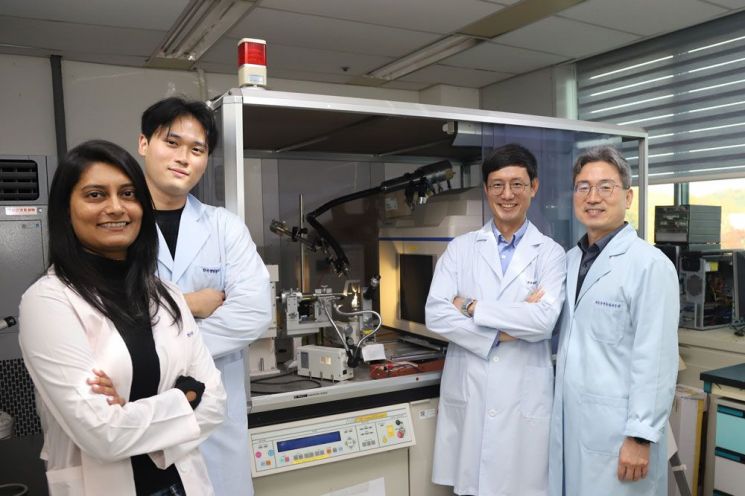 Dr. Woo Eui-jeon (first on the right) and members of Dr. Woo's research team. Courtesy of Korea Research Institute of Bioscience and Biotechnology
IL-6 is a protein that regulates immune responses, and its levels rise sharply when reacting with inflammation or cancer cells in the body. This makes it a crucial marker for the early diagnosis and prognosis monitoring of diseases such as pancreatic cancer, kidney cancer, autoimmune disorders, and sepsis.
However, conventional diagnostic technologies such as ELISA and PCR require significant time for analysis, demand skilled personnel, and have limitations in detecting trace amounts of protein.
To address this, the research team focused on nanobodies, which are one-tenth the size of conventional antibodies. Nanobodies are ultra-small proteins derived from camelid antibodies. They are smaller, structurally robust, and can be easily produced in bacteria, making them advantageous for developing diagnostic devices.
In particular, their small size allows them to be densely attached to sensor surfaces, and their stability against temperature and environmental changes suggests great potential for development into point-of-care testing (POCT) devices.
To leverage these advantages, the research team devised a "CDR grafting" technique, which precisely replicates only the "core part (recognition site)" of conventional antibodies and directly converts them into nanobodies. This enables the rapid production of high-precision nanobodies without the need for immunization experiments in animals.
Notably, the nanobodies designed through this method were combined with the Solution-Immersed Silicon (SIS) sensor technology, owned by the Korea Research Institute of Standards and Science (KRISS), which can directly detect reactions in liquid. This resulted in a biosensor with world-class sensitivity.
The SIS sensor is an advanced optical technology that precisely measures changes in light reflection on a silicon surface in a liquid environment to detect protein binding in real time. It does not require a metal film, resulting in less signal interference and greater stability.
The sensor developed by the research team is highly sensitive, capable of detecting even trace amounts of protein. According to the team, it can detect IL-6 protein at concentrations as low as 1 gram per 1 trillion (4.5 fg/mL), making it about 1,000 times more sensitive than currently used ELISA diagnostic kits.
Most importantly, when analyzing the serum of patients with pancreatic and kidney cancer, the sensor could clearly distinguish between healthy individuals and patients, demonstrating its potential for direct clinical diagnostic applications.
The most significant achievement of this research is not only the creation of a new sensor, but also the presentation of a design platform that enables the direct conversion of antibodies into nanobodies. Using this platform, when antibodies that recognize specific disease proteins have already been secured, they can be rapidly converted into nanobodies and applied to various sensors or diagnostic devices.
Dr. Woo stated, "This research is significant in that it presents a new paradigm by combining antibody engineering and precision measurement technology to detect biomolecular signals at ultra-low levels," adding, "The technology developed by our team will contribute to the rapid and accurate diagnosis of subtle biological changes occurring in the early stages of diseases such as cancer or inflammatory disorders."
Meanwhile, the results of this research were published online in the international scientific journal "Chemical Engineering Journal" on October 23.
© The Asia Business Daily(www.asiae.co.kr). All rights reserved.

















