Guidance Staff Accompany Students on Their Commute
Expansion from Lower Grades to All Grades Nationwide
Seongdong District Reports 98% Satisfaction Among Students and Parents
The "Walking School Bus," a program in which adults accompany children to and from school as if riding a school bus, will be expanded nationwide.
According to the comprehensive measures against child abduction and luring crimes announced on November 12 by the Ministry of the Interior and Safety, the Ministry of Education, and other related agencies, the government will expand the Walking School Bus program-which is currently being implemented for lower grades in select regions-to all grades and regions across the country starting next year.
The Walking School Bus is a service that designates multiple routes for students’ commutes, similar to a bus, and assigns guides to accompany students who are heading in the same direction after school, ensuring their safety. Parents are also notified of their children's commute status in real time through social networking services (SNS).
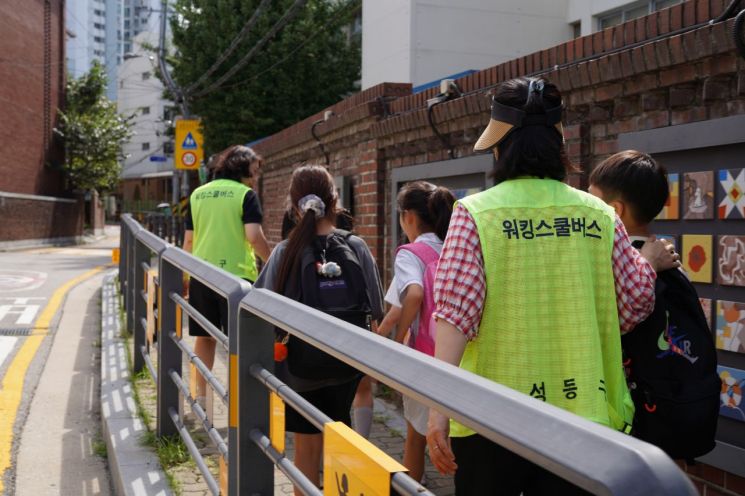
This policy was introduced because of the recent surge in child abduction and luring incidents. After a series of attempted kidnappings targeting children returning home near an elementary school in Seodaemun District, Seoul in August, similar incidents have occurred across the country. In Namyangju, Gyeonggi Province, a parent spotted a kidnapping attempt while seeing their child off to school from their apartment window.
The expansion of the Walking School Bus is expected to strengthen the safety of children on their way to and from school. Currently, the program is actively operated in Seoul, where 691 traffic safety instructors have been deployed to a total of 244 elementary schools. In particular, Seongdong District operates the largest-scale program in the country, supporting not only during school vacations but also after-school and care classes. In a survey conducted in September of 972 parents and students, satisfaction rates were high at 98.4% and 98.6%, respectively.
The expanded Walking School Bus program plans to utilize the Ministry of Health and Welfare’s senior employment project for its guides. Unlike Seoul, where the majority of instructors are middle-aged, the expanded program is expected to primarily employ those aged 65 and older. In Seoul, 54.6% of all traffic safety instructors are between 50 and 64 years old, and 32.0% are between 40 and 49 years old, indicating a predominance of middle-aged and older adults. There are also 16 instructors under the age of 39. The Ministry of Health and Welfare and the Ministry of the Interior and Safety are currently discussing the specific workforce and budget for the Walking School Bus program.
© The Asia Business Daily(www.asiae.co.kr). All rights reserved.
![Clutching a Stolen Dior Bag, Saying "I Hate Being Poor but Real"... The Grotesque Con of a "Human Knockoff" [Slate]](https://cwcontent.asiae.co.kr/asiaresize/183/2026021902243444107_1771435474.jpg)
















