Monetary Policy Committee Minutes Released on October 23
On October 23, when the decision was made to maintain the base interest rate at 2.50% per annum, the majority of the Bank of Korea's Monetary Policy Committee members cited concerns over the real estate market as a key reason for the rate freeze. They emphasized the need to closely monitor how the government's October 15 real estate measures will play out in the coming period.
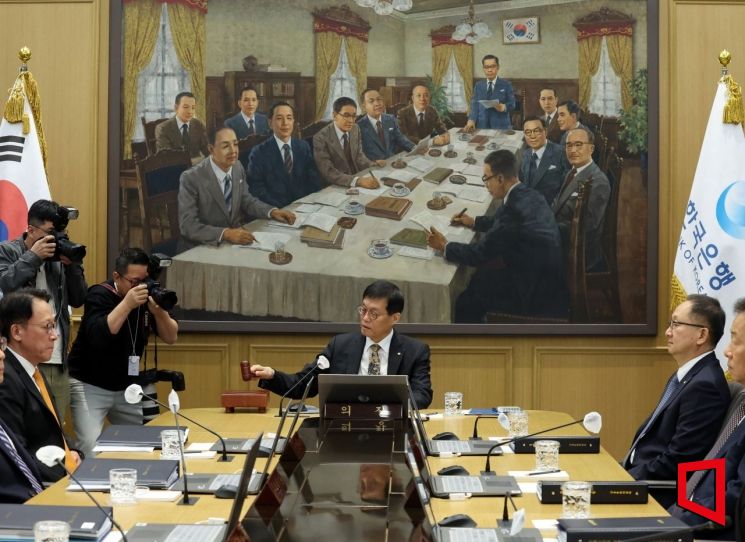 Lee Chang-yong, Governor of the Bank of Korea, is striking the gavel at the Monetary Policy Committee's plenary session held at the Bank of Korea headquarters in Jung-gu, Seoul, on the morning of the 23rd of last month. Photo by Joint Press Corps
According to the minutes of the Monetary Policy Committee meeting on policy direction released by the Bank of Korea on November 11, five out of the six committee members, excluding Governor Lee Chang-yong, supported maintaining the base rate. By contrast, Committee Member Shin Sung-hwan expressed a minority opinion, stating that it would be preferable to lower the base rate by 0.25 percentage points to 2.25%.
The majority of committee members pointed out that lowering the rate at this time could fuel expectations of rising asset prices, including real estate, and thus opted for a freeze. They argued that it is necessary to further assess the impact of the government's additional real estate measures, especially in the metropolitan housing market. One member noted, "Although the growth in household loans has slowed due to the government's real estate measures, housing prices in Seoul and major metropolitan areas have risen again due to supply constraints and high expectations of price increases. While the government's additional measures are expected to stabilize metropolitan housing prices and household loans, factors such as strong pent-up demand among genuine buyers, an increase in cash transactions, and potential spillover effects from regulations could undermine policy effectiveness, so careful monitoring is required."
Another member stated, "Despite the September 7 supply measures, the upward trend in Seoul apartment prices has intensified. If this trend spreads to neighboring areas, it could undermine financial stability. Therefore, we must observe for some time how the effects of the strengthened real estate policies will unfold." Another member analyzed, "Recently, apartment transaction volumes in the metropolitan area have increased significantly, and the rise in housing prices, initially centered on preferred locations, is spreading to less-preferred areas, deepening the differentiation with non-metropolitan regions." However, the member also forecast, "Despite housing price instability, a series of macroprudential policies, including housing market stabilization measures, will keep household loans within target ranges."
Regarding the increased volatility in the foreign exchange sector, including the renewed rise in the won-dollar exchange rate, most members agreed that this warrants caution. One member said, "The won-dollar exchange rate has risen above 1,400 won, and volatility has increased. These developments are largely attributable to Korea-specific factors, such as uncertainty in Korea-US tariff negotiations and supply-demand pressures in the spot FX market, so we need to closely monitor future trends."
While the growth rate continues to fall short of potential, several members noted signs of improvement. One member said, "Despite sluggish construction investment, domestic consumption is improving and exports, especially in semiconductors, are performing well, leading to a somewhat improved growth trajectory. Next year, growth is expected to be stronger than this year, driven mainly by domestic demand." However, the member also pointed out that uncertainties remain regarding major countries' trade negotiations and the global semiconductor cycle.
Another member stated, "Despite weak construction investment, private consumption has continued to recover thanks to improved consumer sentiment and the issuance of consumption coupons, while exports, led by semiconductors and ships, have remained strong. Although exports are expected to gradually slow due to the effects of US tariff hikes, the recovery in domestic demand should continue, supported by previous rate cuts and expansionary fiscal policy."
Regarding inflation, the committee generally expected that both this year and next, inflation would remain around the 2% target, given low demand-side pressures and stable international oil prices. However, they noted that households are experiencing higher perceived inflation due to rising food prices amid an overall elevated price level since COVID-19, and that continued volatility in the exchange rate and increases in asset prices such as real estate and gold necessitate close monitoring of the inflation path. Another member remarked, "Despite sluggish real economic activity, the ongoing global asset price rally is partly driven by rising inflation expectations based on anticipated fiscal expansion in many countries. Once inflation expectations become entrenched, they are hard to reverse, so we must remain vigilant."
On the other hand, Committee Member Shin Sung-hwan, who expressed the minority view that the base rate should be lowered from the current 2.50% to 2.25%, stated, "While the concentration in the housing market and the high exchange rate are making monetary policy more challenging, considering stable inflation, the prolonged period of sluggish economic growth, the likely temporary cooling of the housing market due to recent strong stabilization policies, and the fact that a rate cut has already been delayed for quite some time, it would be preferable to lower the rate as soon as possible and then monitor its effects on inflation, the economy, financial stability, and the exchange rate before making further decisions." Regarding the rise in the won-dollar exchange rate, he argued that the impact of resident overseas investment on the exchange rate is excessive, and called for a whole-of-government policy effort to mitigate this effect.
© The Asia Business Daily(www.asiae.co.kr). All rights reserved.

















