FKI Commissions Export Outlook Survey to Mono Research
150 Out of Top 1,000 Companies Respond
Exports Expected to Rise in Six Sectors Including Ships, Electronics, and Semiconductors
Declines Projected for Four Sectors: Automobiles, Steel, and Petroleum
Concerns Over Tariffs, Oversupply from China, and Intensifying US-China Conflict
There are projections that South Korea’s export growth will slow down due to increasing uncertainty in the global trade environment and exchange rate instability.
The Federation of Korean Industries (FKI) announced on the 11th that, according to a “2026 Export Outlook Survey” conducted by Mono Research on its behalf, targeting the top 1,000 companies by sales in the 10 leading export industries (with 150 companies responding), exports next year are expected to increase by 0.9% compared to this year.
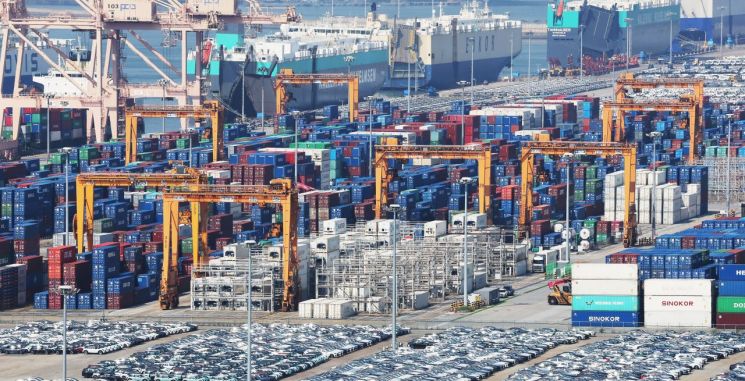
Six industries are expected to see export growth. The projected growth rates are highest for ships (5.0%), followed by electric and electronic goods (3.1%), general machinery (2.3%), bio-health (2.1%), semiconductors (1.7%), and petrochemicals (0.7%). Conversely, exports are expected to decline in four industries: automobiles (-3.5%), steel (-2.3%), auto parts (-1.4%), and petroleum products (-1.3%).
Among the companies that expect exports to increase next year, the main reasons cited were “increased demand due to improvements in global market conditions” (33.7%), “exploring new markets through export market diversification” (22.8%), and “reduced uncertainty through tariff negotiations and similar measures” (20.7%). Companies forecasting a decrease in exports identified “increased uncertainty in the trade environment, such as tariffs” (67.3%) as the primary reason. Other factors mentioned included “economic downturns in major export destinations,” “oversupply in the global market driven by China,” and “intensifying US-China trade conflict” (each at 8.6%).
77.3% of responding companies believe that export profitability next year will be similar to this year. Only 18.0% expect profitability to worsen, while just 4.7% anticipate improvement. Profitability refers to the level of profit a company earns through exports; higher profitability means that a company’s profits increase even if the export volume remains the same.
By industry, except for ships and electric and electronic goods, more companies in the remaining eight industries responded that profitability would “worsen” than “improve.” The highest proportion of negative responses came from petroleum products (50.0%), followed by steel (30.4%), auto parts (22.2%), automobiles (20.0%), and semiconductors (16.7%).
Companies cited the following as reasons for worsening profitability: “increased cost burden due to tariffs” (63.0%), “lower export prices due to intensified export competition” (14.8%), “increased import costs due to exchange rate rises” (11.1%), and “intensifying US-China trade conflict” (11.1%).
The average exchange rate that companies consider adequate to maintain profitability next year was found to be 1,375 won. This year’s average exchange rate was 1,414 won, while next year’s forecast is 1,456 won.
For next year, companies identified “tariff policies of the Trump administration” (53.3%) as the greatest risk impacting exports. This was followed by “exchange rate instability due to the weak won” (17.3%) and “intensifying US-China trade conflict” (16.7%). In fact, after the US tariff hike in April, export companies’ sales and operating profit both fell by 1.1% and 1.3%, respectively, compared to the same period last year. The decline in operating profit was highest in automobiles (-8.5%), followed by steel (-4.0%), electric and electronic goods (-2.6%), general machinery (-1.0%), and petrochemicals (-0.7%).
As countermeasures against tariffs, companies cited “adjustment of export prices” (28.0%), “absorbing costs by reducing production costs” (25.8%), and “exploring new markets through export market diversification” (16.5%). For policy tasks to strengthen export competitiveness, companies mentioned “expanding tax support such as corporate tax cuts and investment tax credits” (23.1%), “reducing tariff burdens through trade agreements” (21.7%), and “enhancing stability in the foreign exchange market” (18.5%).
Lee Sangho, Head of the Economic and Industrial Division at the Federation of Korean Industries, stated, “Although the Korea-US tariff negotiations, which were the biggest issue for companies, have been settled, companies still feel significant uncertainty in the trade environment. The government should pursue policies to strengthen export competitiveness, such as diplomatic efforts to improve the trade environment, tax support, and stabilization of the foreign exchange market.”
© The Asia Business Daily(www.asiae.co.kr). All rights reserved.

















