Commissioning of China’s Fujian Completes Three-Carrier Fleet
US Can Deploy Only 3?4 Out of 11 Carriers in an Emergency
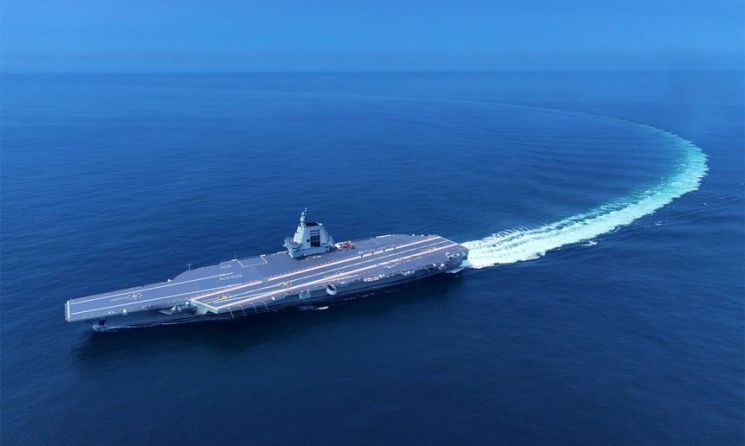 The appearance of Fujian, China's third aircraft carrier, which was officially commissioned on the 5th. Photo by Xinhua News Agency
With the official commissioning of China's third aircraft carrier, the Fujian, military tensions between the United States and China surrounding the Taiwan Strait are escalating further. It is known that the US military can immediately operate only about three to four aircraft carriers in an emergency. As China continues to build additional carriers, concerns are rising that US deterrence against China may weaken. Some in and outside the United States are even calling for the number of operational aircraft carriers to be increased to at least 15, as during the Cold War, to counter China. This suggests that the arms race will intensify going forward.
China's Third Aircraft Carrier Officially Commissioned..."A Step from a Weak Nation to a Great Power"
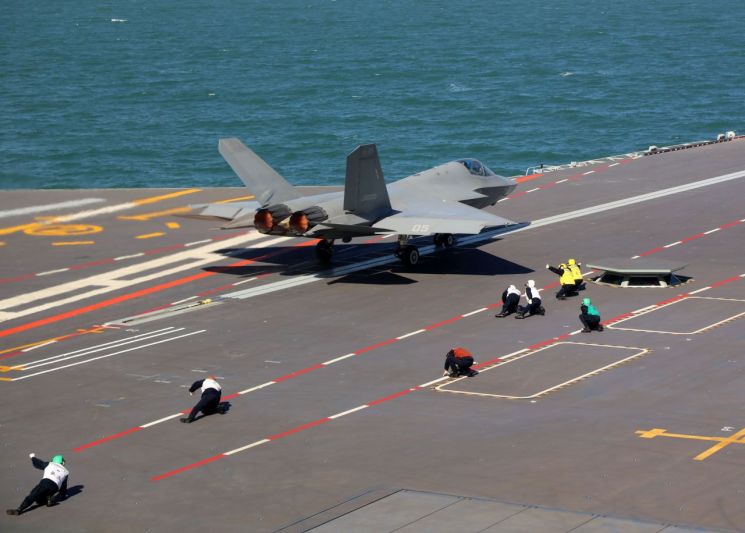 In September, the J-35 fighter jet conducting takeoff training on the Fujian ship. Photo by Xinhua News Agency
According to Xinhua News Agency, China's third aircraft carrier, the Fujian, was officially commissioned on the 5th, with Chinese President Xi Jinping attending the commissioning ceremony. With three aircraft carriers, China now possesses the second-largest number of carriers in the world after the United States, which has eleven. Currently, aside from the United States and China, the United Kingdom, India, and Italy each operate two aircraft carriers.
The Fujian is regarded as the first domestically produced Chinese aircraft carrier, designed and built entirely in China. China's first carrier, the Liaoning, was a former Soviet carrier acquired from Ukraine and refurbished, while the second carrier, the Shandong, was modeled after the Liaoning's design. Notably, unlike the Liaoning and Shandong, the Fujian is equipped with an electromagnetic catapult system, enhancing its ability to operate carrier-based aircraft and its combat capabilities.
The Chinese government claims that the launch of its third aircraft carrier has laid the foundation for becoming a maritime power. The state-run Global Times emphasized, "China has caught up with the more than 100-year history of Western naval aircraft carriers in just over a decade," describing it as "a historic step in transforming from a weak maritime nation to a great power." The report also highlighted, "By rotating the three carriers, China has established an all-weather strike and defense system," and "the Chinese Navy has shifted from a focus on coastal defense to blue-water operations."
It is known that China is currently building its fourth and fifth aircraft carriers. The plan is to launch the fourth carrier by 2030 and secure a total of six carriers by 2035, aiming to establish complete dominance not only in the Taiwan Strait, East China Sea, and South China Sea, but also in the eastern Pacific region.
US Can Operate Only 3-4 Carriers in a Crisis..."Need to Increase the Number of Carriers"
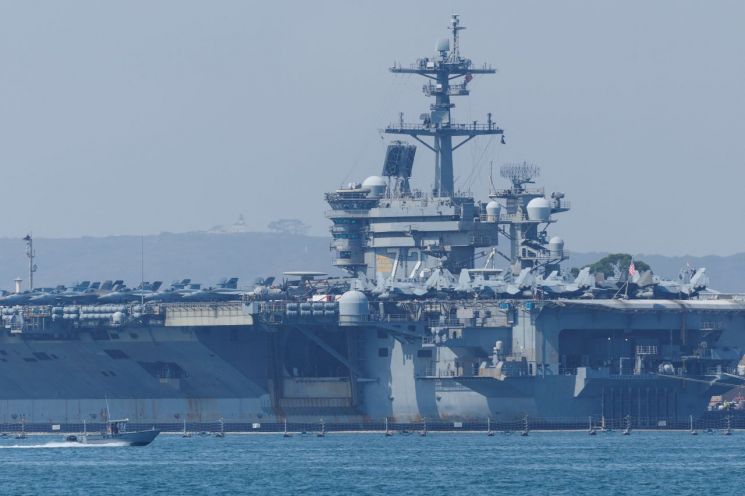 Last August, the USS Abraham Lincoln, a Nimitz-class aircraft carrier of the US Navy, was preparing for training at the San Diego port in California. Photo by Reuters Yonhap News
There are growing concerns in and outside the United States that the expansion of China's carrier fleet could weaken US deterrence. With the US military able to deploy only about three to four aircraft carriers immediately, an increase in China's carrier numbers could raise the risk of Chinese military provocations in the South China Sea.
According to CNN, the US Navy currently operates a total of eleven aircraft carriers, which are distributed across US operational areas worldwide. Under the US military's "one-third rule," about three to four carriers can be deployed at the same time. The one-third rule means that one-third of the total carriers are assigned to combat missions, another third are in transit for force deployment, and the remaining third are in port for maintenance.
Ultimately, if China increases its number of aircraft carriers to six, it could have more carrier strike groups than the US military in the waters around Northeast Asia. Some in and outside the US military argue that to effectively deter China's naval power, the number of operational US carriers should be increased to at least fifteen, as during the Cold War.
The National Security Journal (NSJ), a US defense publication, pointed out, "To maintain superiority and deterrence against China's carrier fleet, a total of six carriers are needed in the Indo-Pacific region alone, including the area around Taiwan and the South China Sea. To achieve this, the current number of eleven carriers must be increased to fifteen." The report added, "Even considering the level of threat from China, the contributions of allies such as Japan and Australia, and the capabilities of unmanned systems and submarines, the minimum number of carriers should be maintained or slightly increased."
© The Asia Business Daily(www.asiae.co.kr). All rights reserved.



















