The government has finalized its target to reduce the country's net greenhouse gas emissions by 53% to 61% compared to 2018 levels by 2035. The government emphasized that this reduction target will not only address the climate crisis but also serve as an opportunity to strengthen the competitiveness of green industries such as renewable energy, electric vehicles, and batteries.
On the 11th, the Ministry of Climate, Energy and Environment announced at a Cabinet meeting that it had finalized the draft of the "2035 National Greenhouse Gas Reduction Target (NDC)." Under the Paris Agreement, each country is required to submit its reduction target (NDC) every five years, and South Korea must officially submit its 2035 target to the United Nations by the end of this year.
According to the reduction target finalized by the government, based on the 2018 net emissions of 742.3 million tons, the plan is to reduce emissions to a minimum of 348.9 million tons (53%) and up to 289.5 million tons (61%) by 2035. Unlike the previous 2030 NDC, which presented a single reduction rate, the new target sets both a lower and upper bound, taking into account uncertainties such as the pace of technological development and investment.
For the power sector, the government set a maximum reduction target of 75.3% compared to 2018, focusing on reducing coal-fired power generation and increasing the share of renewable energy. For the industrial sector, reflecting concerns about the reduction burden, the target was set at a more moderate reduction of 24.3% to 31.0% compared to the previous goal.
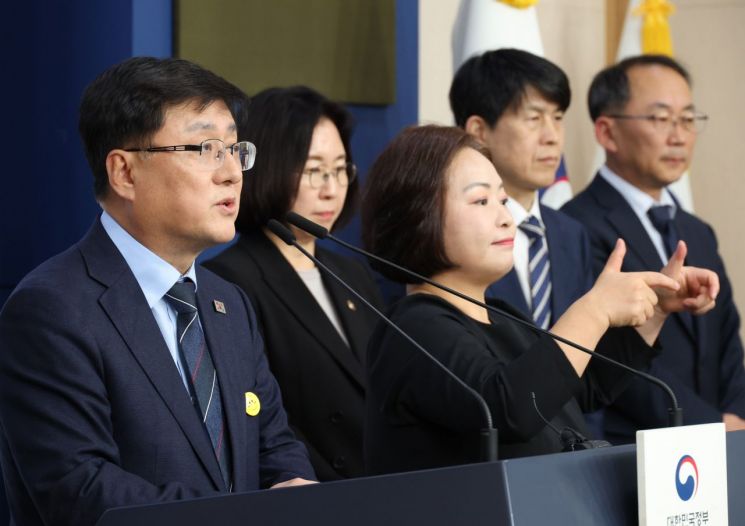 Government Announces 2035 National Greenhouse Gas Reduction Target
(Seoul=Yonhap News) Reporter Shin Junhee = On the 10th, Kim Sung-hwan, Minister of Climate, Energy and Environment, announced the 2035 national greenhouse gas reduction target and the 4th emission allowance allocation plan for the planning period at the Government Seoul Office. 2025.11.10
hama@yna.co.kr (End)
In the power sector, the government plans to expand facilities such as solar and wind power, and increase investment in power grids and energy storage systems (ESS), thereby shifting the power generation mix toward low-carbon and carbon-free sources. In the industrial sector, the main measures will include switching fuels and raw materials, improving process efficiency, and demonstrating and distributing carbon capture, utilization, and storage (CCUS) technology.
In the transportation sector, the plan includes expanding the adoption of electric and hydrogen vehicles, while in the building sector, the focus will be on promoting zero-energy buildings and green remodeling. To achieve these targets, the government plans to establish the "Korea Green Transformation (K-GX)" strategy in the first half of next year.
Meanwhile, at the same meeting, the government also finalized the fourth national emission allowance allocation plan, which will apply from 2026 to 2030, as well as amendments to the third allocation plan. The confirmed fourth allocation plan will directly affect the reduction burden and cost structure for industry. The government announced that it will gradually increase the proportion of paid allocation in the power sector to 50% by 2030, while maintaining 100% free allocation for key export industries such as steel and petrochemicals. However, the proportion of paid allocation for some sectors outside of power generation will be raised from the current 10% to 15%. The government stated that all revenues from the expanded paid allocation auctions will be used as investment resources to support companies in their transition to decarbonization.
A new "Korea Market Stability Reserve (K-MSR)" will also be introduced to enhance the stability of the emissions trading market. This system will allow the government to adjust the supply of allowances using the reserve in cases where demand for allowances surges or drops sharply due to economic fluctuations.
The Ministry of Climate explained that the system was designed to protect the international competitiveness of sectors at risk of carbon leakage, while enabling an overall transition to a decarbonized industrial structure. The finalized reduction target will be officially announced at the 30th Conference of the Parties (COP30) to the United Nations Framework Convention on Climate Change, which will be held in Belem, Brazil, from November 10 to 21.
Kim Sung-hwan, Minister of Climate, stated, "Responding to the climate crisis is not only about overcoming a crisis, but also an opportunity for new growth in green industries," adding, "We will actively support the transition of companies and industries so that Korea can emerge as a leading nation in decarbonized green civilization."
© The Asia Business Daily(www.asiae.co.kr). All rights reserved.

![Clutching a Stolen Dior Bag, Saying "I Hate Being Poor but Real"... The Grotesque Con of a "Human Knockoff" [Slate]](https://cwcontent.asiae.co.kr/asiaresize/183/2026021902243444107_1771435474.jpg)















