Global GDP Expected to Rise 0.01% Amid Tariff Truce
The United States and China will lower and defer tariffs starting from November 10, in accordance with the agreement reached at last month’s U.S.-China summit held in Busan to refrain from escalating the trade war.
The Donald Trump administration will reduce the so-called "fentanyl tariff" imposed on China from 20% to 10%, effective from 12:01 a.m. Eastern Time (2:01 p.m. Korea Standard Time) on this day. From this date, the additional U.S. tariff rate on Chinese goods will be set at 20%.
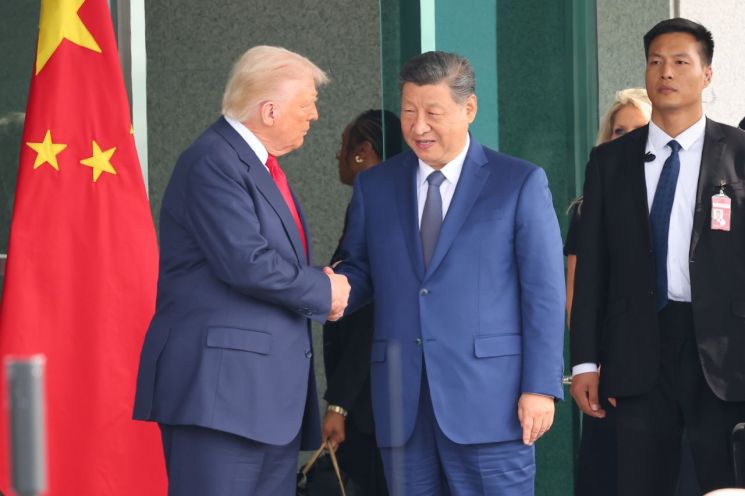 Donald Trump, President of the United States (left), and Xi Jinping, President of China. Photo by Yonhap News Agency
The Office of the United States Trade Representative (USTR) announced that it will defer for one year the port entry fees that had been imposed on Chinese vessels and related entities, starting from today.
In response to the U.S. tariff reduction, China will suspend up to 15% retaliatory tariffs it had imposed on U.S. chicken, soybeans, wheat, corn, and cotton, starting at 1:01 p.m. China Standard Time on the same day. However, China will maintain up to 15% additional tariffs on U.S. LNG and petroleum, which have been in effect since February, as well as the 10% additional tariffs imposed on U.S. imports as a reciprocal measure.
In May, the United States and China agreed to cancel 91% of the 125% additional tariffs, defer 24%, and impose 10%. The 24% tariffs will be deferred for an additional year, until November 10, 2026.
According to a fact sheet released by the White House, China will resume imports of U.S. soybeans, planning to purchase over 12 million tons in 2025 and at least 25 million tons annually from 2026 to 2028.
China has decided to postpone the implementation of rare earth export restrictions for one year. Additionally, it announced a one-year deferral of export controls on dual-use materials (goods that can be used for both military and civilian purposes) such as gallium, germanium, and graphite, as of the previous day.
If these measures lead to a recovery in U.S.-China trade, it is expected to have a positive outlook for the global economy. Kiuchi Nobuhide, Chief Economist at Nomura Research Institute, projected that a 10% reduction in U.S. tariffs on Chinese goods could raise the world's real gross domestic product (GDP) by approximately 0.01% over the course of a year.
However, some analysts note that since China has not completely abandoned the rare earth sanctions card and the United States continues to enforce semiconductor export controls, the risk of reigniting the U.S.-China trade war has not been fully eliminated.
© The Asia Business Daily(www.asiae.co.kr). All rights reserved.

















