Eyeing Venezuela's Vast Rare Earth Resources
Possibility of Chinese and Russian Military Intervention...Tensions Likely to Continue
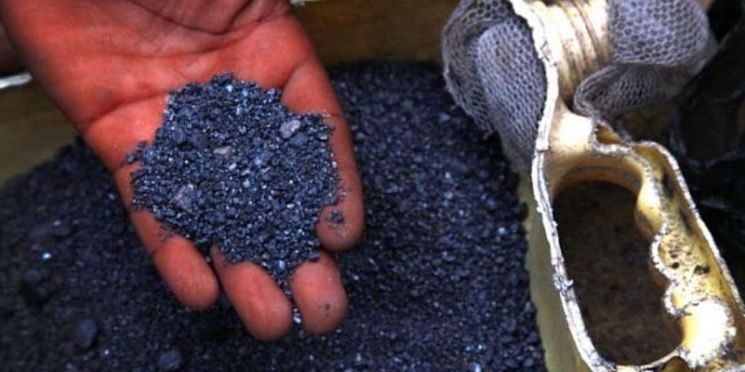 The rare earth coltan, a key raw material for the production of smartphones and electronic devices. Getty Images
There is growing speculation that the reason President Donald Trump of the United States has not ruled out the possibility of attacking Venezuela, despite criticism from both inside and outside the political sphere, is due to Venezuela's vast reserves of rare earth resources. In addition to oil and gold, Venezuela is known to possess large deposits of coltan, a rare earth mineral essential for the production of smartphones and electronic devices. From the perspective of the United States, which now considers securing rare earth materials a top priority, Venezuela's rare earth resources-located in close geographical proximity-are seen as a critical target that must be secured.
The Coltan Mines Targeted by Trump... A Core Mineral for Electronic Devices and Advanced Weapons
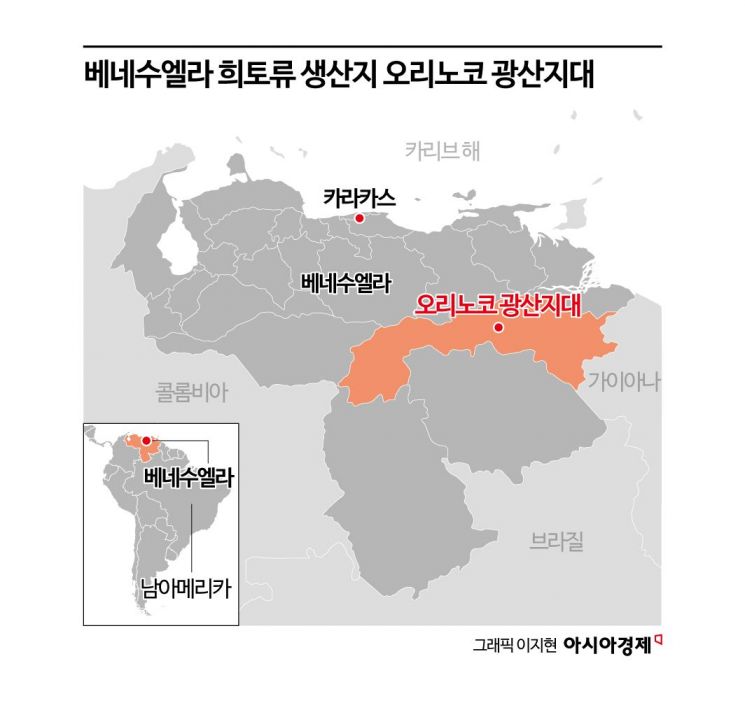
According to The Guardian, after rare earth elements became a key diplomatic variable in tariff negotiations between the United States and China, tensions over rare earth resources have also intensified between the two countries in Venezuela. The competition to secure rare earths is currently centered around the coltan deposits in the Orinoco mining region of Venezuela, which are estimated to be worth 100 billion dollars (approximately 145.5 trillion Korean won).
The Guardian, citing local indigenous sources, reported, "Since 2023, Chinese businesspeople have joined forces with Colombia's largest guerrilla group, the National Liberation Army (ELN), to forcibly seize coltan mined by indigenous people." The report added, "As China, which previously weaponized rare earths in its trade dispute with the United States, now seeks to control Venezuela's coltan, the U.S. government is trying to block China's access."
Coltan is classified as a rare earth mineral with extremely high utility in telecommunications, electronics, military, and aerospace industries, as it is 80 times more electrically conductive than copper, lightweight, and highly heat-resistant. In particular, it is an indispensable material for fighter jets and guided missiles. Since the outbreak of wars in Ukraine and the Middle East, demand for coltan has surged not only from the United States and China, but also from major powers such as the European Union and Russia.
U.S. Senate Fails to Limit Trump’s War Powers... U.S. Forces Gather in the Caribbean
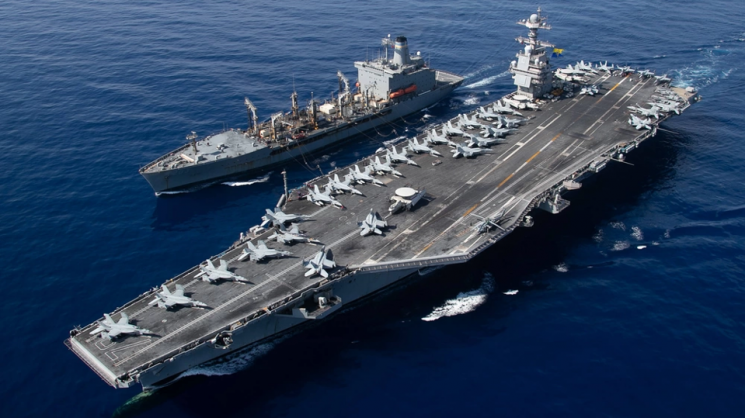 On the 6th (local time), the US Navy aircraft carrier USS Gerald Ford en route to the Caribbean Sea. US Navy website
There is growing discussion within and outside the United States about the possibility of a full-scale war with Venezuela. Currently, around 15,000 U.S. Navy personnel and warships are deployed near Venezuela in the Caribbean Sea, and the USS Gerald Ford, the latest aircraft carrier previously stationed in North Africa, is also en route to the Caribbean. Once this carrier strike group arrives, more than 20,000 troops and over 20% of U.S. naval power will be concentrated off the coast of Venezuela.
Furthermore, efforts by the U.S. Congress to limit President Trump’s war powers have failed, significantly increasing the likelihood of a full-scale war if President Trump orders a ground operation against Venezuela. On the 6th (local time), the U.S. Senate held a vote on the "War Powers Resolution," which would have prevented the president from unilaterally declaring war on Venezuela, but the measure was rejected with 49 votes in favor and 51 against.
However, the Trump administration has stated that it is approaching any potential attack on Venezuela with caution for now. According to CNN, on the 5th, Secretary of State Marco Rubio and Secretary of Defense Pete Hegseth met with leaders from both the Republican and Democratic parties in Congress and stated, "There are no plans to conduct ground airstrikes on Venezuela, and there is no legal basis to support any attacks on ground targets."
Possibility of Chinese and Russian Military Intervention Raised... Trump Weighs the Pros and Cons
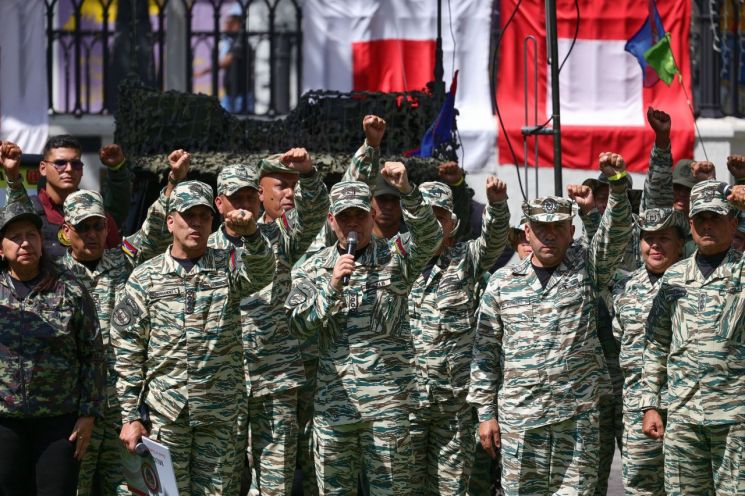 On the 4th of last month (local time), Venezuelan troops conducting military exercises in preparation for a potential U.S. military attack. Photo by AP Yonhap News
The Trump administration’s increased caution in weighing the practical benefits of a military operation is largely attributed to the potential for Chinese and Russian military intervention in the event of a U.S. ground attack on Venezuela.
The possibility of Russian military intervention is already becoming a reality. According to The Washington Post, Venezuelan President Nicolas Maduro sent a letter on the 31st of last month requesting military assistance from China and Russia. While China has yet to announce a concrete position, Russia has mentioned the possibility of providing Venezuela with medium-range missiles.
Alexei Zhuravlyov, Vice Chairman of the Defense Committee of the Russian State Duma, said in an interview with Russian media on the 4th, "I see no obstacles to supplying friendly countries with missiles such as Oresnik and Kalibr," adding, "Russia is a key military technology partner supplying nearly all weapons to Venezuela. The United States could face unexpected situations." These missiles are among Russia's latest hypersonic weapons, recently unveiled and known to be impossible to intercept.
The New York Times, citing White House officials, reported, "President Trump has repeatedly expressed concerns about the possibility of failure in the operation, and above all, is intensely reviewing what the United States stands to gain from attacking Venezuela." The report added, "It remains uncertain whether a military operation would topple the Maduro regime, whether a pro-U.S. government could be established as the next regime, and whether resources could be secured, making the outcome of such an operation still unclear."
© The Asia Business Daily(www.asiae.co.kr). All rights reserved.



















