Interview with Playwright and Director Jung Eeshin
"In order to live, humans must eat. I believe that the act of eating is both deeply humorous and profoundly sad. I wanted to bring that scene to life on stage."
Director Jung Eeshin, who is directing the play "Yakiniku Dragon," which opens at the CJ Towol Theater in the Seoul Arts Center on November 14, explained why he made a point of including a scene where the characters grill beef intestines on stage.
Before the performance begins, for 20 minutes, the actors and musicians attract the audience's attention by grilling meat on stage accompanied by lively music. Set in the Kansai region of Japan in the 1970s, the play tells the story of Yonggil's family, Korean residents in Japan who run a grilled intestines restaurant and struggle to survive after Yonggil loses an arm and his wife in the war. The play was first staged in 2008 as a joint Korea-Japan production to commemorate the 20th anniversary of the Seoul Arts Center and the 10th anniversary of the New National Theatre in Japan. After being revived in 2011, it returns to the stage after 14 years to mark the 60th anniversary of diplomatic relations between Korea and Japan.
 On the 14th, director Jung Eeshin is explaining the play "Yakiniku Dragon," which opens at the CJ Towol Theater in the Seoul Arts Center.
 [Photo by Seoul Arts Center]
Director Jung Eeshin is a second-and-a-half generation Korean resident in Japan, born in a slum in Himeji, Hyogo Prefecture. At a recent press conference held at the Seoul Arts Center, Jung explained that "yakiniku," which means "grilled meat" in Japanese, has become a symbol of Korean residents in Japan.
"Although Japanese people now love yakiniku, back in the 1970s, yakiniku-especially beef intestines-was mostly eaten by poor laborers and Korean residents in Japan. That is why the food itself can be seen as a symbol of poverty and of Korean residents in Japan."
Jung also described the play as containing his own story.
He said, "Many of the father's lines in the play are things my own father actually said. For example, the line where the father says, 'I bought national land,' is something my father really said. There is also a line about packing up to go to Korea, but my younger sibling caught a cold, so we couldn't board the ship, and that ship eventually sank-this, too, is based on a true story."
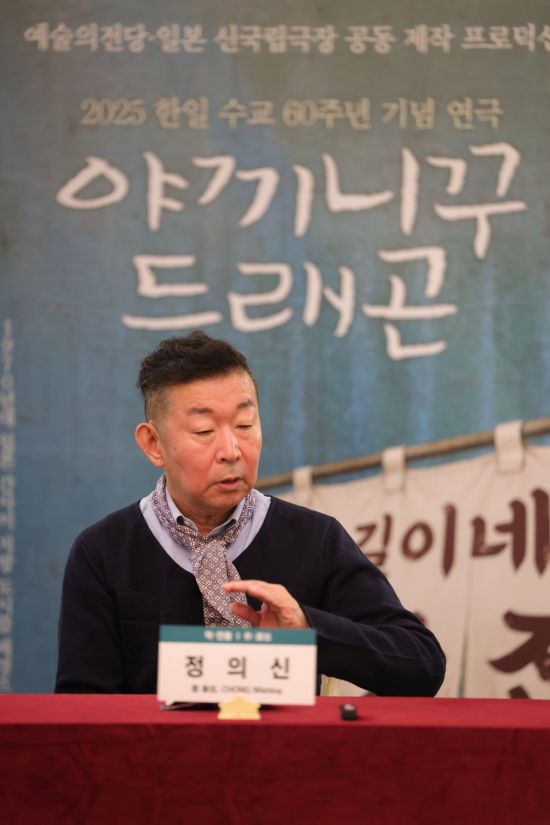 On the 14th, director Jung Eeshin is explaining the play "Yakiniku Dragon," which opens at the CJ Towol Theater in the Seoul Arts Center.
 [Photo by Seoul Arts Center]
Jung explained that, because the play was first performed simultaneously in Korea and Japan, he felt he had to write about the story of Korean residents in Japan. He noted that, although Korea-Japan relations have changed considerably since he first wrote the play, the issues faced by Korean residents in Japan are still not widely recognized.
He said, "I really wanted to show the unique history of Korean residents in Japan, as well as their hidden and concealed aspects. In Japan, the play received a lot of attention as a story about a family who lost their land after the war and had nowhere to go."
Regarding Korean residents in Japan, Jung said, "I think they are people who try very hard to preserve the old traditions of Korea. If young people in Korea today saw them, they might wonder why they are still holding on to such old customs, but Korean residents in Japan continue to keep them alive."
Although the story is about people in extremely difficult circumstances, the characters in the play never lose their sense of humor.
Jung emphasized, "Even in tough situations, people have to go on living, and I believe there is something essential that compels us to keep living."
"I think there are two tracks in life-comedy and tragedy-laid out in front of us. Life flows as those tracks keep flipping back and forth, and I try to reflect that in the play. Sometimes there are moments when life feels unbearable, but even in such times, I hope everyone has someone who can give them a little push, so that, even for a brief moment, they can think, 'Maybe life is worth living, maybe it's fun after all.'"
© The Asia Business Daily(www.asiae.co.kr). All rights reserved.
![Clutching a Stolen Dior Bag, Saying "I Hate Being Poor but Real"... The Grotesque Con of a "Human Knockoff" [Slate]](https://cwcontent.asiae.co.kr/asiaresize/183/2026021902243444107_1771435474.jpg)

















