It has been revealed that China is putting its utmost effort into the production and acquisition of physical AI data, which is even more difficult to secure than data for large language model (LLM) training. In contrast, South Korea is considered to be only at the initial stage when it comes to securing the data essential for advancing physical AI technology.
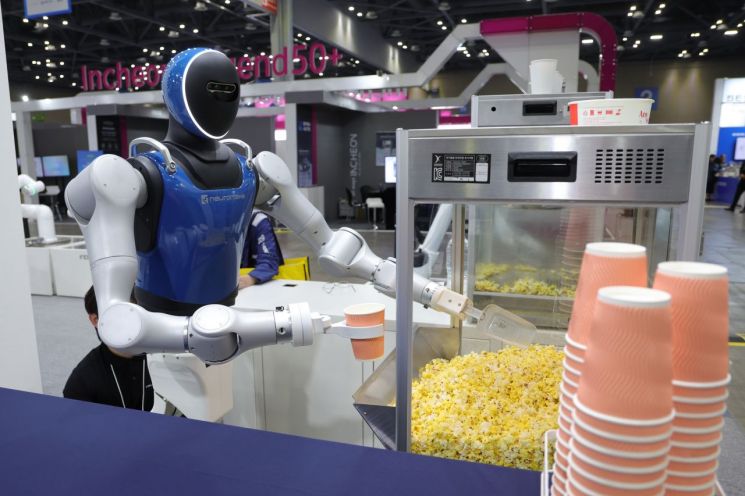 On the 5th, at KINTEX in Goyang, Gyeonggi Province, a humanoid robot is serving popcorn to visitors at RoboWorld 2025. Photo by Yonhap News
According to the report "Current Status of the AI and Humanoid Robot Industry Led by China" published by the National Information Society Agency (NIA) on the 9th, Chinese robot experts are maintaining their global edge in humanoid robot technology by focusing on data-driven learning, training, and the advancement of AI models.
Agibot, a humanoid robot startup that gained fame through investment from Tencent, has established a large-scale data collection facility in Shanghai and is generating high-quality real-world data. In the data collection factory established in Shanghai in 2023, Agibot has deployed about 100 robots and 200 human workers to accumulate between 30,000 and 50,000 data entries per day.
Agibot also released an open-source dataset called "Agibot World," which includes real-world data, last year. There are also findings indicating that 80% of the real-world data used by Nvidia to train its foundation AI model for humanoid robot development, "Isaac Groot N1," was obtained from Agibot World.
China is also ahead in terms of talent related to physical AI. Last year, the number of students majoring in robotics at Chinese universities exceeded 580,000, accounting for 42% of all robotics majors worldwide.
The report analyzed, "If the use of humanoid robots increases in China and spreads to manufacturing plants, the collection of physical AI training data encompassing both real and synthetic data will accelerate," adding, "The Chinese government envisions a 'new industrial revolution' in which humanoid robots perform the work of countless factories."
On the other hand, South Korea is still at a beginner level in securing data for the advancement of physical AI. The NIA's report "Global Trends and Response Strategies for Physical AI" states that the government-operated AI training data platform "AI Hub" is currently providing basic infrastructure that can be used for domestic robotics, autonomous driving research, and service development. However, it pointed out that there are limitations in terms of environmental diversity and international compatibility, and that there is also a lack of real-time data.
The report explained, "It is necessary to gradually build and open in-depth datasets such as robot behavior data and sensor/environment data required at the sites of autonomous driving, robotics, and healthcare industries," adding, "The constructed data should be linked with simulation environments based on digital twins at key locations such as ports, airports, hospitals, and smart buildings."
© The Asia Business Daily(www.asiae.co.kr). All rights reserved.

















