Foreign Investors Record Largest Sell-off Since Data Compilation Began
Investor Sentiment Plummets Amid "AI Bubble" Concerns
Semiconductor-led Selling Shakes the Stock Market
Last week, foreign investors recorded the largest net selling of KOSPI stocks in history. There had been analysis suggesting that the sharp decline in U.S. tech stocks, triggered by concerns over an "AI bubble," along with foreign investor sell-offs, had affected the domestic stock market, and this has now been confirmed with concrete figures.
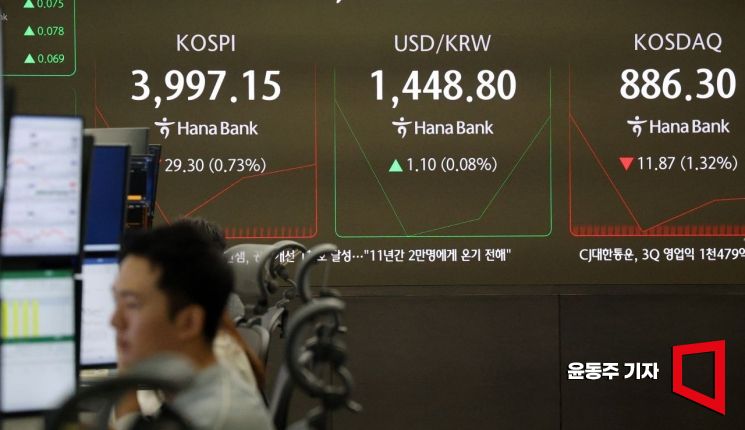 When the KOSPI index falls by more than 1%, various indices are displayed on the index board at the Hana Bank dealing room in Jung-gu, Seoul, on the 7th, the day the market opened.
According to data from the Korea Exchange on November 9, foreign investors made a net sale of 7.264 trillion won in the KOSPI market during the first week of this month (November 3-7). This is the largest amount ever recorded since the statistics began, surpassing the previous record of 7.0454 trillion won set in the second week of August 2021.
Foreign investors sold stocks for five consecutive trading days from November 3 to 7. On the 3rd, they sold approximately 795 billion won, followed by net sales of over 2 trillion won each on the 4th and 5th. On the 6th and 7th, they sold 1.7 trillion won and 455 billion won, respectively. Notably, the net sale on the 4th (2.228 trillion won) was the largest single-day figure in four years and three months since August 13, 2021 (2.699 trillion won).
Experts analyze that the desire to realize profits after a rapid short-term rise in the KOSPI, as well as weakened investor sentiment due to the "AI bubble" controversy, have spurred foreign selling. In fact, the KOSPI has fallen by about 3.7% so far this month. On November 5, it plunged by more than 2.8%, earning the nickname "Black Wednesday" due to the shock, and a sidecar (temporary trading halt) was triggered due to a surge in program selling.
Foreign selling was concentrated in large-cap semiconductor stocks. SK Hynix accounted for the largest amount at 3.715 trillion won, while Samsung Electronics saw net sales of 1.503 trillion won. These two stocks alone accounted for more than 70% of the total net selling by foreign investors. In contrast, buying interest flowed into certain stocks such as LG CNS (194 billion won), SK Square (179 billion won), and LG Innotek (69 billion won).
As of the previous trading day, November 7, most major KOSPI sectors declined. Construction (-3.11%), electricity and gas (-3.41%), manufacturing (-1.84%), and finance (-1.83%) all showed weakness. The KOSDAQ also fell by 2.38% to close at 876.81, reflecting a simultaneous downturn.
According to the securities industry, "It will be difficult for foreign investor inflows to improve until the correction in U.S. tech stocks and concerns over overheated AI-related investments subside," and "There is a high likelihood that a volatile market will persist until the exchange rate and semiconductor industry conditions stabilize."
© The Asia Business Daily(www.asiae.co.kr). All rights reserved.

















