Korean Society for Broadcasting and Telecommunication Studies
2025 Annual Conference
There have been calls to address the issue of fairness in content review regulations between online video services (OTT) and TV broadcasting. This is because scenes that are freely allowed on OTT platforms are often subject to sensitive review standards on television.
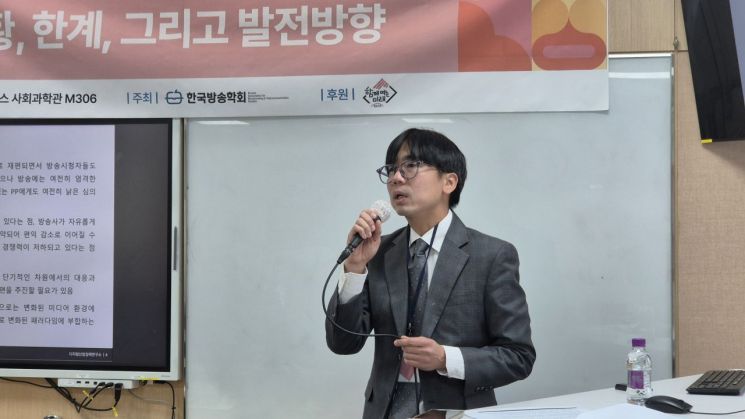
At the 2025 Fall Academic Conference of the Korean Society for Broadcasting and Telecommunication Studies on November 8, concerns were raised that review standards applied only to broadcasting restrict freedom of expression and undermine content competitiveness.
On this day, Changhee Noh, Director of the Digital Industry Policy Research Institute, delivered a presentation on the theme of "Seeking a Paradigm Shift in Broadcasting Review During a Transitional Period." According to Director Noh, while sponsored brands can be repeatedly exposed in OTT content, broadcasting is subject to restrictions under the "excessive advertising effect" regulation.
He also explained that although broadcasting reviews are intended to ensure public interest and fairness, many of the regulations are outdated, and there are numerous expressions such as "excessively," "repeatedly," and "specifically," which are open to subjective interpretation.
He stated, "As the content viewing environment has shifted to internet-based media, TV viewers have also become accustomed to provocative and sensational video content. Nevertheless, strict review standards are still applied to broadcasting," adding, "It is necessary to not only improve broadcasting review regulations but also to fundamentally change the approach to reviews so that it aligns with the current media environment."
He further pointed out, "Broadcasters and creators are inevitably conscious of reviews from the production stage of content. Given the rapid shift to a digital media-centric viewing environment, the continued application of strict review regulations exclusively to broadcasting raises fairness issues."
Director Noh emphasized the need to transform the broadcasting review system into one that is suitable for the digital environment. He argued that the current approach, which is centered on licensing and damage prevention, should be shifted toward self-regulation and prioritizing user choice.
He continued, "Broadcasting review should now be redefined from the perspective of trust, not control," stressing, "An environment must be established where viewers' rights to choose are respected, and creators and broadcasters can autonomously fulfill their responsibilities."
He suggested, "For the current broadcasting review framework to be fundamentally changed, there must be a transition from a broadcasting-centered legal system to an 'expanded media and legal framework.'"
© The Asia Business Daily(www.asiae.co.kr). All rights reserved.
![Clutching a Stolen Dior Bag, Saying "I Hate Being Poor but Real"... The Grotesque Con of a "Human Knockoff" [Slate]](https://cwcontent.asiae.co.kr/asiaresize/183/2026021902243444107_1771435474.jpg)
















