AI and Renewable Energy Converge: Building a New Industrial Ecosystem
Expanding Traditional Industries and Advanced Technology: Fostering AI-Based Strategic Industries
Strengths in Infrastructure Scalability: Boosting Youth Employment and Attracting Population
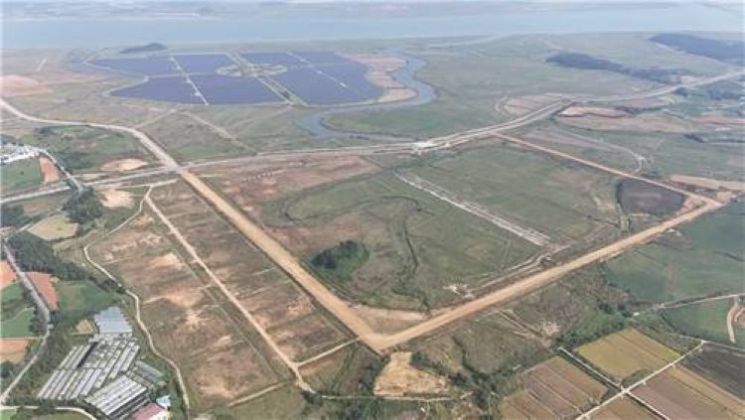
The reclaimed land of Haenam "Solar City" in South Jeolla Province has been selected as a candidate site for the National AI Computing Center by the Samsung SDS consortium, marking a new turning point for the local economy.
Once a desolate reclaimed area, Solar City has now surpassed Gwangju, its main competitor, to emerge as a frontrunner for an "AI+Energy Convergence City," thanks to its strengths in renewable energy infrastructure, affordable land, and a stable power grid.
SK, in partnership with OpenAI, had also been weighing Haenam and Gwangju as potential sites for its AI data center in the southwestern region, but it is reported that the company has internally determined Haenam to be the optimal location. Industry insiders are increasingly convinced that Haenam has effectively been chosen.
The Haenam County government regards this opportunity not as a mere facility expansion, but as a crucial chance to build an industrial ecosystem that integrates AI, renewable energy, and advanced technology.
Why Haenam? The Answer Lies in Infrastructure and Scalability
The reason Haenam has overtaken Gwangju as the preferred site for the National AI Computing Center is its infrastructure and scalability. Solar City in Haenam boasts a 98MW solar power complex, low land costs, a vast area available for development, a stable power supply network, and industrial water infrastructure.
Notably, Jeonnam Province ranks first nationwide in the adoption rate of renewable energy, making it ideally suited for operating large-scale AI data centers. Furthermore, with the recent government designation of Jeonnam as a "Distributed Energy Special Zone," the Haenam area has laid the groundwork to transform into a "smart power self-sufficient city" based on renewable energy.
The plan is to attract data centers to the Haenam and Yeongam regions, which are densely populated with solar power plants, thereby enabling local production and consumption of energy. The project will also demonstrate AI-powered electricity demand forecasting and efficient distribution systems.
Full-Scale Creation of an AI-Energy Convergence Ecosystem
Throughout this process, various local stakeholders-including industrial complexes, universities, and research institutes-are expected to participate, forming an "AI-Energy Convergence Ecosystem."
Haenam County has presented a vision to create a future-oriented city model that fuses AI, renewable energy, and advanced technology through this project. The concentration of data centers is anticipated to attract companies, create high-quality jobs, and encourage young talent to settle in the region, generating multi-layered economic benefits.
A county official stated, "Solar City was evaluated as having advantages over competing sites in terms of power infrastructure, water supply, and land costs," adding, "Our goal is to build a sustainable economic ecosystem by creating a virtuous cycle that transforms the region's environmental assets into economic value."
Targeting Opening in 2028... Heralding Changes in the Southwestern Industrial Landscape
The government plans to select an operator within this year and aims to open the center by 2028. The center is expected to expand to 15,000 GPUs by 2028 and up to 50,000 GPUs by 2030, with access provided to industry, academia, and startups, thereby contributing to the technological independence of the domestic AI industry as a whole.
In addition, under the "Act on the Promotion of the Development, Use, and Distribution of New and Renewable Energy," profit sharing through resident participation will be mandatory, allowing Haenam residents to share in the benefits through direct investment or cooperative membership.
Once the center is operational, the clustering of data centers is expected to attract related companies and create high-quality jobs, encouraging young people to settle in the region. This is anticipated to play a significant role in alleviating Haenam's population decline.
If Solar City is confirmed as the final site, Haenam will firmly establish itself as the AI and energy industry hub of the southwestern region.
Remaining Challenges: Power Grid Efficiency and Infrastructure Expansion
The challenges facing Haenam County are improving power grid efficiency and expanding living infrastructure. Despite abundant solar power generation, Haenam has frequently experienced output control issues due to insufficient demand. The establishment of the AI data center is expected to significantly enhance power grid efficiency.
Additionally, there is an urgent need to expand transportation, housing, educational, and cultural infrastructure, as well as to strengthen industry-academia cooperation and improve settlement conditions to foster and attract specialized talent.
A Haenam County official stated, "This project will serve as an opportunity to upgrade the region's industrial structure," adding, "We aim to build a sustainable economic ecosystem where AI industry and renewable energy technology converge."
© The Asia Business Daily(www.asiae.co.kr). All rights reserved.

















