Despite Controversy Over "Childlike Sex Dolls," Shein Opens Store
Mixed Reactions to Shein's First Offline Store
French Government to Inspect 200,000 Shein Packages
In Paris, the fashion capital of France, controversy has recently arisen over the Chinese fast fashion company Shein. On November 6, Yonhap News reported that the French government has begun procedures to suspend Shein's operations in the French market and has also decided to conduct a full inspection of packages sent via Shein at airports. Amelie de Montchalin, Minister of Public Accounts, announced on her social media account that "customs officers at Charles de Gaulle Airport will inspect 100% of the packages sent from Shein, totaling 200,000 items."
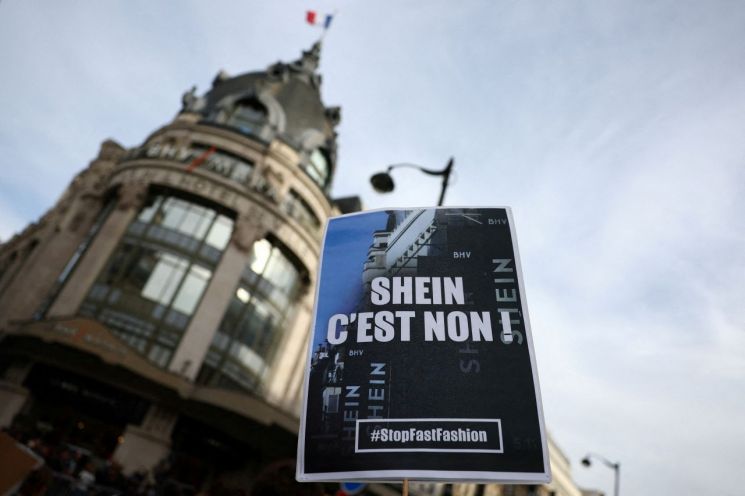 As the Shein store opened as scheduled at the BHV department store in Paris, the area in front of the store became crowded with customers and protesters opposing Shein. Photo by Reuters Yonhap News
Previously, perceptions of Shein within France had not been favorable, due to various social issues such as low wages, poor working conditions, and environmental pollution resulting from low-cost mass production. In addition, controversy has intensified following the recent revelation that adult dolls resembling children were being sold on the Shein website, raising legal concerns as well.
Amid this situation, Shein's first offline store opened at the BHV department store, located across from Paris City Hall. Donald Tang, Chairman of Shein, described France as "the capital of fashion and the birthplace of the modern department store," and stated that the opening of the store was a gesture of respect. However, his remarks only fueled further controversy. The French Women's Ready-to-Wear Association issued an official statement declaring that Societe des Grands Magasins (SGM), which operates BHV in partnership with Shein, had insulted the traditional French fashion industry.
Nevertheless, despite these controversies, when the Shein store opened as scheduled at the BHV department store, the area in front of the store became crowded with both customers and protesters opposing Shein. Emmanuel Gregoire, a Socialist Party candidate for mayor of Paris who participated in the protest, criticized BHV's decision, emphasizing, "We must consider the conditions under which Shein's products are produced."
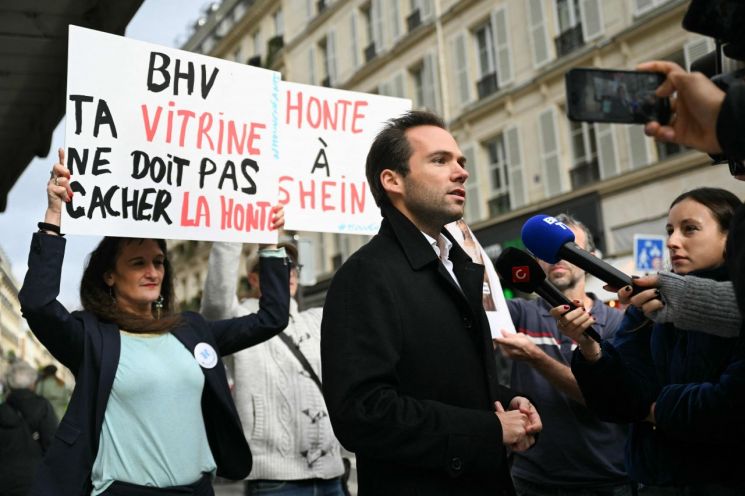 Currently, the backlash against Shein in France reveals not only economic issues but also cultural conflicts. Photo by Yonhap News Agency
On the other hand, consumers seeking to shop at the Shein store displayed a variety of reactions. In particular, some young Parisians eager to visit the Shein store participated in an "open run"-rushing in to make purchases as soon as the store opened. This is because Shein's products, such as T-shirts and blouses priced at 3 to 15 euros (approximately 5,000 to 25,000 won) and dresses at 10 to 30 euros, are much cheaper than those of European fast fashion brands like H&M or Zara. At the same time, they reflect the latest trends, making them highly popular in France.
Currently, the backlash against Shein in France reveals not only economic issues but also cultural conflicts. The low-priced Chinese clothing, which clashes with the "craftsmanship" valued by the French fashion industry, is difficult for many to accept. Shein has since removed all problematic products from its platform. The company explained, "These items were not directly sold by Shein, but by third-party vendors," and stated, "We are investigating how the sellers managed to bypass internal controls to offer such products." However, despite Shein's explanation, French authorities are reportedly expanding their investigation to other Chinese online shopping platforms such as Aliexpress and Temu, while also considering measures to suspend Shein's operations. As a result, the controversy is unlikely to subside anytime soon.
© The Asia Business Daily(www.asiae.co.kr). All rights reserved.


















