First Private-Led R&D Project Since 2013
Focused Nurturing of Future Technologies and Support for Challenging Projects
1.5 Trillion Won Invested in 880 Research Initiatives
"Scientists, Fail Freely and Embrace New Challenges"
Samsung Electronics and the domestic academic community have jointly presented the 'Top 10 Promising Technologies,' signaling a full-fledged shift toward a technology-driven new growth strategy. Samsung emphasized its focus on securing fundamental technologies that will underpin future advanced industries, ranging from basic science to humanoids and bio-computing, and conveyed its commitment to fostering a research environment unafraid of failure.
On the morning of November 7, Samsung held the 'Future Technology Development Project 2025 Annual Forum' at the InterContinental Parnas Hotel in Gangnam-gu, Seoul. Launched in 2013, the Future Technology Development Project is Korea's first private sector-led public interest initiative supporting basic science research, and this is the first time the annual forum has been open to the public.
Announcement of the Top 10 Promising Technologies to Underpin the 'Future Industry'
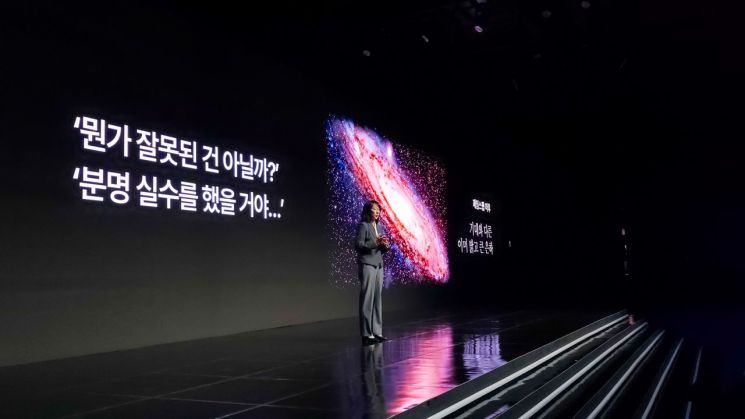 On the 7th, Professor Myungwon Jeon of Kyung Hee University presented a research project at the 'Future Technology Development Project 2025 Annual Forum' hosted by Samsung at the InterContinental Parnas Hotel in Gangnam-gu, Seoul. Samsung Electronics
At the forum, Samsung and academic experts jointly announced the 'Top 10 Promising Technologies.' These technologies span a wide range of future core fields, including: next-generation semiconductor packaging, smart thermal management solutions, alternative energy, artificial intelligence (AI)-based batteries, digital healthcare, AI-based biotherapeutics, bio-computing, next-generation computing architecture, humanoid robots, and post-human physical and cognitive augmentation solutions.
These technologies are directly linked to Samsung's future business portfolio. Samsung's semiconductor division is strengthening technologies such as next-generation packaging to expand the system and AI ecosystem. AI-based battery technology is aligned with Samsung SDI's roadmap for developing next-generation all-solid-state batteries and high-performance energy storage systems (ESS). Digital healthcare and bio-computing form the foundation of the medical platform strategy pursued by Samsung Biologics and Samsung Bioepis.
Samsung supports creative research projects across all fields, including basic science, materials technology, and ICT convergence. The company has established a fund totaling 1.5 trillion won and has provided 1.1419 trillion won in research funding over the past 12 years. Through this, Samsung has supported 880 research projects, with participation from over 16,000 researchers. This contributes to expanding the national scientific talent ecosystem, enabling researchers to focus on their desired studies.
Samsung plans to further expand the private scientific ecosystem through this project. Under the principle that basic science forms the foundation of future industries, the company also expressed its determination to strengthen the base of Korea's technology industry. A Samsung representative explained, "The intention is to tell young scientists, 'It's okay to fail' and 'Let's create an environment where unlimited failure is possible.'"
Kim Hyunsoo, Executive Director of Samsung Electronics Future Technology Development Center, stressed, "We have been pursuing this project with the goal of contributing to the advancement of basic science and industrial technology innovation, and ultimately fostering and producing world-class scientists and engineers."
"Fail Freely"-Continued Support for Challenging Research Projects
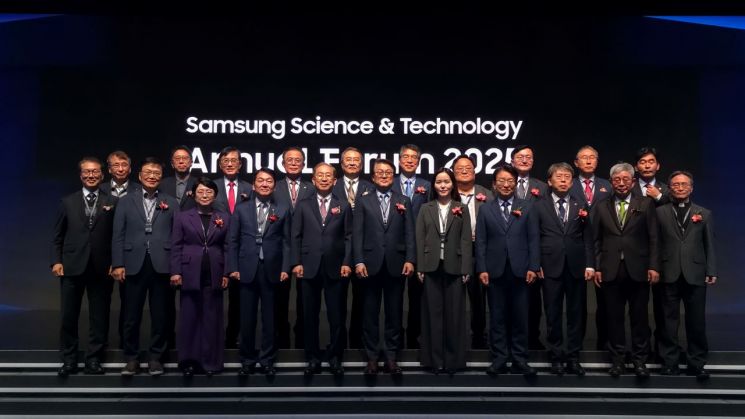 On the 7th, attendees are taking a commemorative photo at Samsung's 'Future Technology Development Project 2025 Annual Forum' held at the InterContinental Parnas Hotel in Gangnam-gu, Seoul. Samsung Electronics
The Future Technology Development Project goes beyond simply providing research funding. It also offers an 'end-to-end' support package for researchers, covering project selection, maximizing results, and technology commercialization. Through this package, researchers receive step-by-step expert mentoring from Samsung, opportunities for technology exchange with industry, and even support for technology startups. To date, 65 research projects have led to the creation of startups.
'Proteina,' a startup founded by Professor Yoon Taeyoung of Seoul National University, received support for five years starting in 2014, laying the groundwork for a 'high-speed antibody screening' platform that rapidly identifies new drug candidates. Even when commercialization was uncertain, Samsung consistently supported challenging technologies, and Proteina was listed on KOSDAQ in July this year. In particular, the company has continued to enhance its platform in collaboration with Samsung Bioepis and was recently selected as the lead research institution for a national AI-based new drug development project.
At the forum, four exemplary cases of achievements from the Future Technology Development Project were presented. Professor Kim Jangwoo of Seoul National University proposed a system semiconductor technology to resolve data center overload, a key technology that addresses server bottlenecks caused by increased AI performance. Professor Jeon Myungwon of Kyung Hee University presented data on the early universe that standard cosmology cannot explain, demonstrating that the early galaxies discovered by the James Webb Space Telescope grew much faster than predicted by standard cosmological calculations established over the past 100 years.
Additionally, domestic science and technology experts gave presentations on a total of 64 topics. Lively discussions took place across four basic science fields-mathematics, physics, chemistry, and life sciences-supported by the Future Technology Development Project, as well as six engineering fields: electronic materials, devices, communication and computing, bio-medical, energy and environment, and AI and robotics.
Kook Yang, Chairman of the Samsung Foundation for Future Technology, stated, "The Future Technology Development Project has established a foundation for the growth of national science and technology," adding, "We will strengthen support so that researchers can fully devote themselves to their studies and contribute to the sustainable development of our society." Park Seunghee, President of Corporate Relations at Samsung Electronics, said, "We will continue to provide support from a long-term perspective, not just for short-term results, so that young scientists have the opportunity to take on new research challenges and grow."
Meanwhile, the event was also attended by political figures such as Kwon Chilseung of the Democratic Party of Korea, Ahn Cheolsoo of the People Power Party, Kim Sunmin of the National Innovation Party, and Lee Jooyoung of the Reform Party, who offered encouragement for the challenges faced by the science and technology community.
© The Asia Business Daily(www.asiae.co.kr). All rights reserved.
![Clutching a Stolen Dior Bag, Saying "I Hate Being Poor but Real"... The Grotesque Con of a "Human Knockoff" [Slate]](https://cwcontent.asiae.co.kr/asiaresize/183/2026021902243444107_1771435474.jpg)

















