A Panoramic View of Gwangyang Bay and the Seomjin River
One-Heart Festival to Be Held on November 8
In autumn, when the entire mountain is colored with fall foliage and low-growing autumn flowers such as Gujeolcho and Ssukbujengi blanket the fields, there is no better place to relax and let go of your worries while breathing in nature than a mountain temple.
Gwangyang City has recommended Junheung Fortress and Junheungsa Temple as destinations where visitors can walk along the fortress walls, gaze out over Gwangyang Bay and the Seomjin River through the crimson leaves, and fully enjoy the tranquil atmosphere of autumn.
Junheung Fortress, one of the four major fortresses of Gwangyang, is a valley-type fortress built during the Goryeo Dynasty, stretching about 4 kilometers along the valleys centered on six peaks. It is the only earthen fortress in Gwangyang constructed during that era.
The entire mountain serves as a natural stronghold. Rather than simply piling up earth, the fortress was constructed using the rammed-earth method, compacting soil along the terrain. Its double-walled structure, consisting of both outer and inner walls, further enhanced its defensive capabilities.
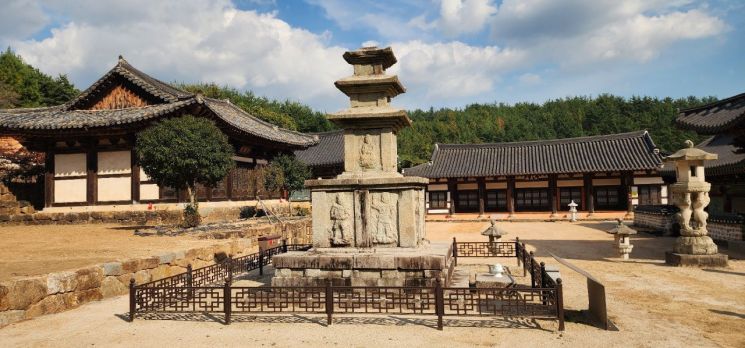
Within Junheung Fortress, which was a key military and strategic point during the Goryeo Dynasty, stands Junheungsa Temple, a thousand-year-old temple so named because it is located inside the fortress.
It is said to have been founded by Doseon Guksa during the reign of King Gyeongmun of Silla. The temple was burned down during the Japanese invasions of Korea and remained as a hermitage for many years before being rebuilt in 1963, taking on its current form.
Within the temple grounds, visitors can find the Three-Story Stone Pagoda (Treasure No. 112) and the Seated Stone Bodhisattva of Ksitigarbha (Jeollanam-do Tangible Cultural Property No. 142), as well as a replica of the 'Gwangyang Junheung Fortress Twin Lion Stone Lantern.'
The Gwangyang Junheung Fortress Twin Lion Stone Lantern, designated as National Treasure No. 103, features a unique structure in which a pair of male and female lions face each other, supporting the lantern chamber with their front paws and mouths. It is considered a masterpiece of stone art from the Unified Silla period.
Originally located within Junheung Fortress, the lantern was removed during the Japanese occupation and, after passing through Gyeongbokgung Palace, Deoksugung Palace, and the National Museum of Korea, is now exhibited at the National Gwangju Museum.
Recognizing its artistic value, the Ministry of Communications issued a regular postage stamp featuring the lantern's design with a face value of 5 won on July 1, 1969.
The description on the stamp highlights the originality of the structure, with two lions supporting the stone lantern with their mouths and front paws, and the vibrant sculptural beauty, depicting it as a brilliant masterpiece of Unified Silla art.
Gwangyang City has designated the 'Return of the Gwangyang Junheung Fortress Twin Lion Stone Lantern National Treasure to Its Original Location' as the first project under the Hometown Love Donation Program and is continuing efforts to bring the artifact back home.
On November 8, at Yudang Park in front of the Gwangyang Five-Day Market, the city will host the '2025 National Heritage One-Heart Festival for the Return of the Gwangyang Junheung Fortress Twin Lion Stone Lantern National Treasure.'
The festival will feature a promotional booth sharing the history and significance of the 'Junheung Fortress Twin Lion Stone Lantern,' as well as a variety of free programs utilizing Gwangyang's national heritage, such as making twin lion stone lantern keyrings, Jangdo pattern bookmarks, egg bundles, and archery experiences.
In addition, a traditional folk performance will be held by Kwon Wontae, a master and transmission instructor for the National Intangible Heritage Namsadang Nori tightrope walking, offering a special attraction amid the autumn scenery of Yudang Park.
Lee Hyunju, Director of Tourism, said, "Junheung Fortress, adorned with autumn leaves and flowers, and the thousand-year-old Junheungsa Temple are special places where Gwangyang's history and nature coexist. I hope visitors can fully enjoy the autumn atmosphere of Gwangyang and find time for reflection and relaxation at the tranquil mountain temple."
She added, "Just as it is said that history gives birth to relics and relics bear witness to history, every time I see the site where the Gwangyang Junheung Fortress Twin Lion Stone Lantern National Treasure has been replaced by a replica, I am reminded that cultural heritage shines brightest in its original place. I hope everyone will deeply appreciate the value of cultural heritage this autumn and enjoy the true charm of an autumn journey in Gwangyang."
© The Asia Business Daily(www.asiae.co.kr). All rights reserved.
![Clutching a Stolen Dior Bag, Saying "I Hate Being Poor but Real"... The Grotesque Con of a "Human Knockoff" [Slate]](https://cwcontent.asiae.co.kr/asiaresize/183/2026021902243444107_1771435474.jpg)
















