[2025 Audit Review]
17 Standing Committees Conduct Audits of 834 Agencies
Inadequate Scrutiny and Complacent Follow-up Measures
Alternatives Emerge: Strengthening Committees and Institutionalizing Year-Round Audits
The National Assembly audit, often referred to as the "highlight of the regular session," is losing public trust due to insufficient scrutiny and complacent follow-up measures. While the number of institutions subject to parliamentary oversight and checks increases every year, the legally mandated period for the audit remains just 30 days. As a result, it has become customary for lawmakers to focus more on sensational political issues that capture public attention, rather than calmly presenting alternative solutions.
This year, the 17 standing committees of the National Assembly conducted audits on a total of 834 institutions from October 13 to November 6. This is an increase of 32 institutions compared to last year. There are not a few committees that audited more than 10 institutions in a single day. Some witnesses and reference persons even leave without having spoken a single word all day.
According to the National Assembly Bill Information System and the Citizens' Coalition for Economic Justice, in 2019, 12 out of the 17 standing committees (70.6%) adopted reports on the results of the audit, but by 2023, this number had dropped to 6 (35.3%). In 2019, 337 out of 785 institutions (42.9%) submitted reports on corrective actions taken in response to audit findings, but in 2023, only 130 out of 793 institutions (16.4%) did so. One National Assembly aide commented, "After the audit ends, lawmakers and parties often have differing views on the required corrections, and the focus quickly shifts to budget and bill reviews, making it difficult to engage in in-depth discussions."
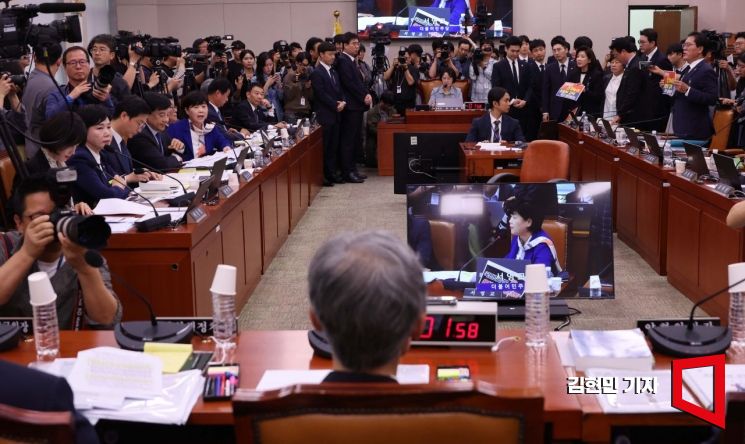 On the 13th, during the Legislation and Judiciary Committee's national audit held at the National Assembly, members of the People Power Party protested as Chairwoman Chu Mi-ae began questioning Chief Justice Cho Hee-dae of the Supreme Court. 2025.10.13 Photo by Kim Hyunmin
There are also many cases where misconduct or requests for improvement identified in the previous year's audit are not addressed. A representative example is the Cambodia kidnapping and confinement incident. During last year's National Policy Committee and Foreign Affairs and Unification Committee audits, the need for measures to ensure the safety of Korean nationals, such as the establishment of a 'Korea Desk,' was raised, but the government did not properly implement these measures.
Institutionalizing year-round audits or transferring some functions of the Board of Audit and Inspection to the National Assembly are being discussed as alternatives. In the United States, national audits are conducted routinely. Efficiency in hearing operations is enhanced through preliminary and pre-audits. In addition, the Government Accountability Office (GAO), an information and investigative agency under Congress, continuously monitors the implementation of corrective actions by the executive branch. The parliaments of the United Kingdom and Japan, both of which have adopted parliamentary cabinet systems, also utilize permanent audit functions. Lee Junhan, professor of political science and international relations at Incheon National University, said, "It is time to improve the system to strengthen the oversight and checks by each standing committee on the government and institutions so that the monitoring and management system can function continuously."
Kim Woni, a Democratic Party lawmaker who proposed a partial amendment to the Act on National Assembly Inspections and Investigations to introduce permanent audits in both the 21st and 22nd National Assemblies, also told The Asia Business Daily, "Through the provisional session, the National Assembly is in session from February to August, and even now, each standing committee receives reports on current issues related to government ministries. If a permanent audit system is introduced, it will be possible to monitor and supervise ministries and institutions more efficiently," emphasizing the need for improvement of the audit system.
He added, "This would allow the regular session to focus on budget and bill reviews, making the process more effective," and further stated, "I hope that both the ruling and opposition parties will reach an agreement and pass the improvement of the audit system."
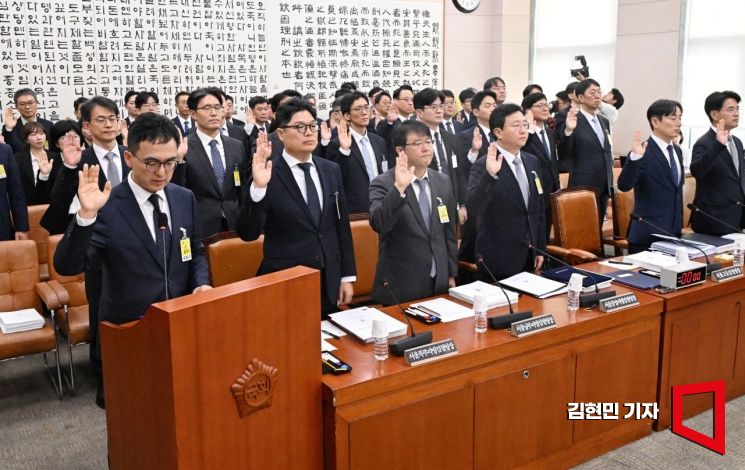 Gu Ja-hyun, Chief Prosecutor of the Seoul High Prosecutors' Office, along with chief prosecutors from prosecution offices in the metropolitan area and Gangwon Province, took an oath at the 2025 National Assembly inspection held by the Legislation and Judiciary Committee on October 23, 2025. Photo by Kim Hyun-min
© The Asia Business Daily(www.asiae.co.kr). All rights reserved.


















